

Why Most Churches Overpay For Accounting (And How To Fix It)
Most churches do not overspend on accounting because they choose expensive solutions on purpose. It happens gradually, almost without notice. A spreadsheet gets created for donations, another tool is added for online giving, and then a separate accounting system is introduced to “keep things official.” At some point, an external accountant is brought in to clean things up. What started as a simple setup turns into a mix of tools, files, and people that do not fully connect.
The real cost is not just the subscriptions or service fees. It is the time spent reconciling numbers between systems, the risk of duplicate or missing records, and the constant uncertainty about whether the reports are actually accurate. When data lives in different places, every report becomes a manual effort, and every decision takes longer than it should.
A simpler approach does not mean cutting corners. It means reducing unnecessary complexity. When donation tracking, member data, and financial records are connected in one system, churches spend less time fixing inconsistencies and more time understanding what is actually happening. Instead of moving data back and forth, everything is recorded once and flows naturally into reports.
This shift changes how bookkeeping feels day to day. Instead of reacting to problems, teams operate with clarity. Instead of relying on multiple tools and outside help for basic tasks, they gain control over their own financial processes. Over time, this is what reduces cost, not just in money, but in effort and stress as well.

Church Bookkeeping Made Simple
Church bookkeeping often sounds more complicated than it really is. At its core, it is about consistently recording what comes in, what goes out, and where the money is meant to be used. When done properly, it gives leaders a clear picture of the church’s financial health without requiring deep accounting knowledge.
This guide is designed for people who are already handling financial tasks or are about to take on that responsibility. That includes treasurers, pastors, administrators, and even volunteers who have been asked to “keep track of things.” The goal is not to turn anyone into an accountant, but to make sure the basics are handled correctly and confidently.
Good bookkeeping in a church setting is not about complexity. It is about clarity. You should be able to answer simple but important questions without hesitation. How much came in this month? Where was it spent? Are restricted donations being used properly? If those answers are easy to find and easy to trust, then your system is working.
What makes this easier today is not more effort, but better structure. When information is organized clearly and tracked in one place, everything becomes easier to follow. Reports make sense, errors are easier to catch, and decisions can be made with confidence instead of guesswork.
What Is Church Bookkeeping?
Church bookkeeping is the ongoing process of recording and organizing every financial activity in the church. It covers donations, expenses, reimbursements, and everything in between. Unlike businesses, churches deal with funds that often come with specific purposes, which means accuracy is not just important, it is expected.
The goal is not to produce complex financial models. It is to maintain clear, reliable records that anyone responsible for oversight can understand without confusion. When bookkeeping is done well, it becomes easy to see where money is coming from, where it is going, and whether it is being used as intended.
How It Differs From Accounting
People often use bookkeeping and accounting as if they mean the same thing, but they serve different roles. Bookkeeping focuses on recording transactions as they happen, while accounting looks at that data and turns it into insights, reports, and decisions.
In most churches, the real need is not advanced accounting. It is consistent bookkeeping. Once transactions are recorded correctly, the rest becomes much easier. Reports can be generated automatically, and there is less need to rely on outside help just to understand basic numbers.
What Is Fund Accounting And Why It Matters
This is where church finances differ the most from standard business practices. Churches do not simply track income and expenses. They also track the purpose of the money.
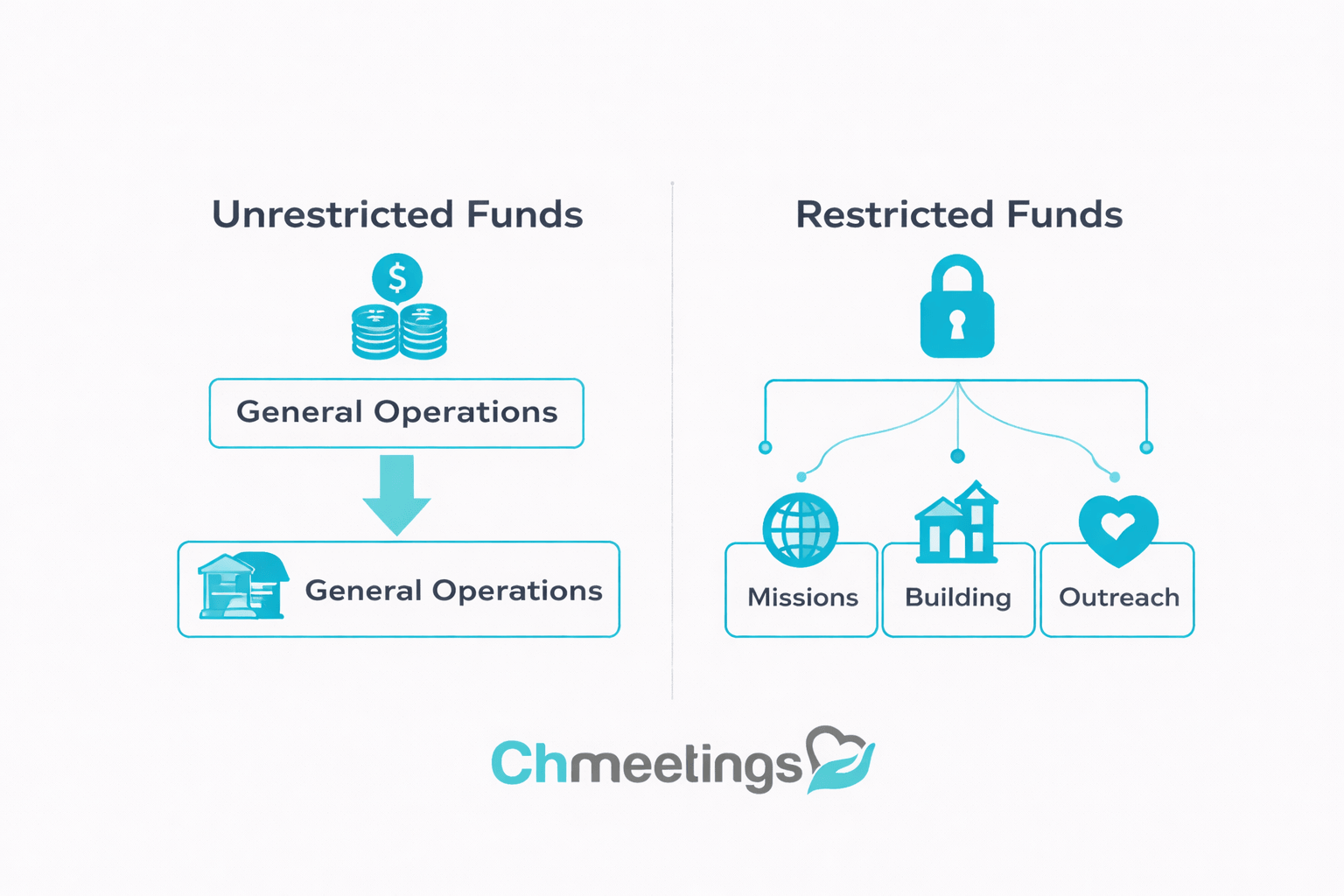
Some funds are unrestricted, meaning they can be used for general operations. Others are restricted, meaning they were given for a specific reason such as a building project, a mission trip, or a charity effort.
If these funds are mixed together or used incorrectly, it creates serious issues, not only in reporting but also in trust. Donors expect their contributions to be used as intended, and leaders need to be able to prove that they were.
A simple way to think about it is:
- Unrestricted funds support day-to-day operations
- Restricted funds must be tracked and used for their specific purpose
Once this distinction is clear in your system, everything else becomes easier to manage and explain.
Who Should Handle Financial Tasks
There is no single answer that works for every church. Some rely on a dedicated treasurer, others split responsibilities between staff and volunteers, and some bring in external help when needed.
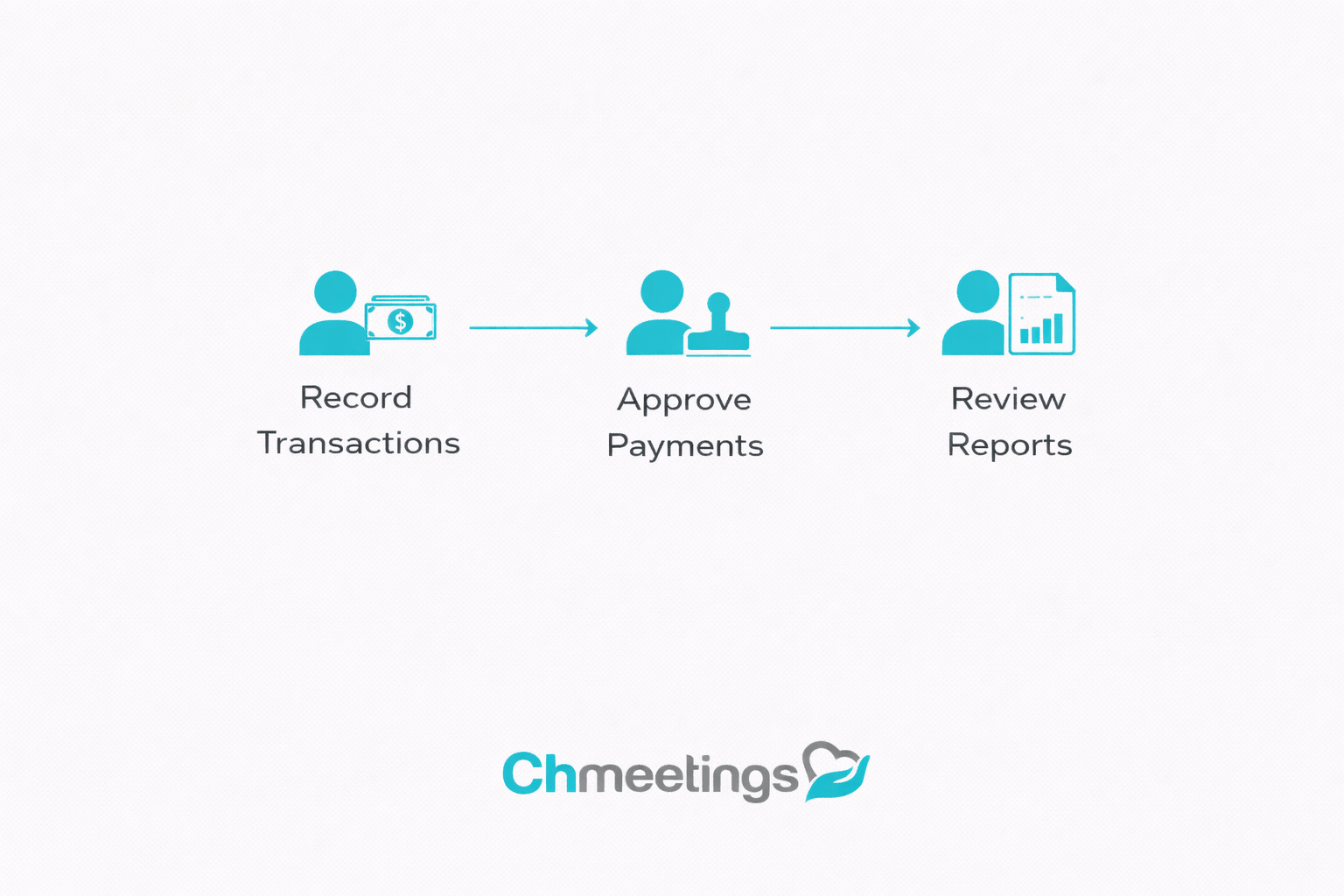
What matters is not the title, but the structure. Financial tasks should not depend on one person alone, especially when that person is also handling other responsibilities. Even in small teams, it helps to separate key roles such as recording transactions, approving expenses, and reviewing reports.
In practice, a simple setup might look like this:
- One person records donations and expenses
- Another reviews and approves payments
- A leader or board member reviews monthly reports
This kind of structure reduces errors and creates accountability without adding unnecessary complexity. Over time, it also makes transitions easier when roles change, since the system does not depend on one individual knowing everything.
Templates And Starter Resources
Most churches begin with simple tools, and that is completely fine. The problem starts when those tools are stretched beyond what they were designed to handle. Before building a full system, it helps to start with clear templates and a basic structure that can grow with you.
Templates give you a starting point so you are not guessing how to organize your finances. They also create consistency, which is what makes reporting and reviewing much easier later on.
Church Bookkeeping Excel Template Examples
Spreadsheets are usually the first step because they are easy to set up and familiar to most people. For very small churches with limited activity, they can work well for a while.
You might use a spreadsheet to:
- Track weekly donations
- Record expenses
- Summarize monthly totals
The issue is not that spreadsheets are bad. It is that they are manual. As activity grows, mistakes become more likely. Duplicate entries, missing records, and broken formulas can quietly affect your numbers without being obvious at first.
At some point, the effort required to maintain the spreadsheet becomes greater than the benefit of using it.
Sample Chart Of Accounts And Financial Reports
A chart of accounts is simply a structured list of categories used to organize all financial activity. It defines how income and expenses are grouped, which directly affects how reports are generated.
A clean structure makes everything easier to understand. Instead of seeing scattered numbers, you see clear groupings such as donations, ministry expenses, and operational costs.
Financial reports should follow the same principle. They do not need to be complicated. They need to be readable. A good report allows someone to quickly understand what happened during a period without needing extra explanation.
Recommended Training And Onboarding
One of the biggest challenges in church bookkeeping is turnover. Roles change, volunteers rotate, and knowledge is often passed informally. Without a clear onboarding process, each new person has to figure things out from scratch.
Training does not need to be extensive, but it does need to be structured. The person responsible should understand:
- How transactions are recorded
- How funds are categorized
- How reports are generated and reviewed
When this is documented and explained clearly, the system becomes repeatable. Anyone stepping into the role can continue the work without disrupting the process.
A Simple Monthly Bookkeeping Checklist
Consistency matters more than complexity. A simple routine followed every month will keep your records accurate and up to date without requiring extra effort at the end of the year.
A typical cycle includes reviewing what came in, confirming what was spent, and making sure everything matches your bank records. Reports are then shared with leadership so decisions can be made based on current information, not assumptions.
When this routine is followed regularly, year-end becomes much easier. Instead of fixing months of missed work, you are simply closing a system that has been maintained all along.
How Do I Set Up A Chart Of Accounts?
Setting up a chart of accounts is one of the most important steps in church bookkeeping. It defines how every transaction will be recorded, grouped, and reported. If this structure is clear from the beginning, everything that follows becomes easier to manage. If it is messy, even simple reports can turn into a headache.
Think of it as the foundation. You are not just listing categories. You are deciding how your church will understand its finances moving forward.
Which Accounts Should Small Churches Use
You do not need dozens of categories to get started. In fact, too many accounts usually create confusion instead of clarity. The goal is to keep things simple while still capturing the essential details.
At a basic level, most churches will organize accounts into income and expenses. Income might include tithes, offerings, and special donations. Expenses might include ministry activities, operational costs, and salaries.
The key is to avoid overcomplicating it early on. If categories are too detailed, people will struggle to choose the right one when recording transactions. If they are too broad, reports will not be useful. Finding the balance is what makes the system work.
How To Categorize Restricted Versus Unrestricted Funds
This is where many churches run into trouble, especially if the structure is not defined clearly from the start. Restricted funds must always be separated from general funds, not just in reporting, but in how they are tracked daily.
If someone donates specifically for a youth program, that amount cannot be mixed into general income and then adjusted later. It needs to be recorded correctly at the moment it is received.
A practical approach is to assign clear categories or tags that indicate whether a fund is restricted and what it is meant for. Once this is in place, reports will naturally reflect the correct balances without extra manual work.
How To Map Ministry Funds And Programs
As churches grow, finances are often tied to specific ministries. Youth, outreach, events, and community programs may each have their own budgets and spending patterns. Without proper mapping, it becomes difficult to understand how each area is performing.
Instead of treating all expenses as one group, it helps to connect them to the ministries they belong to. This allows leaders to see not just total spending, but how resources are being used across different activities.
When this is done well, reporting becomes far more useful. Leaders can make decisions based on real data, adjust budgets where needed, and ensure that each ministry is operating within its means.
How To Track And Report Church Finances
Once your structure is in place, the next step is making sure everything is recorded consistently and reported clearly. This is where many churches struggle, not because the work is difficult, but because it is handled across multiple tools or done inconsistently.
Tracking and reporting are not separate tasks. They are part of the same flow. When transactions are recorded correctly from the start, reports almost build themselves. When they are not, reporting becomes a manual effort that takes time and still leaves room for doubt.
How To Record Cash, Checks, And Online Gifts
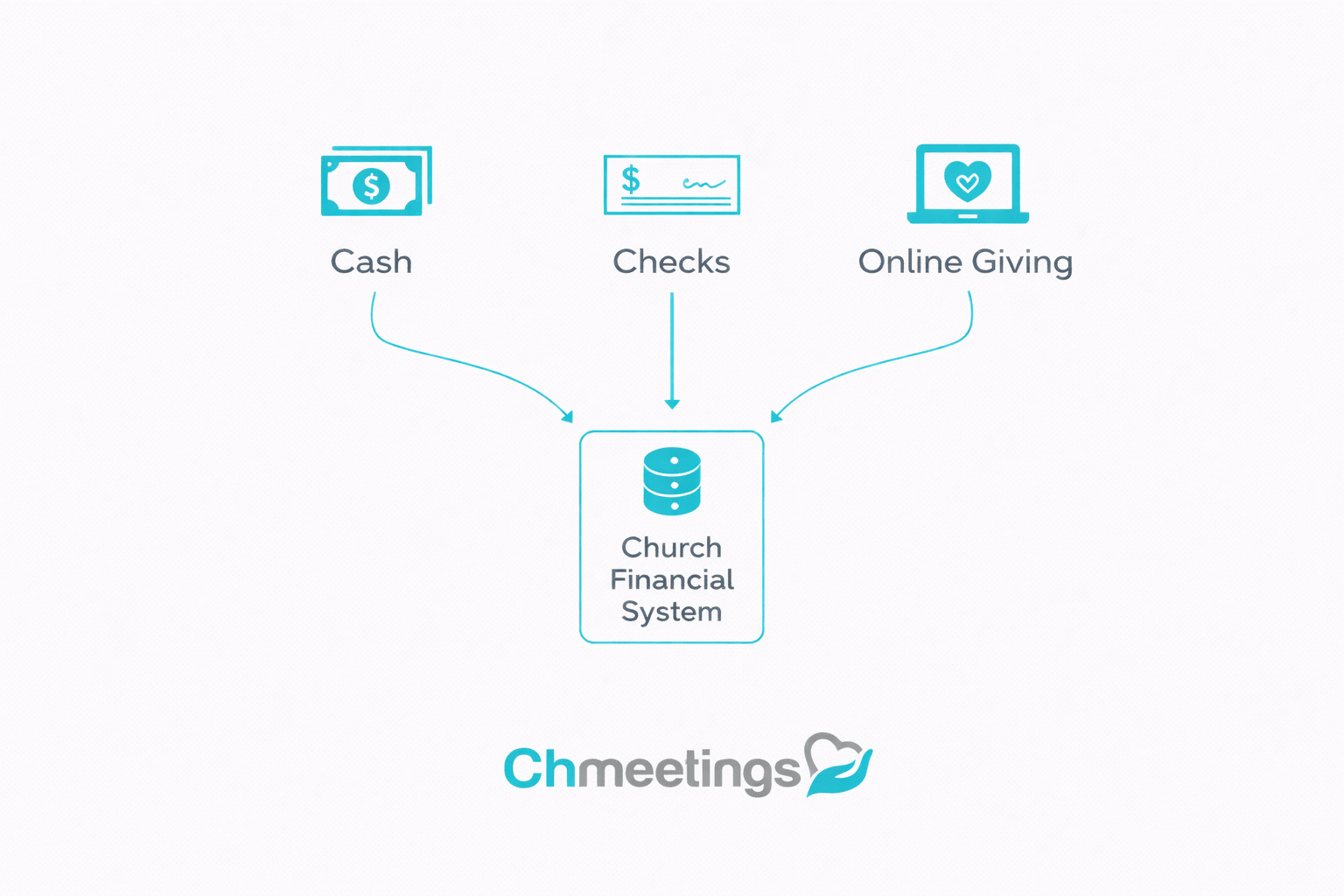
Donations come in different forms, and each one needs to be captured properly. Cash might be collected during services, checks may come in throughout the week, and online giving continues to grow as a primary channel.
The mistake many churches make is treating these channels separately. Cash is tracked in one place, online donations in another, and checks somewhere in between. Over time, this leads to gaps and inconsistencies.
A better approach is to bring everything into one system. Each donation, regardless of how it was received, should follow the same recording process. That way, totals match, reports stay accurate, and nothing gets lost in between.
How To Track Designated And Restricted Donations
Not all donations are equal in how they can be used. Some are given freely, while others are tied to specific purposes. If these are not tracked properly at the moment they are received, it becomes difficult to correct later.
This is where tagging or categorizing donations becomes essential. Each contribution should clearly reflect whether it is restricted and what it is intended for. Once that information is attached from the beginning, reporting becomes straightforward.
You are no longer trying to remember why a donation was made months later. The system already knows.
What Financial Statements Leaders Need Monthly
Leaders do not need complicated reports. They need clear ones. A good monthly report answers a few simple questions without forcing anyone to dig through details.
They should be able to see how much came in, how much was spent, and how that compares to what was planned. If those numbers are easy to read and easy to trust, decisions become faster and more confident.
In most cases, a small set of consistent reports is enough. Adding more does not always add value. It often just adds noise.
How To Present Finances To The Congregation
Transparency matters, but that does not mean overwhelming people with numbers. Most members are not looking for detailed financial breakdowns. They want to understand the big picture.
This means presenting information in a way that is clear, honest, and easy to follow. Instead of focusing on every category, it helps to highlight the main points. Where the money came from, where it went, and how it supports the church’s mission.
When reports are simple and consistent, trust builds naturally. People feel confident that their contributions are being handled responsibly, even if they are not involved in the day-to-day details.
How Do I Manage Expenses And Payments?
Managing expenses is where discipline shows. Donations might come in regularly, but expenses can quickly become unpredictable if there is no clear process in place. Without structure, small issues build up over time, and by the time they are noticed, it is harder to fix them cleanly.
The goal is not to restrict spending. It is to make sure every expense is visible, approved, and recorded properly. When that happens, financial control becomes natural instead of forced.
How To Create Expense Policies And Approval Workflows
Every church, regardless of size, needs a simple approval process. It does not have to be formal or complicated, but it does need to be clear.
People should know:
- What they are allowed to spend
- When they need approval
- Who is responsible for giving that approval
Without this clarity, spending decisions become inconsistent. One person may approve something that another would question, and over time that creates confusion.
A basic workflow can solve most of this. Expenses above a certain amount require approval, while smaller ones follow a predefined guideline. Once this is agreed on, it removes friction and keeps things moving without constant back-and-forth.
How To Handle Petty Cash And Event Spending
Small expenses are often the hardest to track, not because they are complex, but because they are frequent and easy to overlook. Event purchases, quick reimbursements, and minor supplies can slip through if there is no consistent method.
The key is to treat small expenses with the same discipline as larger ones. Each transaction should still be recorded, even if the amount feels insignificant. Over time, these small amounts add up, and ignoring them creates gaps in your records.
It helps to have a simple rule. If money leaves, it gets recorded. No exceptions.
How To Reimburse Volunteers And Staff
Reimbursements should be straightforward, but they often become messy when documentation is missing or processes are unclear. People submit requests late, receipts are incomplete, and approvals are not always consistent.
A clear process fixes most of this. Anyone requesting reimbursement should provide basic documentation, and approvals should happen before the payment is made whenever possible.
What matters here is consistency. When everyone follows the same process, reimbursements become predictable and easy to manage. Records stay complete, and there is no need to chase missing information later.
How Should Payroll And Taxes Be Handled?
A church hires a part-time worship leader. The arrangement feels simple. A fixed monthly payment, agreed informally, with no detailed discussion about classification or taxes. For a while, everything runs smoothly. Payments go out on time. No one raises concerns.
Then, at the end of the year, questions start to surface. Should this person have been treated as an employee or a contractor? Were the right taxes withheld? Are there forms that should have been filed earlier?
What felt straightforward at the beginning becomes unclear when it needs to be documented.
Payroll and taxes are not complicated because they are inherently difficult. They become complicated when decisions are made casually and recorded inconsistently. Once that happens, fixing things later is always harder than setting them up correctly from the start.
When To Classify Workers As Employees Or Contractors
This is where most issues begin. The difference between an employee and a contractor is not just about how someone is paid. It is about the nature of the relationship.
If the church controls how and when the work is done, that person is typically considered an employee. If the person operates independently, using their own methods and schedule, they are more likely to be a contractor.
The problem is that many churches make this decision based on convenience rather than structure. It may feel easier to classify someone as a contractor, especially for part-time roles, but that decision carries implications that extend beyond the moment.
Once a classification is set, everything else follows from it. Payments, taxes, reporting, all depend on getting this one decision right.
How To Process Payroll And Withhold Taxes
A consistent payroll process removes most of the stress associated with payments. When it is handled the same way every cycle, there is little room for confusion.
The church calculates what is owed, applies the necessary withholdings where applicable, and records the transaction in a way that connects directly to its financial records. Over time, this builds a clear history that can be reviewed at any point without needing to reconstruct past payments.
What makes payroll difficult is not the calculation itself. It is the lack of consistency. When payments are handled differently each time, records become harder to follow, and small discrepancies begin to appear.
A steady process avoids that entirely.
What Forms And Filings Churches Must File
Filing requirements are often overlooked until deadlines approach. By then, the focus shifts from doing things correctly to doing them quickly.
Different roles require different forms, and those forms depend on how workers were classified and how payments were handled throughout the year. If records are complete and organized, preparing these filings becomes a routine step. If they are not, it turns into a process of gathering and verifying information under pressure.
The goal is not to memorize every requirement. It is to keep records in a state where those requirements can be met without scrambling. When payroll is handled consistently and documented properly, filings become a confirmation of what has already been done, not a last-minute reconstruction.
Best Church Accounting Software (And How To Choose The Right One)
A church reaches a point where the spreadsheet is no longer enough. Not because it stopped working, but because it started taking too much effort to keep working. Reports take longer to prepare. Donation records need constant checking. Someone always seems to be fixing something instead of moving forward.
That is usually when the question comes up. Do we keep improving what we have, or do we move to something built for this?
The answer is not just about features. It is about how much of your time is spent managing the system instead of using it.
Church-Specific Vs Generic Software
Generic accounting tools are built for businesses. They track income and expenses well, but they are not designed around how churches actually operate. They do not naturally handle fund restrictions, donation tracking, or the relationship between giving and people.
So churches adapt. They create workarounds. They build structures inside systems that were not meant for them.
Church-specific tools start from a different place. They assume that donations are central, that funds have purpose, and that reporting needs to reflect both financial and relational realities. That difference may not seem obvious at first, but it becomes clear as the system is used day to day.
What feels like a small limitation in a generic tool often turns into a repeated task. Over time, those tasks add up.
What Features Matter Most For Small Churches
It is easy to get distracted by long feature lists. What matters more is whether the software supports the actual work you are doing.
A system should allow you to record donations once and have them reflected everywhere they need to be. It should separate funds clearly without requiring manual adjustments. Reports should be generated from real data, not assembled from multiple sources.
More importantly, it should reduce the need to switch between tools. If donation tracking lives in one place, member data in another, and accounting somewhere else, you are still doing integration work manually.
The best systems remove that gap.
How To Integrate Giving, Membership, And Accounting
The real shift happens when everything is connected.
Instead of recording a donation in one system and then re-entering it somewhere else, the information flows through automatically. The person who gave is linked to the contribution. The fund is assigned correctly from the start. The report reflects the transaction without additional work.
This is where tools like ChMeetings change the experience. Not by adding more features, but by removing the need to manage multiple systems at once.
When giving, membership, and financial tracking live together, the work becomes lighter. The data becomes more reliable. And the time that was once spent connecting pieces can be used to actually understand what the numbers are saying.
That is the difference most churches are really looking for, even if they do not describe it that way.
How To Prevent Errors, Fraud, And Missing Money
A discrepancy shows up during a monthly review. It is not large, but it is enough to raise questions. An expense appears twice. A deposit does not match the recorded amount. No one is sure whether it is a simple mistake or something that needs closer attention.
The issue itself is not unusual. What matters is whether the system is strong enough to catch it early and clear enough to explain it.
Errors in church finances are rarely the result of bad intent. More often, they come from unclear roles, inconsistent processes, or simple oversight. But without the right structure, even small mistakes can go unnoticed or take time to untangle.
The goal is not to create a system based on suspicion. It is to create one that makes accuracy the default and makes issues easy to spot.
What Segregation Of Duties Looks Like For Small Teams
In larger organizations, financial responsibilities are divided across multiple roles by design. In smaller churches, that is not always possible. The same person may receive donations, record them, and prepare reports.
Even in that situation, some level of separation can still be introduced.
The idea is simple. The person who records a transaction should not be the only one reviewing it. Someone else, whether a staff member or a board representative, should regularly look at the records with a fresh perspective.
This does not require additional complexity. It requires intentional overlap. When more than one set of eyes is involved, errors are easier to catch, and accountability becomes part of the routine rather than an extra step.
How To Reconcile Accounts And Review Bank Statements
Reconciliation is where everything comes together. It is the process of confirming that what is recorded internally matches what actually happened in the bank.
Without regular reconciliation, records can drift. Transactions may be recorded incorrectly, missed entirely, or duplicated. Over time, the gap between records and reality grows, and fixing it becomes more difficult.
When reconciliation is done consistently, usually on a monthly basis, discrepancies are small and manageable. They can be identified, understood, and corrected before they affect reporting or decision-making.
It also builds confidence. When numbers match, leaders trust the reports they are reviewing.
When To Schedule Internal Or External Reviews
Not every church needs a formal audit every year, but every church benefits from periodic review.
An internal review might involve a board member or finance committee going through records, checking processes, and asking questions. It is less about catching problems and more about confirming that everything is working as intended.
External reviews, whether full audits or lighter assessments, add another layer of assurance. They provide an independent perspective and can highlight issues that internal teams may overlook simply because they are too close to the system.
The value of these reviews is not just in what they find. It is in the confidence they create. When processes are reviewed regularly, both leadership and the congregation can trust that the system is sound and that the numbers reflect reality.
How Do I Budget And Forecast?
A leadership team sits down at the beginning of the year to plan. There is optimism in the room. Ministries have ideas, events are being discussed, and there is a general sense of momentum. Numbers are mentioned, but they are often based on rough estimates or last year’s figures adjusted slightly.
A few months later, reality starts to set in. Some areas spend faster than expected. Others hold back because they are unsure what is available. Questions begin to surface, not because anyone did something wrong, but because the plan was never fully grounded in a clear structure.
Budgeting is not about predicting the future perfectly. It is about setting a direction that is realistic enough to guide decisions as the year unfolds.
How To Create An Annual Budget By Ministry
A budget becomes more useful when it reflects how the church actually operates. Instead of treating all expenses as one pool, it helps to align them with the ministries and activities they support.
This shifts the conversation from “How much are we spending?” to “Where are we investing our resources?”
A simple approach usually includes:
- Estimating expected income based on past trends
- Allocating funds to each ministry based on priorities
- Leaving room for adjustments rather than locking everything too tightly
What matters is not precision at the start. It is clarity. Each ministry should understand what it can realistically plan for, without needing constant approval for every decision.
How To Run Variance Analysis And Adjust Midyear
No budget survives the year exactly as planned. That is not a failure. It is normal.
What matters is how often the budget is reviewed and how quickly adjustments are made. If actual spending and income are compared regularly to what was planned, differences become visible early. Those differences, or variances, are what guide the next decision.
Some ministries may need more support. Others may not use their full allocation. Without reviewing these patterns, the budget remains a document that was created once and then ignored.
A consistent rhythm helps:
- Review actual vs planned numbers monthly
- Identify where differences are growing
- Adjust allocations before issues become constraints
This turns budgeting into an ongoing process rather than a one-time exercise.
How To Use Cash Flow Forecasts For Planning
A church can appear financially stable on paper and still face short-term pressure if cash flow is not considered. Donations may come in unevenly, while expenses often follow a more fixed schedule.
This is where forecasting becomes practical. Instead of looking only at totals, it looks at timing.
When will income likely arrive? When are major expenses expected? Are there periods where outflows exceed inflows, even temporarily?
By mapping this out, leadership can prepare instead of reacting. Decisions about timing, spending, or delaying certain activities become easier because they are based on visibility, not assumptions.
Over time, this level of awareness reduces stress. Financial decisions feel more controlled, even when circumstances change, because the church is not guessing what comes next.
A Simple Monthly Church Bookkeeping Workflow
A treasurer sits down at the end of the month, not to fix problems, but to confirm that everything is already in order. There are no missing entries to chase, no unclear transactions to decode, and no need to reconstruct what happened weeks ago. The numbers make sense because they have been maintained consistently, not because someone spent hours trying to correct them at the last minute.
That kind of clarity does not come from working harder at the end of the month. It comes from following a steady rhythm throughout it.
A reliable workflow turns bookkeeping from a reactive task into a predictable routine. Instead of relying on memory or urgency, it creates a pattern that keeps records accurate without extra effort.
Weekly Tasks
During the week, the focus is simple. Record what happens while it is still fresh and easy to verify. Donations are entered as they come in, whether they arrive through services, transfers, or online platforms. Expenses are logged as they occur, not saved for later when details might be forgotten.
At this stage, the work is light but important. Small delays are what usually lead to larger issues later, so keeping things up to date prevents the need for catch-up work.
A consistent weekly routine usually includes:
- Recording all incoming donations across channels
- Logging expenses with the correct categories and funds
- Keeping documentation attached to each transaction where possible
When this is done regularly, the end of the month feels like a review, not a repair process.
Monthly Tasks
At the end of the month, the focus shifts from recording to confirming. This is where everything that has been tracked throughout the month is checked against actual bank activity.
Reconciliation plays a central role here. Each recorded transaction is matched with what appears in the bank statement. Any differences are identified early, when they are still small enough to resolve quickly.
At the same time, reports are generated from the system rather than built manually. Because the data has been recorded consistently, these reports reflect reality without additional adjustment.
The process typically involves:
- Reconciling bank accounts and confirming balances
- Reviewing income and expense summaries for accuracy
- Ensuring restricted funds are still properly separated
Nothing here should feel rushed. If weekly tracking has been done well, this step becomes straightforward.
Reporting And Review Cycle
Once the numbers are confirmed, they need to be shared. Not in a way that overwhelms, but in a way that informs.
Leadership does not need every detail. They need a clear picture. How did this month compare to expectations? Are there any trends worth paying attention to? Is anything starting to drift that should be addressed early?
When reports are presented regularly and consistently, they become part of how decisions are made, not just something reviewed after the fact.
Over time, this cycle builds confidence. The team knows the numbers are reliable, leadership trusts what they see, and the entire process runs with less friction because nothing is left unattended for too long.
What Metrics Should I Track?
A report is shared with leadership. It shows total income, total expenses, and the remaining balance. The numbers are accurate, but the room is quiet for a moment longer than expected. Someone asks a simple question. “Is this good or bad compared to where we should be?”
That question is what metrics are meant to answer.
Tracking finances is one thing. Understanding what those numbers actually mean is another. Without context, even clean reports can feel incomplete. Metrics add that missing layer. They show patterns, not just totals, and help leaders see direction instead of just position.
Which Giving Metrics Matter Most
Not all giving data needs to be tracked in detail. What matters is identifying the few signals that reflect how the church is doing over time.
Total giving is important, but on its own it does not tell the full story. A steady increase might look positive, but if it comes from a small number of contributors, it carries different implications than broad, consistent participation.
A few metrics tend to offer the most clarity:
- Overall giving trend across months or quarters
- Average donation size over time
- Number of active givers contributing regularly
These do not require complex analysis. They simply require consistency. When tracked over time, they begin to reveal whether giving is stable, growing, or becoming concentrated in ways that need attention.
How To Monitor Expense Ratios And Reserves
Expenses often feel more immediate because they are tied directly to activities and decisions. But looking at them in isolation can be misleading. What matters is how they relate to income and how much flexibility the church has if conditions change.
Expense ratios help bring that perspective. They show how much of the church’s resources are being used for operations, ministries, or fixed costs. When these ratios shift significantly, it usually signals a need to review priorities or adjust spending.
Reserves play a different role. They represent stability. Without them, even a temporary drop in giving can create pressure. With them, the church has room to respond thoughtfully instead of reacting quickly.
A healthy system keeps an eye on both:
- How current spending compares to income
- How much reserve is available if needed
This does not mean aiming for perfection. It means maintaining awareness.
How To Track Donor Retention And New Givers
Growth in giving is not only about attracting new donors. It is also about maintaining relationships with those who already give.
Retention is often overlooked because it is less visible than new contributions. A new donor stands out. A long-term donor who quietly stops giving does not always trigger immediate attention.
Tracking this requires looking beyond totals and focusing on behavior. Are regular contributors continuing at the same level? Are there signs that engagement is changing? At the same time, are new donors appearing, and are they continuing beyond their first contribution?
A simple way to think about it is to watch two movements at once. Who is staying, and who is arriving.
When both are understood together, the picture becomes clearer. Leaders can see whether growth is sustainable or whether it depends too heavily on one side of that equation.
7 Costly Church Bookkeeping Mistakes (And How To Fix Them)
Most bookkeeping problems do not start as problems. They start as shortcuts that feel harmless at the time. A donation gets recorded quickly without full details. An expense is logged later because it “will be remembered.” A report is skipped one month because nothing seemed unusual.
Over time, those small decisions accumulate. Not dramatically, but quietly. Then one day, something does not add up, and tracing it back takes far more effort than it would have to prevent it.
The goal is not to avoid every mistake. It is to recognize the patterns that lead to them and put simple structures in place that make those patterns less likely.
Misclassifying Funds
A donation is received for a specific purpose, but it gets recorded under general income because it is faster in the moment. Weeks later, when reports are reviewed, the numbers no longer reflect what was actually intended.
This is one of the most common issues, and it often starts with small decisions made under time pressure. Once funds are mixed, separating them later becomes difficult and sometimes incomplete.
The fix is not complicated, but it does require discipline. Each donation should be categorized correctly at the moment it is recorded. When that habit is consistent, reports remain accurate without extra effort.
Missing Or Duplicate Donation Records
A contribution is written down during a service and later entered into a system. In the process, it gets recorded twice, or not at all. The totals still seem close enough, so the issue goes unnoticed.
These kinds of errors are rarely intentional. They happen when there is no single, consistent flow for recording donations across different channels.
A reliable system ensures that every donation is recorded once, in one place, and then reflected everywhere it needs to appear. Removing duplication points is what reduces this risk.
Weak Approval Processes
An expense is approved informally, perhaps through a quick conversation or a message that is never documented. Later, when reviewing the records, it is unclear whether the spending was planned or unexpected.
This creates uncertainty, not just about the expense itself, but about the process behind it.
Clear approval steps remove that ambiguity. When every expense follows a defined path, decisions are easier to trace and easier to explain.
Poor Reconciliation Habits
Reconciliation is delayed because things “look fine.” A small discrepancy is ignored because it seems minor. Over time, those small differences begin to stack, and the gap becomes harder to close.
By the time reconciliation is taken seriously again, it involves reviewing weeks or months of transactions, which is both time-consuming and frustrating.
Regular reconciliation keeps discrepancies small. It turns a complex problem into a simple check.
Using Too Many Tools
Donations are tracked in one system, expenses in another, and reports are built in a third. Each tool works on its own, but they do not fully align with each other.
The result is constant switching, manual adjustments, and a growing risk of inconsistency.
Reducing the number of tools does not just simplify the process. It improves accuracy because data is entered once and used consistently across the system.
Ignoring Reports
Reports are generated but not reviewed closely. They are shared because they are expected, not because they are actively used.
Over time, this disconnect means that important signals are missed. Trends develop without being noticed, and decisions are made without full visibility.
Reports only add value when they are part of the decision-making process. Reviewing them regularly turns them into a tool, not just a requirement.
Payroll And Tax Errors
Payroll is handled informally, and tax requirements are addressed only when deadlines approach. This often leads to rushed filings, missing information, or incorrect classifications.
Unlike other mistakes, these carry external consequences. Penalties, corrections, and additional work can follow.
The only reliable way to avoid this is consistency. When payroll is processed the same way each time and records are kept complete throughout the year, filings become straightforward instead of stressful.
How To Close Your Church Books Without Stress At Year End
A church reaches the end of the year and suddenly everything feels urgent. Donation statements need to be prepared, reports are expected, and questions start coming in from both leadership and members. What should have been a routine wrap-up turns into a period of pressure, not because the work is unusually complex, but because it has been building quietly over the months.
Year-end does not have to feel that way. When records are maintained consistently, closing the books becomes a final step in a process that has already been handled carefully throughout the year, not a last-minute attempt to bring order to scattered information.
How To Close Books And Run Final Reconciliations
Closing the books is not about creating new information. It is about confirming that what has already been recorded is complete and accurate. Every account should reflect reality, every transaction should be accounted for, and every balance should make sense.
This is where reconciliation plays its final role. Bank accounts are reviewed, outstanding transactions are resolved, and any discrepancies that remain are investigated while they are still traceable. The focus is not speed, but clarity.
A clean close means that anyone reviewing the records, whether internally or externally, can follow the numbers without needing additional explanation. It is the difference between presenting data and defending it.
What To Include In Year End Donation Statements
For donors, the year-end statement is more than a summary. It is a reflection of how their contributions have been recognized and recorded over time.
Each statement should accurately list what was given, when it was given, and, where relevant, how it was designated. Errors here are not just technical. They affect trust.
Preparing these statements becomes much easier when donations have been tracked consistently throughout the year. Instead of compiling information from multiple sources, the system already holds a complete record. What remains is formatting and verification, not reconstruction.
How To Prepare For Form 990 And Audits
Regulatory requirements tend to feel intimidating when they are approached at the last minute. Forms, filings, and potential audits all require a level of organization that cannot be created overnight.
What simplifies this process is not memorizing every requirement, but maintaining records in a way that supports them. When financial data is structured clearly and supported by consistent documentation, preparing for filings becomes a matter of organizing existing information rather than searching for missing pieces.
Audits, when they occur, follow the same logic. They are not just about checking numbers. They are about understanding how those numbers were produced. A well-maintained system answers those questions naturally, without forcing the team to go back and explain decisions that were never fully recorded at the time.
How To Simplify Church Accounting Without Hiring More Staff
At some point, the conversation comes up. The workload feels heavy, reports take longer than they should, and there is a sense that the system is being held together by effort rather than structure. The natural conclusion is that more people might solve the problem.
In reality, most churches are not short on people. They are short on systems.
Adding another person to a fragmented setup often increases coordination, not clarity. More handoffs, more explanations, more chances for information to be recorded differently by different people. The work gets distributed, but it does not necessarily get simpler.
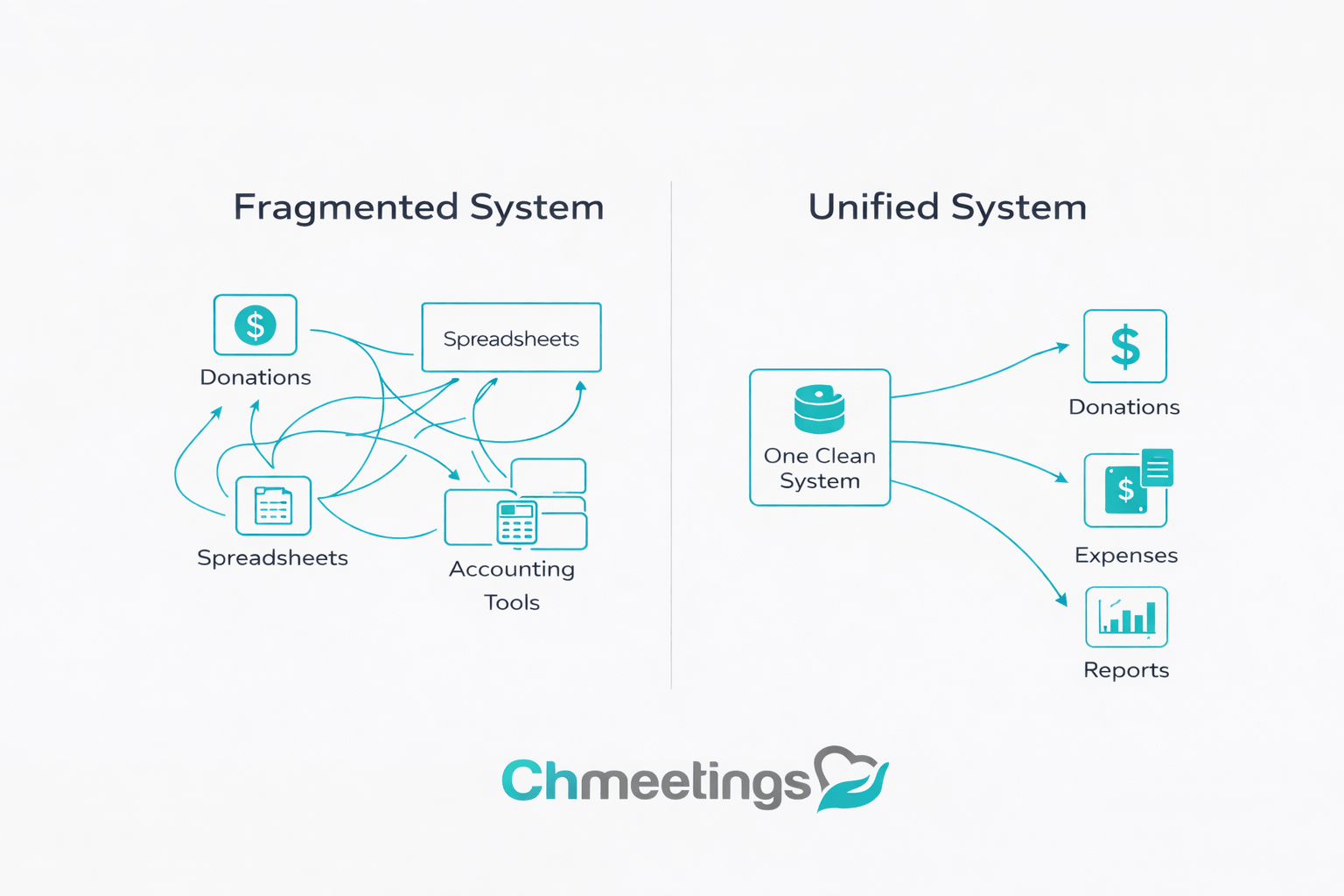
What actually reduces the load is removing the friction inside the process itself.
A typical setup that feels “busy” often looks something like this:
- Donations recorded in one platform
- Member details stored somewhere else
- Expenses tracked in spreadsheets
- Reports assembled manually at the end of each period
Each step works on its own, but together they create constant movement between tools. The same data is entered more than once. Small inconsistencies appear, and someone has to resolve them later.
Simplification begins when that movement is reduced.
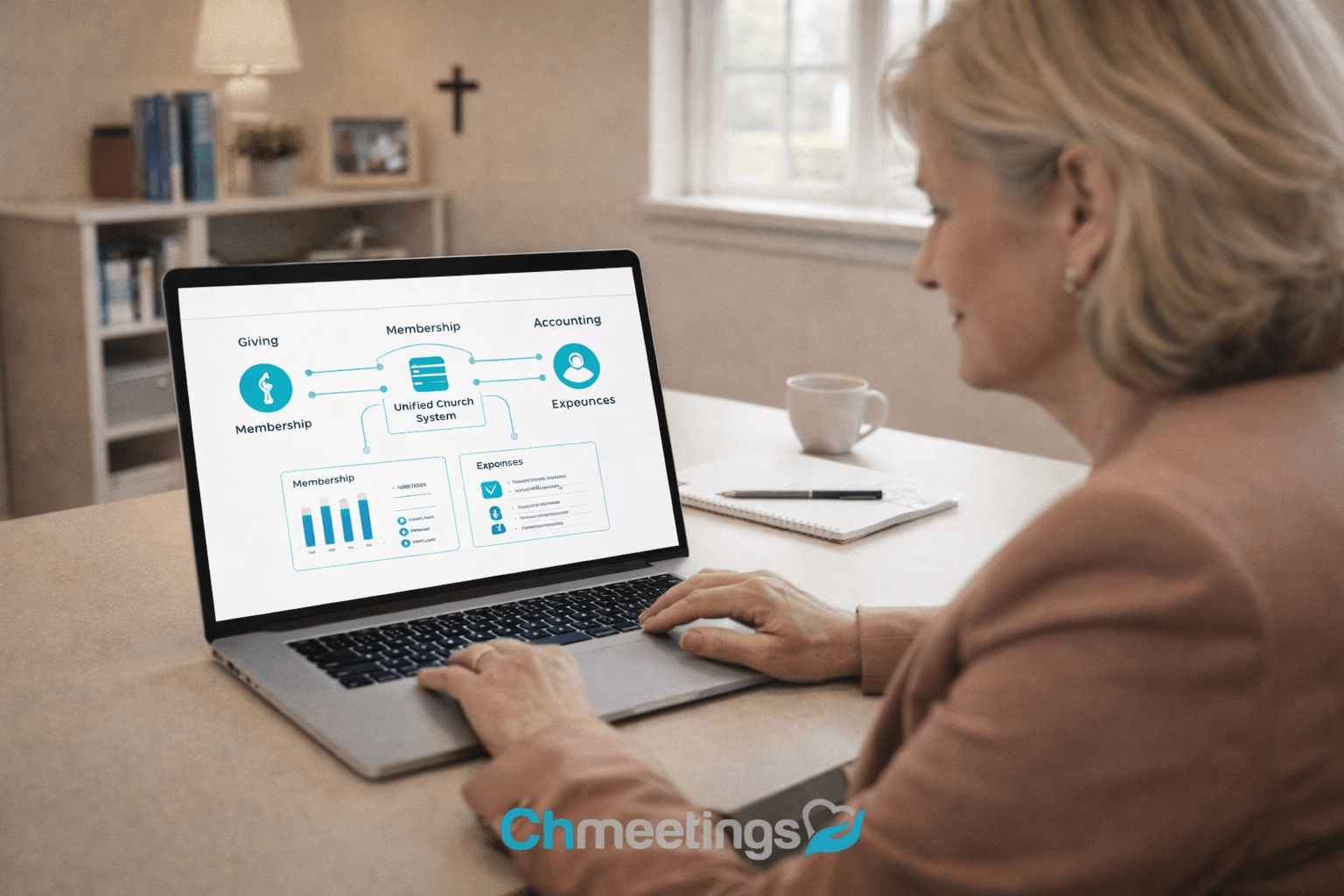
When giving, membership, and financial tracking are connected, the flow changes completely. A donation is recorded once, linked immediately to the person who gave it, assigned to the correct fund, and reflected automatically in reports. There is no second step where someone has to “sync” or re-enter information. The system carries it through.
This is where platforms like ChMeetings shift the experience. Not by adding more layers, but by removing the need to manage multiple ones at the same time.
The result is not just saved time, although that is part of it. It is a different kind of workflow. One where fewer things can go wrong, where reports reflect reality without extra effort, and where the team spends less time maintaining the system and more time understanding what the numbers actually mean.
Over time, that is what replaces the need for additional staff. Not because the work disappears, but because it becomes manageable within a structure that supports it instead of complicating it.
FAQs
Questions around church bookkeeping tend to surface at very practical moments. Someone is trying to set up a system for the first time. Another is trying to fix something that has not been working for a while. Others are simply looking for examples they can follow without starting from zero.
These are not theoretical questions. They come from real situations where clarity is needed quickly, not after reading through multiple guides.
Where Can I Download A Church Bookkeeping Excel Template?
Most churches begin with a template because it provides immediate structure. A simple spreadsheet that tracks donations and expenses can be enough to get started, especially for smaller congregations with limited activity.
What matters is not where the template comes from, but how it is used. If entries are consistent and categories are clear, even a basic file can support accurate tracking. The limitation appears when the volume increases or when multiple people need access at the same time. At that point, the template becomes harder to maintain and easier to break.
Templates are useful as a starting point, not as a long-term system.
What Training Is Available For Church Bookkeepers?
Training does not need to be formal to be effective. Most of what a church bookkeeper needs to know can be learned through a combination of clear documentation, guided practice, and regular review.
The most important areas to focus on are:
- How transactions are recorded
- How funds are categorized
- How reports are generated and checked
When these are understood, everything else builds naturally. What often makes training difficult is not the content, but the lack of a defined process. When the system itself is unclear, teaching it becomes harder.
Where Can I Find Accounting For Churches PDF Guides?
There are many downloadable guides available online, often created by accounting firms or church organizations. They can be helpful for understanding terminology and seeing examples of reports.
However, reading a guide is not the same as having a working system. The value comes from applying what is relevant and ignoring what adds unnecessary complexity.
A guide should support your process, not define it entirely.
How Does Fund Accounting Work For Churches?
Fund accounting is simply a way of keeping track of money based on its purpose, not just its amount. Each fund represents a specific use, and transactions are recorded in a way that keeps those uses separate.
This ensures that money given for one purpose is not accidentally used for another. It also makes reporting clearer, because each fund can be reviewed independently.
Once the structure is set up correctly, fund accounting becomes part of the normal workflow rather than an extra layer of work.
What Does A Church Financial Report Sample PDF Look Like?
A good financial report is not defined by how detailed it is, but by how easy it is to understand. It should show what came in, what went out, and how that compares to what was expected.
Most reports include a summary of income, a breakdown of expenses, and a comparison against the budget. The format can vary, but the purpose remains the same. Clarity over complexity.
If someone unfamiliar with the system can read the report and understand the situation quickly, it is doing its job.
How Do I Write A Job Description For A Church Bookkeeper?
A job description should reflect the actual responsibilities, not an idealized version of the role. It should describe what the person will do regularly, what they are responsible for maintaining, and how their work fits into the broader financial process.
Clarity here prevents confusion later. When expectations are defined from the beginning, performance becomes easier to measure and support.
Can I Use Generic Accounting Software For Church Accounts?
It is possible, and many churches do. Generic tools can handle basic financial tracking, especially when activity is limited.
The challenge appears when church-specific needs come into play. Fund tracking, donation management, and reporting tied to ministries are not always supported naturally. Workarounds become necessary, and over time they add complexity.
What works in the short term may require adjustment later as needs grow.
Where Can I Find Church Accounts Examples And Templates?
Examples are widely available through online resources, guides, and shared templates. They can be useful for understanding how others structure their records and reports.
At the same time, no example will perfectly match your church’s needs. The goal is not to copy a structure exactly, but to adapt what makes sense.
A good system reflects how your church operates. Examples simply help you get there faster.
Conclusion
A church treasurer closes her laptop at the end of the month and realizes something has changed. Not in the numbers, but in how those numbers came together. There were no gaps to chase, no unclear entries to question, and no last-minute adjustments to make things “look right.” The records made sense because they had been handled with consistency from the beginning.
That shift does not come from doing more work. It comes from doing the right work in a clear structure.
Church bookkeeping often feels overwhelming when systems are scattered and processes depend on memory. When that happens, even simple tasks take longer than they should, and confidence in the numbers begins to fade. Over time, the effort required to maintain the system becomes greater than the value it provides.
What changes everything is not complexity, but alignment. When donations, expenses, and reporting are handled within a connected system, the flow becomes natural. Information is recorded once, reflected everywhere it needs to be, and available when decisions are made. The focus moves away from fixing problems and toward understanding what is actually happening.
Most churches do not need larger teams or more advanced financial setups. They need clarity. They need consistency. They need tools and processes that support the way they already operate instead of adding friction to it.
When those elements are in place, bookkeeping becomes what it was meant to be. Not a burden to manage, but a clear, reliable view of the resources that support the church’s mission.