
What Pastor Compensation Includes
Salary Versus Stipend Versus Honoraria
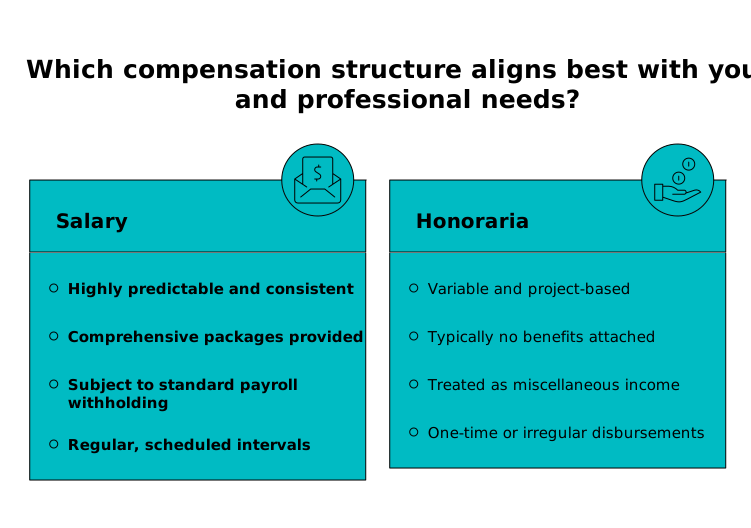
Salary means a regular, agreed pay with withholding and benefits attached. It is predictable, usually budgeted annually, and treated like staff compensation for payroll and benefits planning.
Stipend is a fixed periodic payment meant to partially cover living or ministry expenses, often used for part-time pastors or interns. It may be simpler to administer, but it usually comes with fewer benefits.
Honoraria are one-off payments for specific services, like guest preaching, weddings, or funerals. They are episodic, taxable, and should be tied to a published fee schedule so expectations stay clear.
Housing Allowance Versus Parsonage Value
A housing allowance is a cash portion of compensation designated by the church to cover rent, mortgage, utilities, and furnishings. Properly designated, it reduces taxable income for federal income tax purposes for qualifying clergy.
A parsonage is property owned or leased by the church and provided to the pastor. Its value is the fair rental equivalent plus any utilities or services the church pays. Whether a pastor receives a cash allowance or a parsonage affects bookkeeping, tax reporting, and housing-related budgeting.
Nonmonetary Benefits And Perks

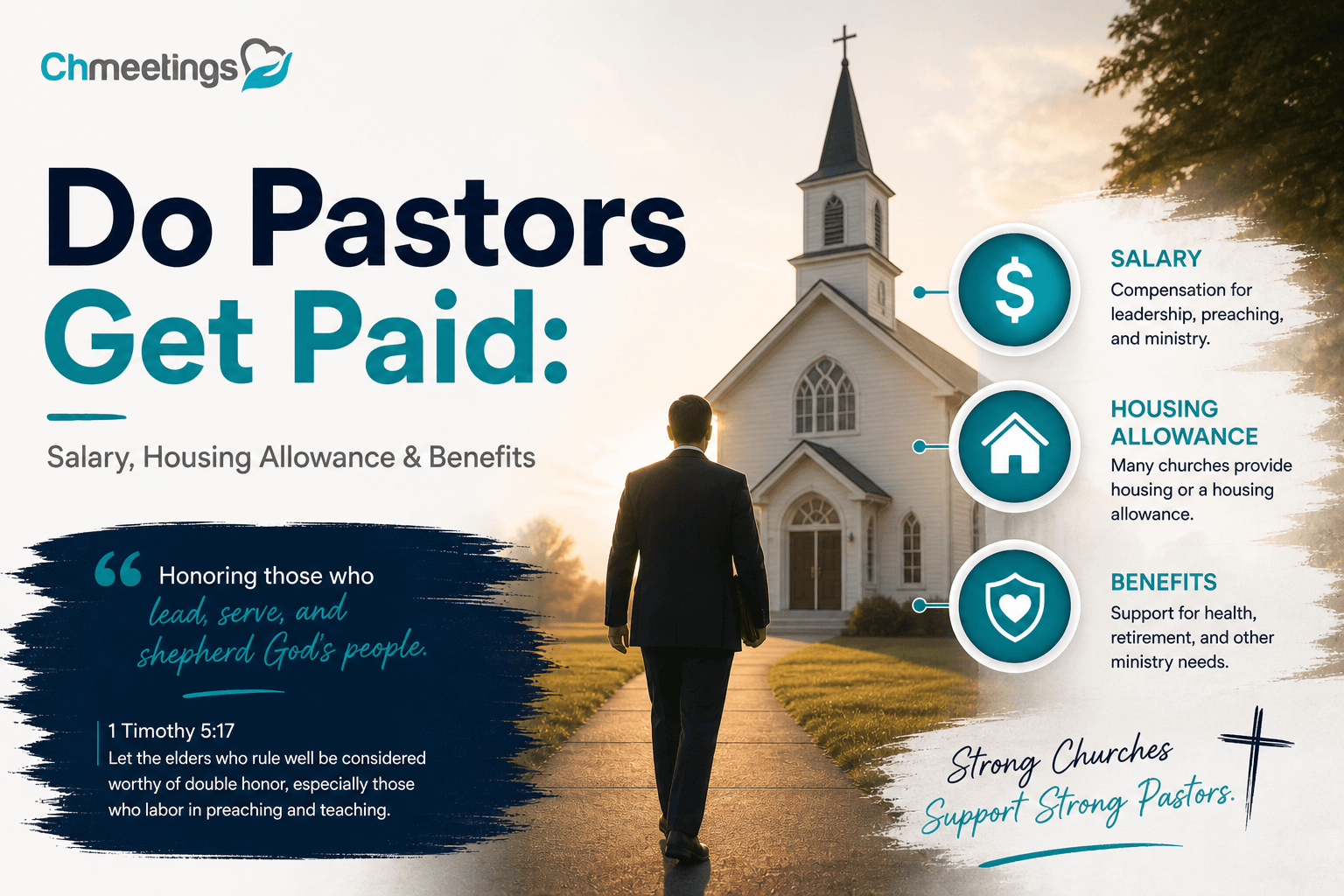
Many churches supplement pay with benefits rather than higher salary. Common items include health insurance, retirement contributions, paid time off, continuing education, mileage reimbursement, a church vehicle, or cell phone allowance.
These perks matter for retention and must be documented, because some are taxable, some are tax-free reimbursements, and some affect benefit eligibility. Clear policies and records make these items sustainable and defensible in audits.
Common Compensation Structures
Full Time Salary Packages

Full-time packages mix base salary with benefits like health insurance, retirement contributions, housing allowance or parsonage, paid leave, and professional development. Churches often benchmark salary bands by congregation size, geography, and denomination.
A transparent package spells out base, housing, employer benefits, expected hours, and review cadence. That clarity helps the pastor plan financially and helps the board budget responsibly.
Bivocational And Part Time Models
Bivocational pastors combine church work with outside employment to meet financial needs. Part-time models reduce church payroll pressure, but require realistic job descriptions, flexible scheduling, and clear boundaries so ministry responsibilities don’t get squeezed.
When a pastor works another job, churches should coordinate benefits expectations, housing decisions, and time off. Documentation and simple reporting of hours and stipend keep things fair.
Fee For Service For Special Ministries
Fee for service covers weddings, funerals, baptisms, and speaking engagements. Churches should publish a fee schedule and follow consistent bookkeeping, so honoraria don’t blur into salary.
Paying these fees through the church treasury and issuing proper tax forms avoids later confusion. Fee-based work can supplement compensation, but needs consistent practice around invoicing, receipts, and reporting.
Housing Allowance Rules And Options
Documenting A Housing Allowance Properly

A housing allowance must be formally designated by the church leadership in writing, usually before the start of the tax year. The designation should state the amount or a method for determining it, and be included in minutes or a personnel file.
Keep receipts and records for housing expenses, and retain the annual board resolution and the pastor’s acceptance. Good documentation protects the church and the pastor if questioned by tax authorities, and makes budgeting straightforward. Church management app tools can help store resolutions, agreements, and receipts in one place for easy access.
Parsonage Accounting And Fair Rental Value
When a church provides a parsonage, treat it as a real asset in the books, track maintenance and utilities, and record any imputed value used for compensation comparisons. Establish fair rental value by comparing similar local rentals, factoring in furnishings, utilities, and neighborhood.
Budget for upkeep and repairs separately from pastoral compensation. That keeps operating expenses visible and prevents maintenance surprises from eating ministry funds.
Housing Allowance Impact On Take Home Pay
A properly designated housing allowance reduces taxable income for federal income tax, which usually increases net take-home pay. That said, the allowance does not automatically reduce Social Security obligations, so net tax responsibility can be complex.
Pastors should plan quarterly estimated taxes if withholding is limited. For practical household planning, include the allowance in cash-flow forecasts and mortgage or loan discussions, since lenders sometimes consider a documented housing allowance as income.
Tax And Legal Classification
Employee Versus Self Employed Contractor

How a pastor is classified affects withholding, benefits, and legal risk. Most churches treat pastors as employees for payroll purposes, issuing W-2s and providing benefits. For Social Security and Medicare purposes, however, ministers are generally treated as self-employed with respect to their ministerial earnings, unless they have filed an exemption.
Classifying a pastor as an independent contractor is risky, and often inaccurate, because pastoral duties are ongoing and controlled by the church. Always confirm classification with a trusted tax advisor or attorney before shifting status.
Payroll Taxes And Withholding Best Practices
Set up a clear payroll system with documented pay dates, withholding policies, and benefit contributions. Decide whether the church will withhold income tax, and communicate that choice to the pastor in writing. Keep personnel files with compensation agreements, housing designations, and board minutes.
Use a reliable payroll provider or professional to avoid errors. Keep copies of W-2s, 1099s for honoraria where appropriate, and quarterly filings. Good records reduce audit stress and make annual budgeting simpler.
Social Security, Medicare, And Clergy Tax Issues
Clergy face special rules for Social Security and Medicare, often called SECA tax for self-employment tax. Ministers may elect to opt out of Social Security for conscientious reasons by filing the right form, but that decision has long term retirement and Medicare implications.
Housing allowance is excluded from federal income tax when properly designated, but generally remains subject to self-employment tax unless circumstances differ. Tax treatment can be nuanced, so the safest path is to work with a CPA familiar with clergy tax issues to set up withholding, estimated tax plans, and retirement contributions that fit the church’s compensation strategy.
Benchmarking Pay Rates
Using Denominational And Regional Guides
Start with denominational salary guides and regional compensation surveys, because those reflect local expectations and theological norms. Compare churches of similar size, staffing, and ministry scope, not just headline numbers. Diocesan offices, national denominational reports, and trusted ministry associations publish useful ranges. Ask other pastors in your region about typical packages, and use multiple sources so you don’t anchor on a single outlier.
Look at both absolute salary and total compensation, since housing allowance, benefits, and retirement change the package meaningfully. Keep notes on the sources you used and the assumptions behind each comparison so the finance team can reproduce the reasoning at annual review.
Estimating Monthly And Hourly Rates

Convert annual figures into monthly and hourly amounts to make budgeting and part-time planning practical. Use simple formulas: divide annual salary by 12 for a monthly rate. For hourly, divide by an assumed annual work hour figure, often 1,800 to 2,080 hours depending on how you count on-call time and ministry tasks. When a parsonage or housing allowance is part of compensation, include the fair rental value plus utilities in the total package before you calculate effective hourly pay.
When you compare candidates or plan a part-time role, prorate the annual package by percent time. Remember to add the employer cost of benefits, payroll taxes, and any retirement contributions to get the full cost to the church.
Adjusting For Church Size And Cost Of Living
Church size and local cost of living move numbers more than denominational identity alone. Larger congregations usually need more pastoral oversight, staff coordination, and program leadership, which justifies higher pay bands. Smaller churches may offer lower base pay but compensate with housing, flexible schedules, or shared staffing.
Use local cost of living indices, rent comparators, and median incomes to adjust benchmarks up or down. Also consider the church budget, not just attendance, since payroll must fit regular giving patterns. Practical tip, a church management app can surface attendance, giving, and program load quickly, so your benchmarking is rooted in real data, not guesswork.
How Small Churches Pay Pastors
Blended Income And Shared Staff Models
Small churches often create blended packages, mixing a modest stipend with a housing allowance, part-time salary, or in-kind support. Another common approach is shared staffing, where one pastor serves two nearby congregations or ministerial responsibilities are split among leaders. These arrangements require clear written agreements on time allocation, decision authority, and how costs are split.
Be explicit about expectations, meeting schedules, and which congregation covers which benefits. That avoids burnout and conflict, and makes budgeting transparent for both churches.
Supplementing Income With Outside Work
Bivocational ministry is normal in smaller settings. When a pastor works outside the church, churches should document boundaries, expected availability, and how time off will be handled. Transparency matters, both for congregational trust and for tax reporting.
Encourage realistic schedules that protect preaching, pastoral care, and rest. If the church wants to attract or retain bivocational leaders, consider modest benefits or flexible hours that make outside employment manageable.
Creative Benefits For Limited Budgets

When cash is tight, nonmonetary benefits help a lot. Offer a parsonage or housing stipend, utilities paid, subsidized childcare, use of a vehicle, tuition assistance, or paid continuing education. Provide practical support too, like administrative help, volunteer care teams, or outsourced bookkeeping to reduce the pastor’s workload.
Document these perks in the personnel policy so everyone knows their value. Consistent practice prevents ad hoc decisions that breed resentment.
Paying For Special Services
Fees For Weddings, Funerals, And Pastoral Care
Publish a clear fee schedule for weddings, funerals, baptisms, and similar services. Make explicit what the fee covers, what can be waived, and how proceeds are handled. Treat those payments as separate from base compensation, unless you intentionally roll them into salary.
Consistent billing and receipts prevent awkward conversations and make accounting straightforward.
Handling Honoraria And One Time Gifts
Honoraria and one time gifts need clear policy too. Decide whether they go to the pastor personally or into the church treasury, and record that decision in writing. If a pastor accepts personal gifts, note the donor and occasion for transparency. If payments are routed through the church, follow your payroll and tax procedures so reporting stays clean.
Either way, keep a log of honoraria, who paid them, and how they were used. That protects both pastor and congregation.
Recording Gifts Versus Salary
Accounting distinction matters. Record salary and housing allowance on payroll and issue the appropriate forms at year end. Track honoraria and one-off gifts in separate general ledger accounts. If honoraria are paid through the church, issue a 1099 when appropriate and follow your accountant’s advice.
A church management app can simplify this by linking contributions and fees to member profiles and generating reports for the finance team, which reduces mistakes and keeps records audit ready.
Designing A Benefits Package
Health Insurance Options For Clergy
Health coverage choices vary. Churches can contribute to marketplace premiums, join denominational group plans, or reimburse via a qualified arrangement if rules allow. For small churches, association plans or group purchasing options often give better rates than individual plans. Consider HSA compatible plans and set clear reimbursement rules for premiums and out of pocket costs.
Work with a broker who understands clergy rules, and document enrollment, employer contributions, and eligibility in the personnel file.
Retirement Plans And Employer Contributions

Common retirement vehicles include SEP IRAs, SIMPLE IRAs, and 403b plans when the church adopts them. Decide whether the church will match contributions, make flat employer contributions, or offer a defined contribution formula. Clarify vesting, how contributions are calculated, and who administers the plan.
Remember clergy tax quirks when planning contributions, and get professional counsel so your plan meets legal and tax requirements.
Paid Time Off, Continuing Education, Sabbatical
Define vacation, sick leave, continuing education allowances, and sabbatical policy in writing. State accrual rates, approval process, and how pulpit coverage is arranged. Budget an annual line for continuing education and plan for sabbatical coverage financially and operationally.
Use scheduling tools in your operations toolbox to track time off, coordinate supply preachers, and log education requests so ministry keeps running smoothly while pastors rest and grow.
Creating A Church Compensation Policy
Building A Clear Approval Process
Set who approves compensation, and how decisions are documented. Typical practice names the personnel or finance committee to draft recommendations, the board to approve, and the congregation to ratify major changes. Require written motions, minutes, and a signed offer letter or contract for every pastor. That paper trail protects the church, supports transparency, and makes future reviews straightforward.
Writing Salary Bands And Job Descriptions
Create salary bands tied to role, scope, and percent time, not to a person. Pair each band with a concise job description that lists core duties, expected hours, supervisory relationships, and on-call expectations. Include total compensation elements, housing treatment, and benefit eligibility so comparison is apples to apples. Clear bands reduce negotiation friction and help small churches plan for growth.
Communicating Compensation With Congregation
Decide what information is public, and explain why that level of transparency exists. Congregations appreciate clarity about stewardship and the church’s financial priorities, but personal payroll details should remain confidential. Publish the policy, explain the approval process, and offer summary budget lines that show total pastoral compensation versus overall ministry spending. Regular, simple communication builds trust and reduces rumor.
Tracking Compensation Metrics
Staff Cost As Percentage Of Budget
Track total personnel cost as a percent of operating budget, including salary, housing, benefits, payroll taxes, and employer retirement contributions. That ratio shows whether the church is overstaffed or under-resourced relative to mission and giving. Benchmark against similar-sized churches and your denomination, and use the number to test hiring or cut scenarios.
Compensation Per Attender And Per Giving Dollar
Calculate compensation per average weekly attender and per dollar of annual giving to put pastor cost into practical context. These metrics help small churches see how sustainable a package is, and help larger churches weigh staffing for growth initiatives. Use consistent attendance and giving definitions so comparisons over time are valid.
Review Cadence And Performance Metrics
Set a regular review cycle, usually annual for salary and semiannual for major benefits. Tie compensation changes to objective performance indicators, like congregational growth, discipleship outcomes, program delivery, and financial stewardship. Keep review notes, goal statements, and any improvement plans in personnel files so compensation decisions are repeatable and defensible.
Common Mistakes To Avoid
Misclassifying Clergy Employment Status
Treating a minister as an independent contractor when the role meets employee criteria creates tax and legal risk. Confirm classification with professionals and document decisions. If the pastor is treated as staff for payroll, keep consistent records and forms, and handle housing designation correctly.
Neglecting Housing Documentation And Records
A housing allowance must be formally designated and recorded before the tax year starts. Keep the board resolution, the pastor’s acceptance, and receipts for housing expenses together in the personnel file. Missing documentation can cost the pastor and expose the church to questions from tax authorities.
Underestimating Total Cost Of Employment
Focus on base salary alone and you will misbudget. Add employer-side payroll taxes, retirement contributions, health premiums, benefits administration, and employer-paid utilities or vehicle costs. Model hires at full cost to the church, not just take-home pay to the pastor, so you avoid midyear surprises.
Negotiating And Reviewing Pay
Preparing A Pastor For Compensation Conversations
Give pastors the data they need before negotiations, such as budget lines, benchmark reports, and expected ministry outcomes. Encourage them to present a written case that includes role priorities, cost-of-living needs, and professional development goals. A prepared conversation is less emotional and more productive.
Board Responsibilities And Conflict Prevention
Boards should separate governance from personnel management, using committees for negotiation and recommendations. Establish clear roles, a standard offer template, and a conflict of interest policy so decisions are fair. When disagreements arise, rely on documented policy and objective benchmarks to de-escalate tension.
Timing Reviews And Using Benchmark Data
Align compensation reviews with annual budgeting cycles so changes are affordable and visible to the congregation. Use multiple benchmark sources, adjust for cost of living, and document assumptions behind any increase or freeze. When possible, present changes as part of a broader compensation strategy so pay decisions support ministry goals rather than appearing ad hoc.
Compensation Templates And Tools
Sample Pastor Salary Band Table
Below is a simple, adaptable salary band you can copy and tweak for your context. Replace numbers with local benchmarks, then attach notes explaining assumptions.
| Congregation size (avg weekly attendance) | Full-time base salary (annual) | Housing allowance or parsonage value | Estimated total compensation (annual) | Notes |
|---|---|---|---|---|
| Under 75 | $30,000–$45,000 | $6,000–$12,000 | $36,000–$57,000 | Small budget, often bivocational |
| 75–200 | $45,000–$65,000 | $10,000–$18,000 | $55,000–$83,000 | Part of midrange expectations |
| 200–500 | $65,000–$95,000 | $15,000–$30,000 | $80,000–$125,000 | Larger program and staff oversight |
| 500+ | $95,000+ | $20,000+ | $115,000+ | Multi-staff leadership roles |
How to use it
- Record the source and date for any benchmark numbers.
- Translate annual figures into monthly and hourly values when comparing candidates or budgeting.
- Add employer cost lines, like retirement and payroll taxes, to see full cost to the church.
Housing Allowance Resolution Template
Use this short resolution language in board minutes or a signed personnel file. Fill in the blanks and keep a copy in the pastor’s file.
Sample resolution text
- The [Name of Church] hereby designates, for the calendar year [YYYY], a housing allowance for [Pastor Name] in the amount of $[Amount] for the pastor’s housing expenses, including rent, mortgage, utilities, repairs, and furnishings. This designation is made prior to or contemporaneous with the payment of the allowance. The pastor’s acceptance of this designation is on file.
Pastor acceptance (add signature)
- I, [Pastor Name], accept the housing allowance designation for [YYYY]. Signature: __ Date: __
Recordkeeping checklist
- Attach the signed resolution to the pastor’s personnel record.
- Keep receipts and a running expense log for housing costs.
- Reaffirm or amend the designation annually before the fiscal or tax year begins.
Storing the resolution with other personnel documents in your church management software makes retrieval easy during audits and annual reviews.
Simple Salary Calculator And Budget Entry Checklist
Quick formulas
- Monthly salary = Annual salary ÷ 12.
- Estimated hourly rate = Annual salary ÷ assumed annual hours (use 1,800 for ministry roles that include on-call time, or 2,080 for standard full-time hours).
- Full cost to church = Annual salary + employer-side payroll taxes (about 7.65% for Social Security and Medicare where applicable) + employer retirement contribution + benefits cost + housing cost if paid by church.
Practical example
- Annual salary $48,000 → Monthly $4,000.
- Using 1,800 hours → Hourly ≈ $26.67.
- Add employer costs: payroll taxes (7.65% ≈ $3,672), retirement match (for example 3% ≈ $1,440), health premium contribution, etc.
Budget entry checklist before payroll runs
- Personnel contract or offer letter signed and filed.
- Board minutes approving salary and any housing allowance resolution.
- GL accounts set up: Salary, Housing Allowance, Employer Taxes, Benefits.
- Payroll vendor or processor configured with withholding choices and pay schedule.
- Benefit providers notified and enrollment paperwork completed.
- Published fee schedule for honoraria and funerals, with 1099 workflow if applicable.
- Backup of all documents stored securely, ideally in your church management software or shared finance folder for easy access during reviews.
Keeping these templates and a simple calculator at hand makes salary conversations quicker, more transparent, and easier to audit.
FAQs
Do Pastors Get Paid From Tithes
Pastor compensation typically comes from the church’s operating funds, which are supported by tithes, offerings, and other income. Some churches maintain a separate “pastoral support” fund, but most treat compensation as part of the overall budget. Clear budgeting and communication about funding sources protect trust.
Do Pastors Pay Taxes
Yes. Pastors pay federal income tax on taxable compensation. A properly designated housing allowance can be excluded from federal income tax, but it usually remains subject to Social Security and Medicare self-employment tax unless the pastor has filed an exemption. State tax rules vary. Work with a CPA who knows clergy tax rules.
How Much Do Pastors Get Paid Per Month
That depends on the annual package. Convert annual salary to monthly by dividing by 12. For example, a $48,000 annual package equals $4,000 per month, before employer-paid benefits and housing are factored in. Use local benchmarks and your church’s budget to set realistic monthly expectations.
How Much Do Pastors Get Paid Per Hour
There’s no universal hourly rate for pastors. Estimate by dividing annual compensation by an assumed annual hour total. Use 1,800 hours for a ministry role that includes on-call duties, or 2,080 for standard full-time. Example, $48,000 ÷ 1,800 ≈ $26.67 per hour.
Do Pastors Get Paid For Funerals
Often yes, through an honorarium or fee. Churches should publish a fee schedule that clarifies what the fee covers and whether it’s separate from salary. Some churches include occasional funerals in the pastor’s regular duties and do not pay extra, but that needs to be explicit in the compensation policy.
How Do Small Church Pastors Get Paid
Small churches commonly use stipends, part-time salaries, housing allowance or parsonage, or blended packages. Many pastors are bivocational. Clear written agreements about hours, expectations, and benefits make modest packages sustainable. Shared staffing arrangements are another practical option.
Do Governments Pay Pastors
Generally no, not for congregational pastors. Exceptions include government-employed chaplains in the military, prisons, hospitals, or schools, who are paid by the government. In some countries with established state churches, governments may provide clergy stipends. Always check local context.
Are Pastors Employees Or Contractors
Most pastors are treated as employees for payroll and benefits purposes, and for Social Security and Medicare issues they often have special self-employment considerations. Classifying a pastor as an independent contractor is risky and usually incorrect because pastoral work is ongoing and under church authority. Confirm classification with legal and tax counsel.