
- What Is A Church Financial Audit?
- Decide Which Audit Type You Need
- Prepare Records Before An Audit
- Audit Checklist: Documents To Gather
- Audit Checklist: Transactions And Controls To Test
- Track Donations And Fund Restrictions
- Strengthen Internal Controls To Prevent Fraud
- Conduct Fieldwork And Testing Steps
- Write And Present The Audit Report
- Act On Findings And Create An Action Plan
- Choose Cost-Effective Options For Small Churches
- Use Tools, Templates, And Sample Reports
- Key Metrics To Monitor Year-Round
- FAQs
What Is A Church Financial Audit?
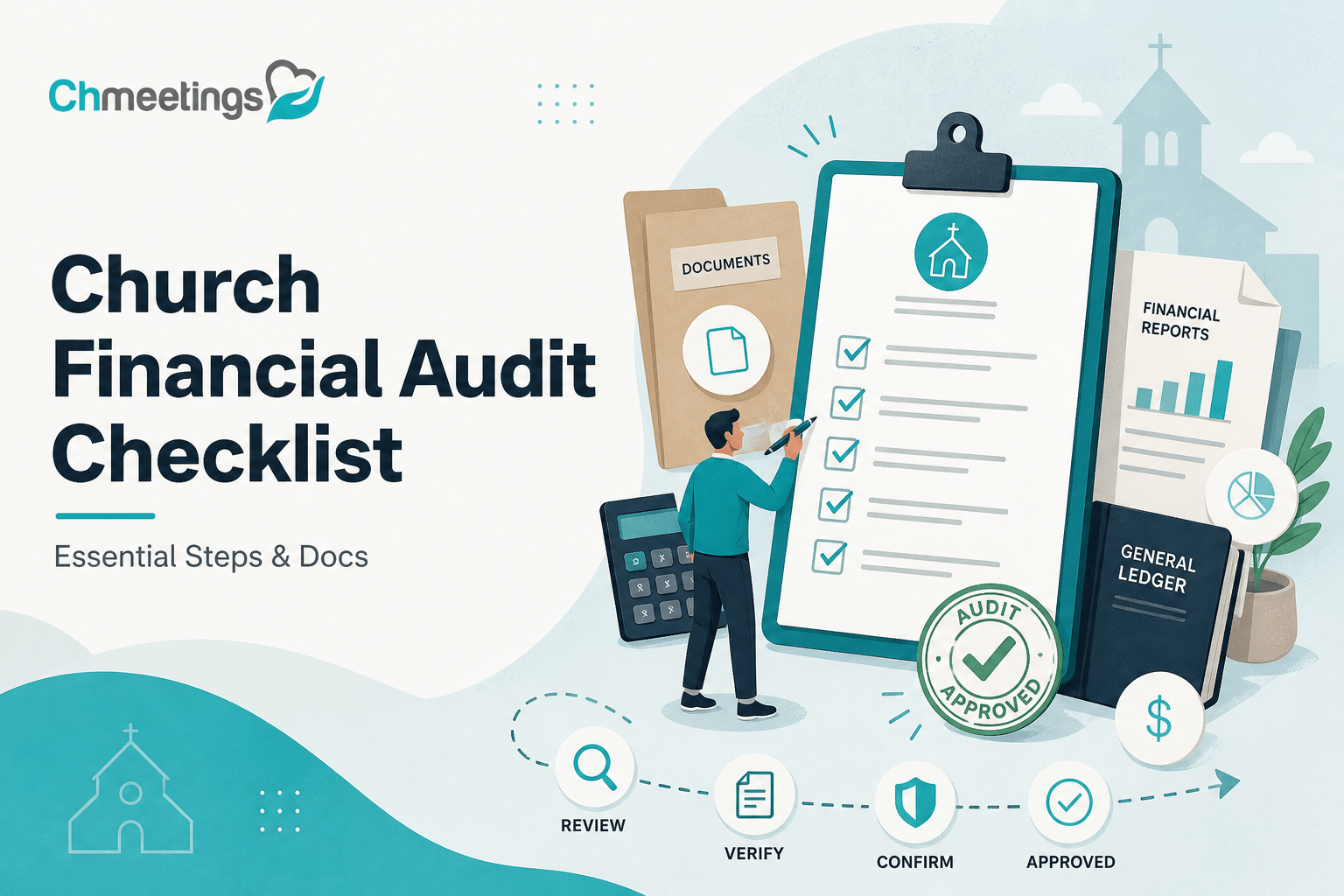
A church financial audit is an independent examination of your congregation’s financial records, systems, and controls to determine whether financial statements are accurate and funds are being handled appropriately. An audit looks beyond numbers, testing processes and accountability so leaders, donors, and regulators can trust reported results. For churches, the goal is both financial transparency and stewardship that supports ministry, not just compliance with accounting rules.
Purpose And Expected Outcomes

An audit should answer three questions: are the financial statements reliable, are controls adequate, and were any irregularities found. Expected outcomes include an auditor’s opinion or report, recommendations to tighten controls, and a clear record you can share with governing bodies, major donors, or grantmakers. Good audits also surface operational gaps you can fix before they become bigger problems.
Types Of Audits At A Glance

- Financial statement audit, highest level of assurance, independent CPA expresses an opinion.
- Review, limited assurance and less costly, offers moderate comfort without full testing.
- Compilation, prepares financial statements from provided data, no assurance given.
- Agreed upon procedures, auditor performs specific tests you request and reports findings only.
- Internal audit or internal review, ongoing self-assessment by staff or volunteers focused on controls and processes.
Decide Which Audit Type You Need
Choosing the right engagement depends on size, risk, legal needs, donor expectations, and budget. Match the audit type to the audience that will rely on the results and the level of assurance required.
External Audit Versus Review
External audits provide the strongest assurance and are often required by lenders, large donors, or grant agreements. Reviews cost less but give only limited assurance; they might suffice for smaller churches or interim oversight. If an external audit is required, plan months ahead for scheduling and documentation.
Internal Review And Agreed Procedures
Internal reviews are practical for ongoing oversight, risk management, and preparing for an external audit. Agreed upon procedures let you target hot spots, for example cash handling or payroll, without the cost of a full audit. Use these when you need clear answers about specific risks.
Legal And Tax Requirements
Check state charity registration, donor solicitation rules, and local regulations, some of which demand audited financials or annual filings. Federal tax rules generally exempt churches from filing Form 990, but if your church has unrelated business income or other special circumstances you may need additional filings. Confirm requirements with your attorney or CPA so you don’t get surprised.
Denominational Or Grant Obligations
Denominations, dioceses, and grantmakers often set audit standards, frequency, and the level of assurance required. Grants commonly require audited statements or an independent accountant’s letter for reimbursement. Review those contracts early so your audit scope meets outside expectations.
Prepare Records Before An Audit
Getting organized lowers audit time and cost, and reduces questions. Finish the year close, reconcile accounts, and assemble supporting documents so the auditor can work efficiently and you can act quickly on recommendations.
Assign Roles And Timeline

Designate a single point person as auditor liaison, assign staff or volunteers to gather specific documents, and set a realistic timeline with checkpoints. Build in time for corrections after auditor inquiries. Clear roles prevent duplicated work and missing items.
Clean Up Accounting And Bank Records
Reconcile all bank and credit card accounts through the audit cutoff date, clear stale checks and unidentified deposits, post necessary adjusting entries, and produce a clean trial balance. Fix obvious errors before the auditor arrives, auditors appreciate tidy books.
Organize Minutes Contracts And Policies
Collect board and finance committee minutes, personnel contracts, vendor agreements, lease or mortgage documents, and written financial policies like conflict of interest and travel reimbursement. Minutes and policies show governance in action, and they often answer auditor questions without digging.
Secure Electronic Files And Access Logs
Provide a secure, single place for electronic records and a list of user access for accounting and giving systems. Change or document passwords for terminated users, export audit trails for donations and accounting entries, and back up files. If you use a church management app it can centralize giving and member reports, making exports simpler and more reliable.
Audit Checklist: Documents To Gather
Below are the essential documents auditors expect. The more complete your packet, the faster the audit moves.
Governing Documents And Bylaws
- Articles of incorporation and amendments
- Bylaws and any bylaws amendments
- Board and finance committee charters or terms of reference
- Conflict of interest statements and signed acknowledgements
Financial Statements And Trial Balance
- Year-end financial statements, comparative if available
- General ledger and detailed trial balance with all account balances
- Chart of accounts and description of accounting policies
Bank Statements And Reconciliations
- Bank and credit card statements for the audit period and subsequent months
- Bank reconciliations with supporting deposits and cleared checks
- Investment account statements and trustee reports
Payroll Files And Tax Filings
- Payroll register, timesheets, and personnel records for paid staff
- Payroll tax filings, W-2s, 1099s or local equivalents
- Employee benefit and retirement plan summaries
Donation Records And Contribution Logs
- Contribution statements and donor registers, with restricted gift details
- Online giving exports and batch reports, including third-party processor fees
- Gift acceptance policies and acknowledgement templates
- If you use a church management app, include exported giving reports and audit trails
Vendor Invoices Contracts And Grants
- Vendor invoices, purchase orders, and payment approvals
- Significant vendor and contractor agreements, including scope and payment terms
- Grant agreements, budgets, draw schedules, and reporting to funders
Fixed Asset Schedules And Insurance
- Fixed asset register with purchase dates, costs, and depreciation schedules
- Titles and deeds for property, vehicle registrations, and equipment warranties
- Insurance policies, coverage summaries, and claims history
Audit Checklist: Transactions And Controls To Test
Offering Counting And Deposit Procedures

Test whether offering counts are accurate and consistently documented. Verify dual control for counting teams, compare count sheets to bank deposit slips, and trace deposits to the bank statement. Look for gaps between collection date and deposit date, unexplained cash variances, or frequent voided checks. Confirm supporting documentation exists for special collections, mission offerings, and cash received at events.
Bank Transfers And Interfund Activity
Review all interbank transfers and activity between funds to ensure proper authorization and recording. Match transfer amounts to bank statements, board minutes, or approved budget reallocations. Check that transfers between restricted and unrestricted funds follow donor intent, and test journal entries for interfund eliminations or temporary loans. Watch for repeated shortfalls that may indicate hidden cash flow problems.
Payroll And Staff Benefit Payments
Compare payroll registers to personnel files, approved timesheets, and employment agreements. Confirm payroll tax filings, W-2s or 1099s, and benefit deductions are complete and timely. Test last-pay and termination payments, housing allowances, and pastor compensation against board approvals and IRS rules. Spot check benefit plan contributions and retirement deposits to make sure they were remitted to providers.
Expense Reimbursements And Credit Cards
Ensure reimbursement requests are supported by original receipts, purpose descriptions, and prior approval when required. Review credit card statements for policies compliance, personal charges, or split coding errors. Test frequency of reimbursements for unusual patterns and confirm expense allocations match program budgets. Verify approval chains and that supporting documentation is retained in an accessible file.
Petty Cash And Cash Disbursements
Count petty cash on a surprise basis and reconcile against vouchers and receipts. Test that petty cash is used only for authorized small purchases and replenished with proper approvals. Review cash disbursement files for signed check requests, vendor invoices, and evidence of goods or services received. Look for round-number payments or duplicate invoices that could indicate misuse.
Related Party And Conflict Transactions
Identify transactions involving board members, staff, or close relatives and confirm disclosures exist. Test that related party contracts were competitively evaluated or approved by disinterested board members. Review conflict of interest statements and minutes for approvals of significant related party transactions. Any favorable terms, waived fees, or unusual payments should be documented and explained.
Track Donations And Fund Restrictions
Reconcile Online Giving Platforms
Reconcile totals from online giving platforms to the general ledger and bank deposits every month. Export batch reports, processor fee detail, and donation timestamps, then match these to contribution entries. If you use a church management app like ChMeetings, include exported giving reports and audit trails to speed reconciliation and reduce spreadsheet errors. Watch for timing differences around month end and for refunded or charged-back donations.
Record Donor Intent And Acknowledgements
Confirm donor intent is captured at point of gift and reflected in accounting, especially for restricted or designated gifts. Review contribution statements and acknowledgement letters for tax compliance and timely delivery. Test a sample of gifts to ensure donor restrictions are honored in financial reporting and communications. Maintain a clear paper or electronic trail showing how restricted funds were spent.
Monitor Restricted And Designated Funds
Compare restricted fund balances in the ledger to fund-specific bank accounts and activity reports. Trace expenditures charged to restricted funds back to supporting invoices and board- or donor-authorized purposes. Review procedures for reclassifying or releasing restrictions, including required approvals or donor consent. Watch for unrestricted use of restricted funds, even temporarily, without formal authorization.
Account For Noncash Gifts And In-Kind Support
Verify valuation methods for noncash gifts follow consistent, reasonable policies and donor statements. Inspect documentation such as donation forms, appraisals, or vendor quotes that support recorded values. For in-kind services, confirm whether recognition or expense recording is appropriate under accounting rules and donor restrictions. Ensure gifts of property or vehicles have title transfers and insurance updates documented.
Strengthen Internal Controls To Prevent Fraud
Segregation Of Duties Best Practices
Where possible separate authorization, custody, and recording of transactions so no one person controls a complete transaction cycle. For small churches, use compensating controls, like mandatory dual signoffs, periodic independent reviews, or volunteer oversight. Document who performs counting, reconciliation, check signing, and bookkeeping so gaps are visible. Regularly rotate or add reviewers to reduce fraud risk from familiarity.
Approval Limits And Authorization Paths
Set clear approval limits tied to roles, not personalities, and require written or electronic signoff for large or unusual expenditures. Maintain an approval matrix that auditors can review, and enforce it consistently. Require board or finance committee approval for related party transactions, capital purchases, and budget reallocations. Keep thresholds reasonable so routine items are efficient and significant items get proper oversight.
Physical Controls And Access Management
Control access to cash, check stock, safe combinations, and accounting systems by limiting keys and permissions. Track who has access to bank and giving platforms, and promptly remove rights for terminated staff or volunteers. Secure important documents like titles, donor lists, and checkbooks in locked storage. Use logs to record withdrawals or access to safes and archives.
Regular Reconciliations And Surprise Counts
Reconcile bank accounts, credit cards, and giving platform totals monthly, and have someone independent review the reconciliations. Schedule surprise counts of offering cash, petty cash, and inventories to validate records. Document who performed the surprise count and any variances found, with corrective actions recorded. Regular, independent checks are a strong deterrent to theft and errors.
Conduct Fieldwork And Testing Steps
Sampling Methods And Documentation
Choose testing samples based on risk, dollar size, and unusual transactions rather than random picks alone. Use stratified sampling for high-dollar items and judgmental sampling for areas with prior issues. Document your sampling rationale, items tested, and conclusions so results are reproducible. Keep workpapers tidy and indexed, auditors will thank you.
Confirmations With Banks And Vendors
Send bank confirmations for cash, loans, and lines of credit, and request vendor confirmations for outstanding balances or related party status. Reconcile confirmation responses to recorded balances and follow up on discrepancies. For investments, obtain custodian statements directly from the provider rather than relying on internal copies. Confirmations provide external evidence that strengthens audit conclusions.
Physical Verification Of Assets
Inspect fixed assets, vehicles, and equipment to confirm existence, condition, and location. Compare ID numbers and descriptions to the fixed asset register and depreciation schedule. For property, verify deeds and insurance are current and recorded correctly. Tagging assets and keeping photos or GPS notes helps future audits and reduces lost items.
Staff And Volunteer Interviews
Interview staff and volunteers to understand processes, controls, and any informal practices that could create risk. Ask about offering procedures, approval flows, and access to financial systems, and reconcile answers with documented policies. Interviews often uncover control gaps or workarounds that records alone do not show. Treat interviews as collaborative, not accusatory, so people are candid and solutions are practical.
Write And Present The Audit Report
Core Report Components Explained

An audit report should be clear and focused, not a pile of pages. Key parts are the auditor’s opinion, the financial statements and notes, a summary of significant adjustments, and a section on internal control findings. Include a concise executive summary up front that states the auditor’s conclusion in plain language, then let technical schedules live in appendices. Leaders need the bottom line fast, backed by the evidence they can dig into.
Drafting The Management Letter
The management letter is where auditors move from facts to practical advice. Keep the tone constructive, point to root causes, and recommend specific, achievable fixes. Include estimated effort or cost for each recommendation and suggest who should own the change. Avoid naming or blaming individuals; focus on systems and processes so the board can act without defensiveness.
Communicating Findings To Leadership
Prepare a short presentation for the finance committee and board that highlights high-risk items, required corrective actions, and any compliance gaps. Use one page for top risks, one page for remediation steps, and one for timing and resources. Allow ample time for questions, and provide a confidential package with detailed workpapers for board members who want them. Make clear which items require immediate board approval.
Sharing Results With The Congregation
Transparency builds trust, but not every detail belongs in a bulletin. Share a plain-language summary that explains the audit outcome, what was fixed, and what’s planned next. Emphasize stewardship and accountability, and avoid technical accounting jargon. Offer a short Q and A or a town hall for people who want more context, and post the summary on your website or newsletter for ongoing access.
Act On Findings And Create An Action Plan
Prioritize Recommendations By Risk
Not all recommendations are equal. Rank them by financial impact, legal or compliance risk, and likelihood of recurrence. Treat donor-restricted fund errors, payroll tax issues, and missing bank reconciliations as high priority. Medium items might be process improvements that reduce work, and low items are nice-to-have efficiencies. Prioritization keeps limited resources focused where they matter most.
Assign Owners And Deadlines
Every recommendation needs a named owner, a deliverable, and a deadline. Put those assignments in meeting minutes and in written action plans so responsibility is visible. If a volunteer is assigned, make sure a staff backup exists. Build approval touchpoints into the timeline, for example finance committee sign-off at key milestones.
Track Implementation And Reassess
Use a simple tracker to show status, evidence of completion, and any roadblocks. Review progress monthly at finance meetings and close items only when documentation verifies the change. For high-risk fixes, plan a follow-up review or spot check within six to twelve months. Treat the audit as the start of a continuous improvement loop, not a one-off event.
Use Findings To Improve Stewardship
Frame audit results as stewardship work, not punishment. Update written policies, strengthen approval limits, and train staff and volunteers on new procedures. Share wins with the congregation, like improved reconciliation processes or the establishment of a restricted funds policy. When people see concrete improvements, confidence in leadership and giving often follows.
Choose Cost-Effective Options For Small Churches
Peer Reviews And Financial Reviews
Smaller churches can get valuable assurance from peer reviews or an independent financial review. These are less expensive than full audits, focus on key controls, and are often performed by accountants within the denomination or by volunteer accountants from nearby churches. They provide practical recommendations and build confidence without the full audit price tag.
Compilation Services Versus Full Audit
A compilation prepares financial statements from your records and costs less, but it gives no assurance. A review offers limited assurance and catches obvious issues. A full audit gives the strongest assurance but is the most costly. Choose based on who needs the report, such as grantors or lenders, and on the level of risk you or stakeholders are comfortable with.
Denominational Resources And Pro Bono Help
Many denominations, dioceses, or regional church networks offer audit guidance, reviewer lists, or subsidized services. Local CPA firms sometimes provide pro bono or reduced-rate help for churches. Check denominational offices first, then ask neighboring congregations for referrals. Those contacts can save money and speed the process.
Budgeting For Professional Services
Plan audit costs in the annual budget and start the procurement process early. Ask for fixed fee proposals, sample workpapers, and references from other churches. Consider a staged approach, for example a financial review this year and a full audit later, to spread costs. Factor in internal staff time too, because clean books cut external fees.
Use Tools, Templates, And Sample Reports
Downloadable Checklist And Report PDFs
Keep a living audit checklist and PDF packet you can hand auditors, board members, or volunteers. Include the document list, reconciliations, policy copies, and a template for the board presentation. Having a ready packet shortens fieldwork and reduces billable hours.
Sample Audit Report And Presentation Templates
Use a simple executive summary template for the board that highlights the opinion, top three risks, and recommended actions. Prepare a one-page public summary for the congregation. Templates ensure consistency from year to year and make it easier for lay leaders to understand and share results.
Accounting Software And Integrations
Integrated tools reduce manual reconciliation and errors. Link your giving platform to accounting software, enable bank feeds, and keep member and donation records in one place to speed audits. A church management app that ties giving, membership, and events to accounting exports makes audits smoother and supports stronger stewardship.
Where To Find Audit Report Samples
Look to denominational offices, state societies of CPAs, national accounting bodies, and nonprofit resource sites for sample reports and letters. Ask your auditor for redacted examples from other churches, and compare formats so you can choose what best fits your audience. Real samples help set expectations for tone, length, and level of detail.
Key Metrics To Monitor Year-Round
Good audits catch problems after the fact. Good monitoring catches them earlier. Track a short set of financial metrics each month so leaders know when to dig deeper, when to celebrate, and when to adjust stewardship strategy. Below are the metrics that matter most for churches, what they tell you, and how often to review them.
Giving Trends And Donor Retention
Track total giving, giving by channel, average gift size, number of givers, recurring donors, and donor retention rate. Donor retention rate is simple to calculate, take the number of donors who gave this year and also gave last year, then divide by last year’s donor count. Watch trends month to month and year over year, not just raw totals. A steady decline in active givers, or a drop in recurring gifts, signals a stewardship or engagement issue before budgets run short. Segment giving by new donors, lapsing donors, and major donors so follow up is targeted. Review these numbers monthly and present a concise trend chart quarterly to the finance committee.
Liquidity And Reserve Ratios
Liquidity tells you whether you can cover shortfalls or unexpected expenses without borrowing. The easiest metric for churches is months of operating reserves, calculate unrestricted cash divided by average monthly operating expenses. Aim to set a target, commonly three to six months, based on your size, cash flow variability, and denominational expectations. Also watch bank balance trends and days cash on hand. Reconcile bank balances monthly and flag any sustained drop below your minimum reserve target immediately.
Budget Variance And Expense Ratios
Compare actual to budget at least monthly, and report both dollar variance and percentage variance. Highlight any variances outside an agreed tolerance, for example plus or minus five percent, so leaders can act quickly. Track expense ratios such as program versus administration and payroll as a percent of total expenses. Benchmarks vary, but having consistent ratios over time shows disciplined stewardship. Use year to date variance to spot structural issues early rather than reacting at year end.
Exception Rates And Fraud Indicators
Exception metrics measure transactions that fall outside normal patterns, think duplicate payments, frequent voids or refunds, late deposits, unusually high cash disbursements, or an uptick in manual journal entries near month end. Calculate an exception rate, the percentage of sampled transactions flagged for review, and set escalation thresholds. High exception rates in a specific area mean tighten controls, add independent reviews, or run surprise counts. Automate alerts where you can, and assign an independent reviewer to clear exceptions weekly or monthly.
FAQs
How Often Should A Church Be Audited?
It depends on size, risk, and outside requirements. Large churches or those with grant and lender obligations often do annual external audits. Smaller churches commonly do an independent review or peer review annually, and a full audit every two to five years or when required by donors or denominational rules. At minimum, plan an external assurance engagement or an internal control review every few years and a routine internal reconciliation process every month.
How Much Does A Church Audit Typically Cost?
Costs vary widely by scope and complexity. As a rough guide, financial reviews can run a few thousand dollars, while full audits often start in the mid single thousands and can go up to tens of thousands for large or complex organizations. Ask for fixed fee proposals, request sample workpapers, and factor in your internal prep time, because clean books reduce billable hours and cost.
Can Small Churches Use A Financial Review Instead?
Yes. A review provides limited assurance at lower cost and can be the right choice when stakeholders need comfort but not the highest level of assurance. Peer reviews, compilations, or agreed upon procedures are other lower cost options. Pick the engagement that fits who will rely on the report, what they need it for, and how much risk you’re managing.
Where Can I Download A Free Audit Checklist PDF?
Denominational offices, state societies of CPAs, nonprofit resource centers, and national accounting bodies often publish free checklists. Search your denomination’s resources or your state CPA society for church-specific materials. You can also build a quick PDF from this article’s checklist items and share it with your finance team.
What Should An Audit Report Include?
A clear audit report includes the auditor’s opinion, the audited financial statements and notes, a concise executive summary, a schedule of significant adjustments, and a management letter with internal control findings and recommendations. Appendices can include workpapers, schedules, and legal confirmations. Present a one page summary for board and congregation use.
Who Can Perform An Audit For My Church?
Independent licensed CPAs or CPA firms experienced with nonprofit and church accounting perform formal audits. For reviews or agreed upon procedures, use an independent accountant or reviewer, ideally with nonprofit experience. Avoid conflicts of interest, so don’t use someone closely related to board members or staff for independent assurance work.
Are Audited Financial Statements Required For Nonprofits?
Not always. Churches are often exempt from federal filing requirements like Form 990, but state laws, grant agreements, denominational rules, lenders, or donors may require audited statements. Some states set revenue thresholds that trigger mandatory audits. Always check your funder contracts, state charity regulations, and denominational guidance, and consult your CPA when in doubt.