
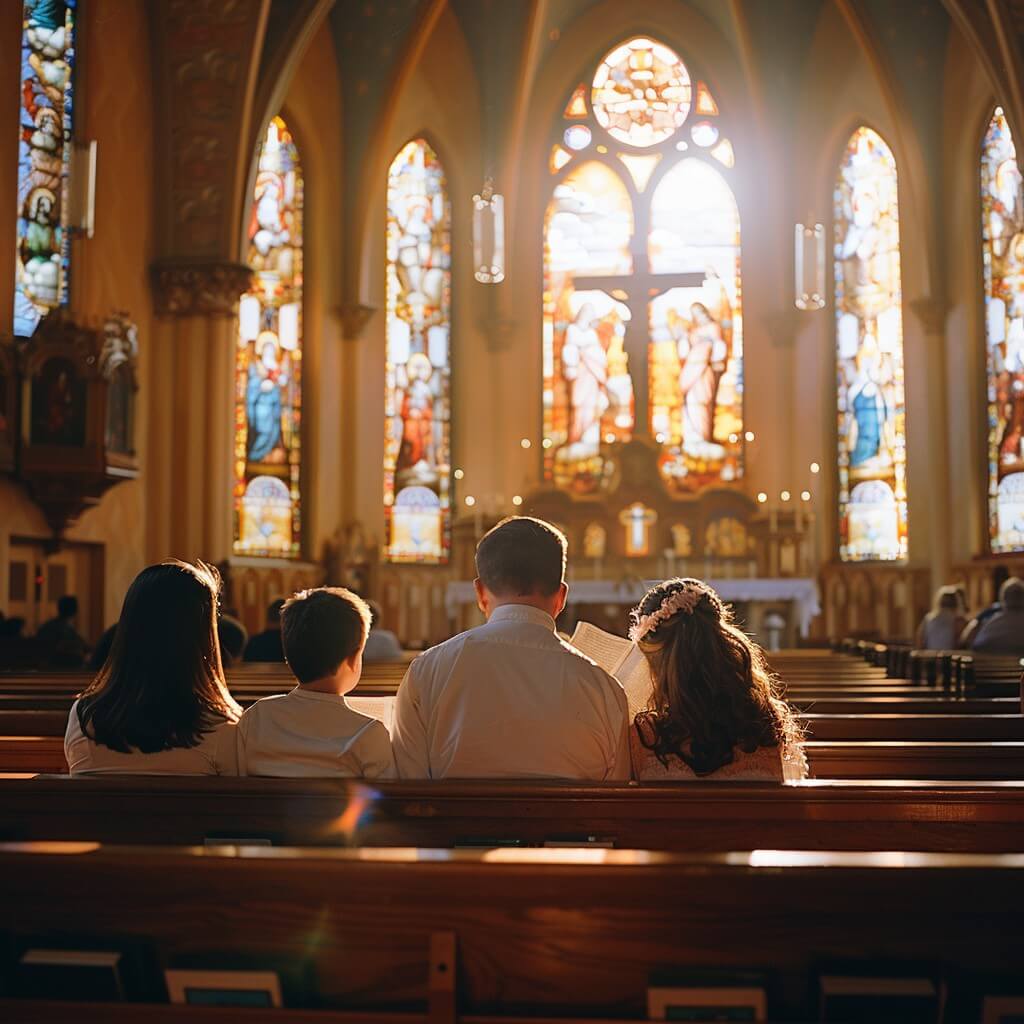

A Sunday prayer is more than a ritual that opens a church service. It is a deliberate turning of the heart toward God at the beginning of the week’s most sacred day. In my experience, the quality of a Sunday is shaped significantly by how it begins: whether I rush into it distracted or pause to pray before anything else happens.
84 percent of Christians believe prayer is essential for personal peace, according to Pew Research. And 60 percent of people who pray regularly report a greater sense of spiritual fulfillment, according to Barna Group. Sunday is the natural anchor point for that practice: the day set apart, the day that reorients everything that follows.
This guide offers specific Sunday prayers, practical guidance for building a prayer atmosphere, and ways to bring family and intentionality into your Sunday worship.
“Sunday prayers are transformative. They are not just a routine, but a sacred moment to invite the divine into our everyday lives.” — Tim Challies, Author
- The Importance of Sunday in Christianity
- Creating an Atmosphere for Prayer
- Seven Empowering Sunday Prayers
- Incorporating Sunday Prayer into Family Worship
- The Role of Intentionality in Prayer
- Scriptural Inspirations for Sunday Prayers
-
Frequently Asked Questions
- What is a good Sunday morning prayer?
- How can I pray as a family on Sundays?
- What are the benefits of Sunday prayers?
- Why is Sunday referred to as the Lord's Day?
- Can I use the same prayer every Sunday?
- How can I include scripture in my Sunday prayers?
- Are there specific prayers for difficult weeks?
- What should I pray for on Sundays?
- Conclusion: Embracing Sunday Through Prayer
- The Importance of Sunday in Christianity
- Creating an Atmosphere for Prayer
- Seven Empowering Sunday Prayers
- Incorporating Sunday Prayer into Family Worship
- The Role of Intentionality in Prayer
- Scriptural Inspirations for Sunday Prayers
-
Frequently Asked Questions
- What is a good Sunday morning prayer?
- How can I pray as a family on Sundays?
- What are the benefits of Sunday prayers?
- Why is Sunday referred to as the Lord's Day?
- Can I use the same prayer every Sunday?
- How can I include scripture in my Sunday prayers?
- Are there specific prayers for difficult weeks?
- What should I pray for on Sundays?
- Conclusion: Embracing Sunday Through Prayer
The Importance of Sunday in Christianity
Biblical Foundations of Sunday Worship
Why do Christians gather on Sunday specifically? The answer goes back to the resurrection. Every Gospel account places the resurrection of Jesus on the first day of the week, and the early church began meeting on that day to commemorate it. Acts 20:7 describes the disciples gathering on the first day to break bread. Revelation 1:10 refers to John being in the Spirit on the Lord’s Day. Sunday became not just a day of rest but a day of resurrection celebration.
The transition from the Jewish Sabbath on Saturday to Sunday worship was not arbitrary. It was a theological statement: the resurrection inaugurated a new creation, and Christians gather on its anniversary every week.
Modern Christian Practices
Today, Sunday worship takes many forms across traditions, from high liturgical services in cathedrals to informal gatherings in living rooms. What unifies them is the intention: to orient the day and the week around the worship of God rather than around productivity or leisure. Sunday prayer is the most personal expression of that orientation.
For those who want to build a richer prayer life that extends beyond Sunday, effective church prayer offers a practical guide to developing prayer habits that sustain spiritual vitality across the full week.
Spiritual Renewal Through Sunday
Churches with a strong prayer life see a 50 percent increase in attendance and participation, according to Christianity Today. But the deeper benefit of Sunday prayer is not institutional. It is personal: the person who prays on Sunday morning arrives at whatever comes next, the service, the family lunch, the difficult conversation, with a different quality of presence than the one who did not.
“The steadfast love of the Lord never ceases; His mercies never come to an end; they are new every morning.” — Lamentations 3:22
Creating an Atmosphere for Prayer
Designing Your Prayer Corner
Where you pray shapes how you pray. A physical space designated for prayer, even a simple chair by a window, a table with a candle, a corner of the bedroom, communicates to the body and mind that this time is different. It reduces the friction between intention and action.
The space does not need to be elaborate. What it needs is consistency: the same place, the same time, the same posture of welcome. Over time, arriving in that space triggers a shift in attention that becomes its own form of preparation.
The Role of Music in Worship
Music opens dimensions of the heart that spoken words sometimes cannot reach. Before or during Sunday prayer, a hymn or a worship song played quietly can dissolve the residue of the week and create interior space for genuine encounter with God. The Psalms were themselves songs, and their emotional range, from lament to ecstatic praise, gives permission for the full spectrum of human experience to enter the prayer space.
Using Scripture for Focus
Beginning a Sunday prayer by reading a single verse and sitting with it before speaking any words of your own is one of the most effective prayer practices I have encountered. For daily sustenance across the week, Bible verses for daily inspiration offers a curated collection worth returning to regularly.
Isaiah 26:3 is one of the most powerful anchors for Sunday morning: “You will keep in perfect peace those whose minds are steadfast, because they trust in you.” Reading it slowly, twice, before praying, centers the mind in the peace that prayer is meant to access rather than the anxiety it is meant to release.
Seven Empowering Sunday Prayers
Prayer for Peace and Calm
Lord, before this day begins in earnest, I bring you the noise inside me. The week that just ended left marks. I release them to you now. You promise perfect peace to those whose minds are fixed on you. Fix mine. Let me enter this Sunday with a quietness of spirit that is not dependent on circumstances but on your presence. Amen.
Prayer for Strength and Guidance
Father, the week ahead holds things I cannot see yet. Decisions I have not made, conversations I have not had, challenges I have not anticipated. I do not need to know what they are. I only need to know you go before me. Give me strength that is not my own and wisdom that exceeds what I can manufacture on my best day. Guide my steps, not just today but all week. Amen.
Prayer for Community and Connection
Lord, today I will gather with others in your name, whether in a building or around a table or over a phone call. Remind me that the person beside me is carrying something I cannot see. Make me genuinely present to the people around me today. Let worship not be something I watch but something I participate in fully. Amen.
Prayer for Family Blessings
God, I pray for the people in my home. For those I love whose faith is strong and for those whose faith is wavering. For the children who do not yet understand what Sunday means and for the adults who have forgotten. Cover this family today. Let what happens in our home today reflect your grace more than our flaws. Amen.
Prayer for Personal Growth
Lord, I want to leave this Sunday different from how I arrived. Not dramatically, necessarily, but genuinely. Show me one thing today: one place I need to grow, one habit that needs to change, one relationship that needs attention. I am willing to hear it. Give me the courage to act on it. Amen.
Prayer for Upcoming Challenges
Father, I name before you what I am dreading this week. I do not want to carry it alone. I give it to you not because I think it will disappear but because carrying it with you is different from carrying it alone. Let your strength be made perfect in my weakness, as Paul discovered. I trust you with this. Amen.
Prayer of Gratitude
1 Thessalonians 5:18 commands: “Give thanks in all circumstances; for this is God’s will for you in Christ Jesus.” In all circumstances, not only the comfortable ones. This Sunday prayer takes that seriously:
Thank you, Lord, for the breath in my lungs this morning. For the fact that I woke up. For whatever is right in my life today, named or unnamed. For the mercy that has followed me through the difficult seasons and the grace that has met me in the good ones. I am grateful. Genuinely, specifically, without performance. Thank you. Amen.
Incorporating Sunday Prayer into Family Worship
Creating a Family Prayer Routine
70 percent of families that include prayer in their weekly rituals report stronger family bonds, according to LifeWay Research. The ritual does not need to be long to be meaningful. Five minutes at the breakfast table, a single verse read aloud, one sentence from each family member about something they are thankful for: these small practices build a shared spiritual language over years that individual, private prayer cannot create alone.
Interactive Prayer Activities for Kids
Children pray best when prayer is concrete and participatory. Ask a child to name one good thing that happened this week and one thing they are hoping for next week, then turn those into a brief prayer together. Give children a candle to hold or a simple action to do while the family prays. Draw a picture of something to be thankful for before Sunday lunch. The form matters less than the consistent message: prayer is something our family does together.
How to Discuss Sunday Themes as a Family
After a church service, one of the most valuable things a family can do is spend ten minutes discussing what they heard. Not evaluating the sermon, but responding to it: what stayed with you, what confused you, what do you want to think more about? This practice transforms Sunday worship from a passive experience into a shared conversation that continues into the week.
The Role of Intentionality in Prayer
Understanding Intentionality in Worship
Prayer without intention tends to wander. Not because God requires a structured agenda, but because the mind that enters prayer without any orientation tends to be pulled back toward the same anxieties and preoccupations it was trying to leave. Setting a brief intention before praying, even just naming the one thing you most want to bring to God today, gives the prayer a center of gravity.
Tips for Setting Intentions
Before praying, spend sixty seconds in silence. Notice what is loudest in your mind. Name it. Then bring it to God deliberately rather than letting it drift in and crowd out everything else. A journal kept near your prayer space where you write one intention each Sunday morning creates a record of your spiritual life over time that becomes its own form of encouragement.
Mindfulness Techniques for Prayer
Breathing slowly and deliberately before speaking any words in prayer is a simple practice that significantly changes the quality of attention available for what follows. Three slow breaths, noticing the exhale, allowing the body to release tension before the mind begins to form words: this is not a spiritual technique separate from prayer but a physical preparation that makes genuine prayer more accessible.
“Prayer is an opportunity to step back, breathe, and reconnect with what matters most in our lives.” — Rich Bitterman, Pastor
Scriptural Inspirations for Sunday Prayers
Key Bible Verses for Sunday
| Scripture | Theme | Application in Prayer |
|---|---|---|
| Isaiah 26:3 | Peace through trust | Anchor for anxious minds before worship |
| Lamentations 3:22-23 | New mercies each morning | Gratitude prayer at the start of the day |
| 1 Thessalonians 5:18 | Thanksgiving in all things | Foundation for gratitude prayer |
| Psalm 118:24 | This is the day the Lord has made | Opening declaration of Sunday worship |
| Matthew 6:33 | Seek first the kingdom | Intention-setting prayer for the week |
| Philippians 4:6-7 | Anxiety replaced by peace | Prayer for those carrying heavy burdens |
| Romans 12:1 | Living sacrifice as worship | Prayer of personal surrender |
The Connection Between Prayer and Scripture
Prayer informed by scripture is more than the sum of its parts. When a verse enters the prayer, it brings the weight of its context: the history of the people who first heard it, the circumstances of its writing, the centuries of believers who have prayed it before. That weight is not a burden; it is an anchor. It connects individual prayer to something much larger than one person’s experience.
Using Scripture as a Reflection Tool
After praying, read the same verse again. Notice whether it lands differently after having prayed. This practice, praying into a verse and then returning to it, is one of the simplest and most consistently fruitful methods of integrating scripture and prayer that I have used and recommended.
Frequently Asked Questions
What is a good Sunday morning prayer?
A good Sunday morning prayer resonates with your personal needs and the particular moment you are in. It does not need to be long or eloquent. It needs to be honest. Begin by naming where you are, what you are carrying, and what you need. Thank God for the week that passed, ask for what the week ahead will require, and arrive at church or at your family table having already oriented your heart toward God rather than waiting for the service to do it for you.
How can I pray as a family on Sundays?
Set a specific time, even five minutes at the breakfast table or before leaving for church. Invite each family member to share one thing they are grateful for and one thing they are hoping for. Turn those into a brief prayer together. Keep it short enough that children do not lose interest and genuine enough that adults do not feel it is a performance. Consistency over months matters more than the quality of any single prayer.
What are the benefits of Sunday prayers?
Sunday prayers reset the spirit at the beginning of the week, create a sense of connection with God that carries into the days ahead, and foster community and family bonding when practiced together. They also contribute to measurable wellbeing: prayer contributes to mental health improvements in 68 percent of participants, according to the American Psychological Association.
Why is Sunday referred to as the Lord’s Day?
Sunday is called the Lord’s Day because it commemorates the resurrection of Jesus Christ, which all four Gospels place on the first day of the week. The early church began gathering on this day specifically to celebrate the resurrection, and the practice has continued across Christian traditions for two thousand years. It is not merely a day of rest but a weekly act of remembrance and celebration.
Can I use the same prayer every Sunday?
Yes, and there is genuine value in repetition. A prayer prayed consistently over months becomes more deeply inhabited over time, its words carrying layers of meaning added by the different circumstances in which you have prayed it. The Lord’s Prayer is itself a model of a repeated prayer that does not become hollow but deepens with use. That said, varying your prayers or adding elements that reflect the specific season of life you are in keeps Sunday prayer from becoming mechanical.
How can I include scripture in my Sunday prayers?
Read a verse before you pray and let it set the direction of your prayer. Pray the verse back to God in your own words. After praying, return to the verse and notice what has shifted. Keep a short list of verses that have been particularly meaningful in your prayer life and return to them on Sundays when you are not sure where to begin.
Are there specific prayers for difficult weeks?
Yes. The prayers for strength and guidance and for upcoming challenges in this guide are specifically designed for those weeks. The Psalms are also the richest biblical resource for praying through difficulty: Psalm 22, 46, 63, 88, and 121 all address different forms of hardship with honesty and faith held together.
What should I pray for on Sundays?
Pray for whatever is most alive in you: peace if you are anxious, gratitude if you have just experienced blessing, strength if you are facing something difficult, guidance if you are at a decision point, and connection if you feel isolated. Sunday prayer is not a formal agenda to be completed. It is a conversation to be entered honestly, with whatever is actually true about your life today.
Conclusion: Embracing Sunday Through Prayer
Summary of Key Points
Sunday prayer is not one thing. It is a daily orientation, a family practice, a scriptural encounter, a personal surrender, and a communal act of remembrance, all held together in the one day the church has always called the Lord’s Day. The prayers in this guide are starting points, not scripts. Use what resonates and make it your own.
Moving Forward with Prayer
The most important thing about Sunday prayer is not how eloquent it is but how consistent. A brief, honest, weekly prayer practiced across years produces a depth of spiritual life that occasional elaborate prayers cannot match. Begin this Sunday with five minutes before anything else happens. Name what you are carrying. Thank God for what is good. Ask for what the week will require. That is enough.
Engaging Others in Prayer
Prayer increases feelings of community and belonging by 75 percent among churchgoers, according to Gallup. The Sunday prayer you share with another person, whether a spouse, a child, a friend, or a congregation, does not only benefit you. It builds something between you that private prayer alone cannot create. Share a prayer this Sunday. Invite someone into yours.
Try ChMeetings Today to manage your congregation’s events, communication, and community life so that more of your Sunday is spent in worship and less in administration.