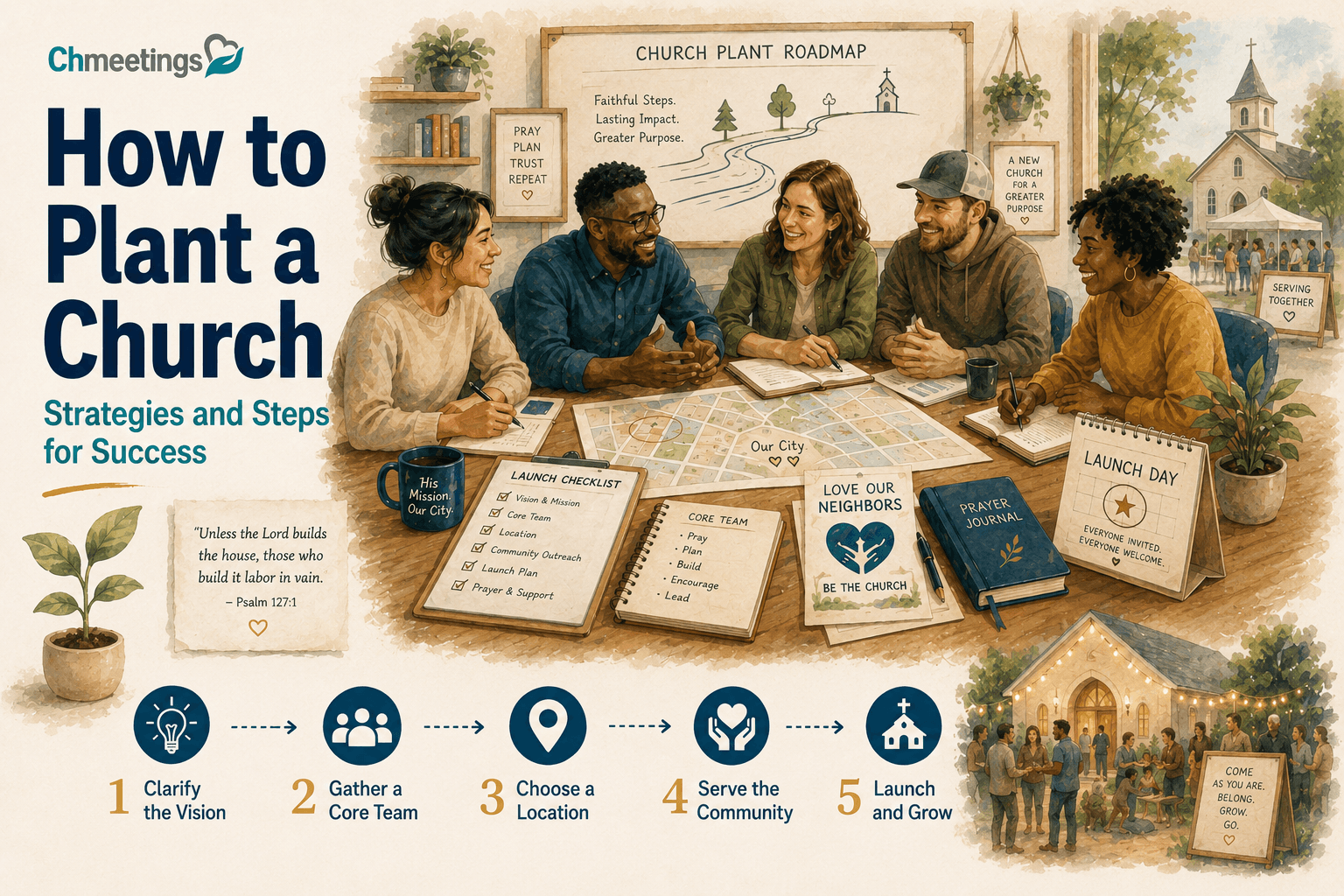

Some church plants flourish, while others fade too soon. The difference often comes down to one thing: how well you plan.
Every church once was a small group of believers with a shared vision. Then it expands into outreach, discipleship, and leadership growth. Planning is the core foundation, because without direction, no organization can stand tall long enough. I have walked alongside enough church plants, some that thrived and a few that struggled, to know that the ones who make it are rarely the ones with the biggest budget. They are the ones who understood the process before they started and stayed consistent once they did.
This guide breaks down how to plant a church the right way, from confirming your calling to measuring real growth once your doors are open. For a broader theological grounding alongside the practical steps here, Logos’ church planting guide is a solid companion resource.
- Understanding the Foundations of Church Planting
- Confirming Your Calling and Vision
- Building Your Team: Key Roles and Responsibilities
- Fundraising for Your Church Plant: Strategies That Work
- Crafting a Sustainable Church Budget
- Community Engagement: Building Your Church's Presence
- Overcoming Common Challenges in Church Planting
- Measuring Success: Growth and Impact Assessment
- FAQs
- Understanding the Foundations of Church Planting
- Confirming Your Calling and Vision
- Building Your Team: Key Roles and Responsibilities
- Fundraising for Your Church Plant: Strategies That Work
- Crafting a Sustainable Church Budget
- Community Engagement: Building Your Church's Presence
- Overcoming Common Challenges in Church Planting
- Measuring Success: Growth and Impact Assessment
- FAQs
Understanding the Foundations of Church Planting
What Is Church Planting?
Church planting refers to the process of starting a new local church, gathering a community of faith that grows beyond a single Sunday service into something self-sustaining. It is not just launching a Sunday gathering. It is building leaders, forming teams, and reaching people who may not otherwise walk into a church at all.
At its core, church planting comes down to a handful of moving parts working together: a clear vision, committed leaders and volunteers, consistent outreach, sound financial planning, and a willingness to be patient. Stay focused on people rather than programs, and the rest tends to follow.
Biblical Basis for Church Planting
Church planting is not a modern invention. It reflects a mandate that runs through the New Testament itself, where the call to reach the unreached is stated plainly:
“The harvest is plentiful, but the laborers are few.” (Matthew 9:37 ESV)
That verse has guided church planters for generations, and it still captures the tension every planter feels early on: there is more need than there are people ready to meet it.
Different Church Planting Models
Not every church plant looks the same, and choosing a model early helps you build a team and budget that actually fits your context.
| Model | Description | Best For | Example Approach |
|---|---|---|---|
| Mother-Daughter | An established church sponsors and launches a new congregation | Planters with denominational or church backing | Parent church provides staff, funding, and initial members |
| Parachute Drop | A planter moves into an unfamiliar community with no existing base | Planters with a strong sense of calling to a specific region | Starts from personal relationships and slow, organic growth |
| House Church Network | Small, multiplying home gatherings rather than one central building | Planters prioritizing low overhead and close community | Groups multiply as they grow past a comfortable size |
| Multi-Site Launch | An existing church opens an additional campus | Churches with proven systems wanting to reach new areas | Shared leadership and resources across locations |
Each model has real trade-offs. Mother-daughter plants launch with more support but less independence early on. Parachute drops offer full ownership of vision but demand more patience before any momentum builds.
Confirming Your Calling and Vision
Recognizing Your Calling
Before anything else, sit with the honest question of why you want to plant a church. Calling is not just enthusiasm. It shows up as a persistent conviction that holds up under pressure, prayer, and honest conversations with people who know you well. Talk to mentors, other planters, and your own family before you commit, since planting affects everyone close to you, not just you.
Crafting Your Mission Statement
A mission statement should say clearly who you want to reach and what your church believes, without vague language that could describe any church anywhere. Keep it short enough that your whole team can repeat it from memory. That clarity matters more later than it seems to at the start, since it becomes the filter for every decision about programs, hires, and partnerships.
The value of getting this right is not just anecdotal. The majority of church planters, 86% in one recent survey, recommend establishing a clear mission statement before doing much else, and that recommendation lines up with what I have seen firsthand. Plants with a fuzzy mission tend to drift into whatever is easiest rather than what they were actually called to do.
Vision vs. Mission: What’s the Difference?
Mission describes what your church does. Vision describes what it is moving toward. A mission statement might focus on making disciples in a specific neighborhood, while a vision might describe what that neighborhood looks like in ten years because of your church’s presence. Both matter, and confusing the two tends to leave a team clear on daily tasks but unclear on the bigger picture they are working toward.
Building Your Team: Key Roles and Responsibilities
Who Do You Need on Your Team?
Appoint leaders as early as possible, ideally people with different strengths rather than several people who think alike. A healthy early team usually covers teaching, worship, community outreach, and administration. You do not need all of these to be paid staff. Many strong church plants run almost entirely on volunteers in the first year or two.
Defining Roles and Responsibilities
Vague roles create friction fast. Write down who owns what, even in a simple shared document, so responsibilities do not quietly fall through the cracks or duplicate between two people who both assumed someone else had it covered.
Cultivating a Supportive Team Culture
Regular meetings and shared workload keep a church plant steady and prevent burnout, which is one of the quieter risks in the early years. Planting is demanding in ways that are hard to explain to someone who has not done it. One anonymous planter described the emotional weight of the role bluntly:
“Being a pastor is like death by a thousand paper cuts. You’re scrutinized and criticized from top to bottom, stem to stern.”
That honesty matters, and it is worth reading the full context in Acts 29’s list of things every church planter should know before you assume the hardest parts of the role will be obvious going in. A team culture built on support, not just productivity, is what keeps leaders from burning out before the church ever finds its footing.
Fundraising for Your Church Plant: Strategies That Work
Diverse Funding Sources
Do not rely on a single funding stream. Individual donations, denominational or network grants, and crowdfunding campaigns each carry different risks and different timelines, and combining them gives your plant more stability than betting everything on one source.
Building a Fundraising Plan
Outline expected costs and revenue sources before you ask anyone for money. A fundraising roadmap with specific milestones, not just a general appeal, gives potential donors confidence that their gift is going toward something concrete rather than an open-ended need.
Using Online Platforms for Fundraising
Digital giving platforms make it far easier for supporters outside your immediate circle to contribute consistently. Set up recurring giving options early, since a small group of monthly donors tends to provide more predictable support than a larger group of one-time givers.
Crafting a Sustainable Church Budget
Essential Budget Components
Write down your launch expenses, rent, and staffing costs before you spend on anything else. These core numbers form the floor your entire first-year budget needs to sit on. If you have not yet handled the legal and financial setup, such as incorporation or tax-exempt status, Foundation Group’s guide to planting a church walks through those requirements in detail.
Budgeting for Growth
A budget built only for your launch size will need revisiting quickly if your plant grows the way you hope. Build in some flexibility from the start rather than treating every early budget as fixed.
Monitoring and Adjusting Your Budget
Track giving from day one and use simple software for budgeting and reporting rather than a spreadsheet that gets forgotten after a few months. A clear financial plan is one of the few real guarantees that your church will still be functioning well after the first year. It is also worth saying plainly that this work is not glamorous. Calvary Chapel leadership put the bigger picture well:
“Never forget that Christ is the head of the Church. We are simply working for Him on his mission to seek and save the lost.”
Budgeting is administrative, but it exists to support a mission that is not.
Community Engagement: Building Your Church’s Presence
Why Community Engagement Matters
A church plant that only talks to itself will struggle to grow. Having an effective growth strategy for church planting means knowing the people you are trying to reach on a genuinely personal level, not as an abstract demographic. Talk to people directly, visit local spots, and learn what is actually missing in the neighborhood before designing programs around assumptions.
Ideas for Community Involvement
A few outreach approaches consistently work well for new plants:
- Visit homes and meet people face-to-face
- Organize local events or community drives
- Use social media to share updates and build familiarity before people ever visit
- Start small groups where people can connect outside of a Sunday service
- Follow up personally after every visit or event
Creating Partnerships with Local Organizations
Partnering with local nonprofits, schools, or community groups extends your reach without requiring you to build every program from scratch. These partnerships also tend to build trust faster than direct outreach alone, since you are showing up as a genuine contributor to the community rather than only as a church trying to grow its numbers.
The payoff for this kind of investment is measurable. Research shows that churches engaged in community service see a 30% increase in attendance, and churches planted with an emphasis on community engagement grow 40% faster than those that do not prioritize it. That is a significant enough gap that community engagement should never be treated as optional or secondary to Sunday programming.
Overcoming Common Challenges in Church Planting
Typical Challenges in Church Planting
Funding, attracting members, and building a stable team are the three challenges nearly every planter faces at some point. None of them are signs you made a mistake. They are simply part of the process. It helps to know the numbers going in. Around 70% of church planters report feeling overwhelmed and unsure of their next steps, and over 50% of new church plants do not make it past the first five years. Neither statistic should discourage you from planting. They should push you toward better planning and real support before you start.
Cultivating Resilience
Resilience in church planting looks less like grit and more like consistency through seasons that feel slow or discouraging. Keep showing up to the same relationships and the same rhythms even when growth is not visible yet. Growth in a church plant is rarely linear, and expecting steady, visible progress every month sets planters up for unnecessary discouragement.
Finding Mentorship and Support
Seek out experienced planters who have already navigated the specific challenges you are facing. Mentorship does not need to be formal. A regular call with someone a few years ahead of you in the process can save you from repeating avoidable mistakes.
Measuring Success: Growth and Impact Assessment
What Does Success Look Like?
Success in church planting is not only attendance numbers, though those matter. It also includes discipleship depth, volunteer engagement, and whether your church is genuinely meeting needs in its community rather than just gathering a crowd.
Tools to Measure Engagement
Track attendance, new guests, giving, volunteer hours, and group growth on a weekly basis so trends are visible early rather than after a problem has already taken hold. This is where the right software gives you everything required to manage your church efficiently, instead of juggling spreadsheets across several disconnected tools.
Platforms built specifically for churches, and suitable for small budgets, let you schedule volunteers, track attendance, manage small groups, and generate giving reports from one place. Affordable platforms like ChMeetings keep you organized while you focus your energy on people rather than administrative overhead.
Evaluating Community Impact
Beyond internal metrics, ask whether your presence is changing anything in the surrounding neighborhood. Fewer families in crisis without support, stronger relationships between neighbors, and visible partnerships with local organizations are all signs your church is having an impact that goes beyond its own attendance count.
FAQs
What are the first steps to take in planting a church?
The first steps include confirming your calling, developing a clear mission statement, and assembling a core team. Begin with prayer and seek guidance from experienced church planters to build a solid foundation before you launch anything publicly.
How do I fund a church plant?
Funding typically combines individual donations, crowdfunding, and grants from larger church organizations or denominations. Build a diverse fundraising plan that outlines your expected costs and revenue sources rather than relying on a single funding stream.
What challenges should I expect when starting a church?
Common challenges include securing funding, attracting members, and building a stable team. Every church plant is different, so staying adaptable and seeking mentorship from experienced planters is one of the most effective ways to navigate these obstacles.
Why is community engagement important for a church?
Community engagement lets a church build real relationships, establish trust, and meet genuine local needs. That combination creates a sense of belonging that supports both growth and long-term sustainability far more than outreach efforts done in isolation.
How can I measure the success of my church plant?
Measuring success means setting clear metrics around growth, engagement, and community impact, then reviewing them regularly rather than only at the end of the year. Consistent evaluation helps ensure your church stays aligned with its original mission as it grows.