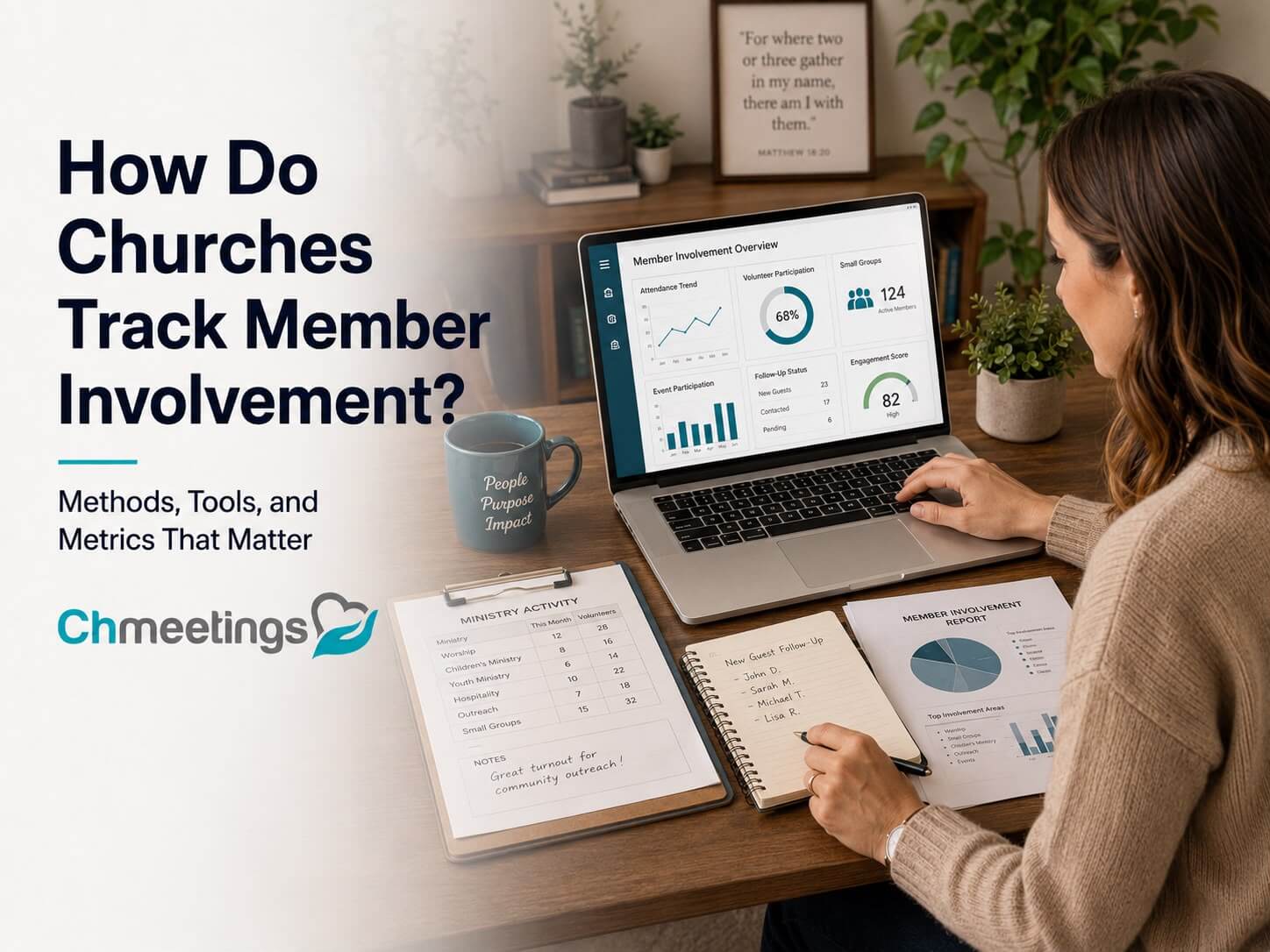

I have spent a good chunk of my career inside church operations, and one question comes up in almost every conversation with ministry leaders: how do churches track member involvement without turning church into something that feels like a spreadsheet? The honest answer is that tracking, done well, is not about surveillance. It is about knowing who is connected, who is drifting, and where to invest time and resources.
Here is what I have seen work, and where churches tend to get tripped up.
- The Need for Tracking Church Member Involvement
- Methods of Tracking Church Attendance
- Using Church Management Software (ChMS)
- Data-Driven Insights: The Metrics that Matter
- Challenges in Tracking Member Involvement
- Emerging Trends in Church Member Tracking
- Conclusion: Creating a Culture of Engagement
- Frequently Asked Questions
- The Need for Tracking Church Member Involvement
- Methods of Tracking Church Attendance
- Using Church Management Software (ChMS)
- Data-Driven Insights: The Metrics that Matter
- Challenges in Tracking Member Involvement
- Emerging Trends in Church Member Tracking
- Conclusion: Creating a Culture of Engagement
- Frequently Asked Questions
The Need for Tracking Church Member Involvement
Tracking exists for one reason: churches cannot serve people they cannot see. If a member stops showing up to a small group or stops volunteering, tracking is what surfaces that shift early enough to do something about it.
Importance for Church Growth
Growth is not just new visitors. It is existing members staying engaged. Lifeway Research has found that 71% of Protestant pastors believe there are ways to measure discipleship in a local church, yet only 30% of churches actually have specific methods in place for doing so. That gap between belief and practice is where most churches lose ground.
Effective Resource Management
Tracking tells a church where to put its budget and volunteer hours. A ministry with declining attendance does not need more marketing. It usually needs a direct conversation with the people who stopped showing up.
Building Community Connections
As Lifeway Research has noted, church leaders often struggle to measure true engagement beyond attendance averages. I have seen this firsthand. A packed sanctuary can still hide a congregation full of people nobody actually knows well.
Methods of Tracking Church Attendance
There is no single right way to track attendance. Most churches use a mix of methods depending on their size and comfort with technology.
Manual Counting Techniques
Head counts and sign-in sheets are still common, especially in smaller churches. According to the Baptist Convention of Iowa, only about 10% of churches in America keep any form of metric-based tracking at all, which tells me most churches are still relying on rough estimates rather than real data.
Digital Attendance Solutions
Check-in kiosks, QR codes, and mobile apps have made digital tracking far more accessible than it was even a few years ago. These tools remove the guesswork from manual counting and create a record a church can actually analyze over time.
Biometric Tracking Systems
Biometric check-in exists but remains rare in churches, mostly because it raises legitimate privacy questions. I would only recommend it for very large churches with a clear, transparent policy around how the data is used.
As Thom Rainer of the Baptist Convention of Iowa has put it, keeping metric-based records is often dismissed as impractical, even though those records hold real insight for church leadership.
Using Church Management Software (ChMS)
Church Management Software has become the backbone of member tracking for most mid-sized and larger churches I have worked with.
Overview of Popular ChMS
Modern ChMS platforms handle attendance, giving, volunteer scheduling, and communication in one system, replacing the patchwork of spreadsheets and paper forms many churches used a decade ago.
Key Features to Look For
| Feature Category | What to Look For |
|---|---|
| Attendance Tracking | Check-in options, historical trend reports |
| Volunteer Management | Scheduling, role assignment, availability tracking |
| Membership Records | Centralized profiles, family linking, contact history |
| Giving Integration | Online giving tied directly to member records |
| Communication Tools | Email, SMS, and group messaging built in |
Integration with Online Services
The most useful ChMS platforms sync attendance and engagement data with online giving and event registration, so a church gets one full picture of involvement instead of separate, disconnected data sets. Try ChMeetings Today if you are looking for a platform built to bring these pieces together in one place.
Data-Driven Insights: The Metrics that Matter
Not every metric is worth tracking. The ones that matter are the ones tied directly to whether people are staying connected.
The Importance of Attendance Consistency
Attendance consistency is closely linked to effective assimilation, meaning members who attend regularly are far more likely to stay engaged long term than members who attend sporadically. Consistency, not raw headcount, is the number worth watching closely.
Measuring Volunteer Participation
Volunteer participation rates reveal ownership. A member who volunteers regularly is almost always more connected to a church than one who only attends services.
Connecting Financial Trends to Engagement
Giving patterns often shift before attendance does. A member whose giving quietly drops off is frequently signaling disengagement well before they stop showing up.
As Ministry Brands has put it, today’s churches need metrics that reflect not just how many people show up, but how deeply they are connected. That shift in mindset, from headcounts to relational depth, is the biggest change I have seen in how churches approach tracking over the past few years. Essential church metrics to track offers a good breakdown of which numbers actually matter.
Challenges in Tracking Member Involvement
Tracking sounds simple until a church actually tries to implement it consistently.
Addressing Privacy Concerns
Members are often wary of being tracked, particularly with digital or biometric tools. Transparency about what is collected and why goes a long way toward easing that concern.
Overcoming Resistance from Members
Some members will resist any form of tracking on principle. I have found that framing tracking as a way to notice when someone is struggling, rather than as surveillance, changes the conversation significantly.
Essential Training for Staff
Even the best ChMS platform fails if staff are not trained to actually use it. Ongoing, hands-on training matters more than the software itself in most cases I have seen.
Emerging Trends in Church Member Tracking
Tracking is evolving quickly, and churches that stay current tend to get more value out of their data.
Mobile Apps for Real-Time Engagement
Mobile apps now allow members to check in, register for events, and give, all from their phones, which gives churches real-time data instead of data that trickles in weeks later.
AI and Predictive Analytics in Churches
Predictive analytics is still new in church settings, but it is starting to help identify members at risk of disengaging before they actually stop attending.
Social Media as an Engagement Tool
Social media engagement, likes, shares, and comments, is becoming a supplementary signal of involvement, particularly for younger members who may engage online more than in person.
Ministry Brands has reported that in 2026, churches are focusing more on hybrid and relational engagement rather than attendance alone, which matches what I am seeing across the churches I work with. Deep dive into church metrics and Creative methods for measuring attendance are both worth reading for a fuller picture of where tracking is headed.
Conclusion: Creating a Culture of Engagement
Synergizing Metrics with Engagement Strategies
Tracking only matters if it changes how a church actually engages people. Data without action is just noise.
Building a Community Through Insights
The churches that use tracking well are the ones that treat the data as a conversation starter, not a final judgment on any one member.
Encouraging Participation and Involvement
Ultimately, how churches track member involvement should always circle back to one goal: helping more people feel genuinely known and connected, not just counted.
Frequently Asked Questions
What are the best tools to track church member involvement?
The best tools are Church Management Software platforms that combine attendance tracking, membership databases, and volunteer management in one system, such as ChMeetings, which lets churches see engagement across every touchpoint instead of piecing data together manually.
How can churches improve member engagement?
Churches improve engagement by tracking attendance patterns consistently, personalizing communication based on that data, and creating regular volunteer and small group opportunities that give members a reason to stay connected.
What metrics should churches track for member involvement?
Key metrics include attendance consistency, volunteer participation rates, giving trends, and small group involvement. Together, these give a far more complete picture of engagement than attendance numbers alone.
Why is measuring church engagement important?
Measuring engagement helps churches spot disengagement early, allocate resources where they are actually needed, and make ministry decisions based on real patterns rather than assumptions.
Are biometric systems effective for tracking attendance?
Biometric systems can be accurate and convenient, but they raise real privacy concerns. Churches considering them should have a clear, transparent policy and make sure congregants are genuinely comfortable with the method before rolling it out.