

I have spent years inside church operations, and if there is one thing that quietly burns out staff and volunteers faster than anything else, it is disorganized recurring events. A weekly small group, a monthly outreach dinner, a quarterly baptism service, each one seems manageable on its own. Multiply that across a full calendar year, and most churches are managing far more moving parts than they realize.
This guide walks through what actually works, based on what I have seen succeed and fail across different church sizes and event types.
- Understanding the Landscape of Church Events
- The Importance of Centralized Event Management
- Leveraging Technology for Scheduling and Management
- Volunteer Management: Maximizing Contributions
- Engaging the Congregation: Strategies for Encouragement
- Measuring Success: KPIs for Church Events
-
FAQs on Managing Recurring Church Events
- What are the best tools for managing recurring church events?
- How can I increase volunteer participation in church events?
- What strategies improve communication about church events?
- Why is centralizing event management important?
- How often should I evaluate the effectiveness of church events?
- Can technology really enhance participation in church events?
- What are key performance indicators (KPIs) for church events?
- Understanding the Landscape of Church Events
- The Importance of Centralized Event Management
- Leveraging Technology for Scheduling and Management
- Volunteer Management: Maximizing Contributions
- Engaging the Congregation: Strategies for Encouragement
- Measuring Success: KPIs for Church Events
-
FAQs on Managing Recurring Church Events
- What are the best tools for managing recurring church events?
- How can I increase volunteer participation in church events?
- What strategies improve communication about church events?
- Why is centralizing event management important?
- How often should I evaluate the effectiveness of church events?
- Can technology really enhance participation in church events?
- What are key performance indicators (KPIs) for church events?
Understanding the Landscape of Church Events
Before fixing anything, it helps to understand the actual scale of what most churches are managing.
Types of Church Events
Church events generally fall into two buckets: recurring events like weekly services, small groups, and monthly outreach programs, and special events like conferences, baptisms, or holiday services. Recurring events demand a different kind of management because the same logistics repeat over and over, which means small inefficiencies compound quickly.
Significance for Community Engagement
Well-run recurring events are often what actually keep a congregation connected week to week, far more than any single big event. A member who reliably shows up to a Tuesday night group is usually more engaged than one who only attends an annual conference.
Recurrence and Member Participation Rates
The scale here surprises most people I talk to. According to Smart Church Solutions, most churches create about 640 unique events annually, which adds up to more than 2,000 total occurrences each year once recurrence is factored in. As Nathan Parr of Smart Church Solutions has put it, managing church events efficiently becomes more vital than ever once a church is generating that many unique events. That volume alone explains why so many churches eventually outgrow manual, ad hoc event planning.
The Importance of Centralized Event Management
Centralization is the single biggest shift I have seen turn chaotic event calendars into manageable ones.
Defining Centralized Management
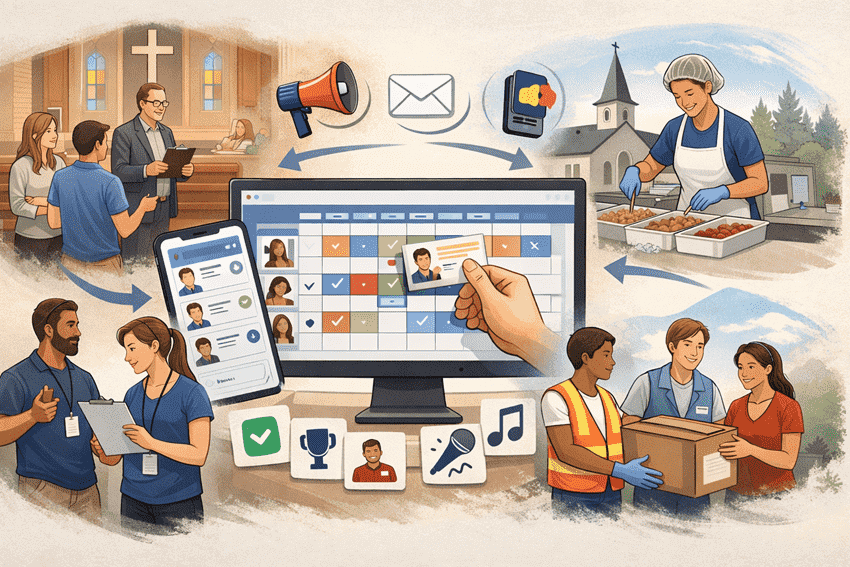
Centralized event management means every event, recurring or one-off, lives in a single system that staff, volunteers, and often members can see. It replaces the scattered mix of group texts, personal calendars, and paper sign-up sheets that most churches start out with.
Benefits in Communication
Miscommunication is the most common reason recurring events fall apart. Someone books the fellowship hall for two different events on the same night, or a volunteer shows up expecting a different setup than what was planned. A centralized calendar removes most of that friction by giving everyone one source of truth.
Integrating Technology Solutions
Centralized management works best when it connects directly to a church’s broader management system, so event data, attendance, and volunteer scheduling are not living in separate, disconnected tools. Churches leveraging centralized event management can see meaningfully fewer administrative errors, though the exact figures vary by church size and setup.
Leveraging Technology for Scheduling and Management
Technology is where most of the practical gains happen, but only when a church picks tools that match its actual needs.
Essential Features to Look For
The core features worth prioritizing are calendar syncing, automated reminders, online registration, and volunteer scheduling. Anything beyond that is a nice-to-have rather than a necessity for most churches.
Comparing Popular Tools
| Tool Category | Best For | Key Strength |
|---|---|---|
| Full ChMS platforms | Churches wanting one integrated system | Combines events, attendance, and volunteer data |
| Dedicated scheduling tools | Volunteer sign-ups and shift coverage | Simple, focused sign-up workflows |
| Registration platforms | Ticketed or RSVP-based events | Streamlined online registration |
Try ChMeetings Today if your church is looking for a single platform that brings event scheduling, volunteer management, and attendance tracking together rather than juggling separate tools.
Case Studies of Successful Implementations
A mid-sized church I worked with consolidated five separate sign-up sheets into one centralized scheduling tool. Within two months, volunteer no-shows dropped noticeably, mostly because reminders were finally automated instead of relying on someone remembering to send a text. Some industry sources suggest automated reminder systems can meaningfully boost attendance, though results tend to vary depending on how consistently a church uses them. As one source from Pushpay puts it, automated reminders have been linked to a real increase in event participation among churches that implement them consistently.
Volunteer Management: Maximizing Contributions
Volunteers are the actual infrastructure behind most recurring church events, and volunteer burnout is one of the most underdiscussed risks in event planning.
Effective Recruitment Strategies
The churches that recruit volunteers most successfully make the ask specific. “We need three people to help with setup on Sunday mornings” recruits far better than a general call for volunteers.
Role Mapping and Responsibilities
Mapping out exactly who is responsible for what, setup, greeting, teardown, cleanup, prevents the common problem where everyone assumes someone else has a task covered. Clear role mapping is also one of the more effective ways to reduce volunteer burnout over time.
As the SignUpGenius team has put it, burnout in church volunteerism is almost always a distribution problem rather than an enthusiasm problem, since most congregations actually have more willing volunteers than they realize, they just lack a visible, low-friction way to get involved. That framing changed how I approach volunteer recruitment entirely. Instead of assuming a shortage, I now start by asking whether the sign-up process itself is the actual barrier.
Training and Communication Best Practices
Short, role-specific training beats long general orientations. A volunteer who knows exactly what their role looks like for one specific event type performs better than one given a broad overview of everything.
For more on structuring this well, Manage Church Volunteers and Events in One Place is a useful resource on building sustainable volunteer systems.
Engaging the Congregation: Strategies for Encouragement
Even a perfectly organized event fails if nobody shows up, which makes promotion and feedback just as important as logistics.
Promotional Strategies
Multi-channel promotion, combining bulletin announcements, social media, email, and verbal mentions from the platform, consistently outperforms relying on any single channel alone.
Incorporating Feedback from Members
Asking a small group of regular attendees what worked and what did not after each recurring event creates a feedback loop that steadily improves future events without requiring a formal survey process every time.
Spiritual and Community Benefits
Recurring events succeed longest when they are tied to a clear spiritual or relational purpose, not just logistics. A weekly gathering that consistently reinforces why it matters tends to retain participants far longer than one that runs purely on habit.
Measuring Success: KPIs for Church Events
Managing events well eventually requires knowing whether they are actually working.
Setting Objectives
Every recurring event should have one or two clear objectives defined in advance, whether that is consistent attendance, new visitor conversion, or volunteer engagement. Without a defined objective, it is nearly impossible to judge whether an event succeeded.
Tracking Attendance and Engagement
Attendance trends over time matter more than any single week’s numbers. Some churches also track secondary engagement metrics such as volunteer sign-up rates and feedback scores tied to specific events. Churches using dedicated tech tools for event management often report improved engagement metrics, though the actual scale of that improvement depends heavily on how consistently the tools are used.
Adjusting Strategies Based on Data
The churches that improve fastest treat each recurring event as something to review and adjust quarterly, rather than running it the same way indefinitely simply because it has always been done that way.
It is worth noting that recurring donors tied to ongoing events and programs typically contribute more than double what one-time givers do, which is a strong argument for building consistent, well-run recurring programming rather than relying heavily on one-off events. For more detail on this connection, Tithely’s Insights on Recurring Donations and How to Encourage Recurring Donations both dig into the financial side of consistent event programming. For a broader look at how management systems support this kind of growth, The Role of Church Management Systems and Event Software for Churches are both worth reading.
FAQs on Managing Recurring Church Events
What are the best tools for managing recurring church events?
The best tools combine scheduling, volunteer management, and automated reminders in one place. A full church management platform like ChMeetings tends to serve recurring events better than standalone tools, since attendance, volunteers, and communication all stay connected.
How can I increase volunteer participation in church events?
Define roles clearly, offer flexible scheduling options, and make the sign-up process as visible and frictionless as possible. Recognizing volunteer contributions publicly also goes a long way toward keeping people engaged long term.
What strategies improve communication about church events?
Use multiple channels together, bulletin announcements, social media, email, and verbal reminders, rather than relying on just one. Encouraging members to share event details within their own networks extends reach further than official channels alone.
Why is centralizing event management important?
Centralizing event management prevents scheduling conflicts and communication breakdowns by giving everyone involved a single, reliable source of truth for event details and changes.
How often should I evaluate the effectiveness of church events?
Reviewing effectiveness after each occurrence, or at minimum quarterly, gives churches enough data to spot real patterns without overreacting to any single event’s results.
Can technology really enhance participation in church events?
Yes. Tools that simplify registration, automate reminders, and centralize communication tend to reduce the friction that keeps people from showing up, which translates into more consistent participation over time.
What are key performance indicators (KPIs) for church events?
Useful KPIs include attendance trends, volunteer participation rates, feedback scores, and giving connected to specific events. Together, these give a much fuller picture of an event’s impact than attendance numbers alone.