
How do churches onboard new members is a question that reveals something important about a congregation’s actual values, not just its stated ones. In my experience working with churches of different sizes and traditions, the gap between a church that says it values community and a church that actually builds it almost always shows up first in how it treats people in their first thirty days.
Research shows that members who go through a structured onboarding process are 69 percent more likely to stay engaged long-term, according to Checkr. Yet some churches have reported onboarding success rates as low as 20 percent. The difference between those two outcomes is not accidental. It is structural.
This guide covers every stage of effective church member onboarding: what it means, how to create a welcoming environment, how to follow up in ways that actually retain people, how to connect new members to community life, and what mistakes to stop making immediately.
“The first eight minutes dictate whether a visitor will return. You must curate those moments thoughtfully and meticulously.” — MosesTab
- Understanding the Onboarding Process
- Creating a Welcoming Environment
- Personalized Follow-Up Strategies
- Integrating New Members into Community Life
- Ongoing Engagement Techniques
- Avoiding Common Onboarding Mistakes
-
Frequently Asked Questions
- What is the best way to welcome new members to my church?
- How important is follow-up after the first visit?
- What role do small groups play in member onboarding?
- How often should I check in with new members?
- What are common mistakes churches make during onboarding?
- How can I engage volunteers during the onboarding process?
- Conclusion
- Understanding the Onboarding Process
- Creating a Welcoming Environment
- Personalized Follow-Up Strategies
- Integrating New Members into Community Life
- Ongoing Engagement Techniques
- Avoiding Common Onboarding Mistakes
-
Frequently Asked Questions
- What is the best way to welcome new members to my church?
- How important is follow-up after the first visit?
- What role do small groups play in member onboarding?
- How often should I check in with new members?
- What are common mistakes churches make during onboarding?
- How can I engage volunteers during the onboarding process?
- Conclusion
Understanding the Onboarding Process
What is Church Onboarding?
Church onboarding is the intentional process of moving a first-time visitor from initial contact to genuine community membership. It is not a single event or a welcome packet. It is a structured sequence of touchpoints, personal connections, and integration opportunities that unfold over weeks and months after someone first walks through the door.
The phases of onboarding in a church context typically move through initial welcome, personal follow-up, community integration, and ongoing engagement. Each phase has a distinct purpose and requires different tools and people. A church that handles the welcome beautifully but has no follow-up system will lose people at phase two. One that follows up but never connects new members to community life will lose them at phase three.
The Importance of Effective Onboarding
70 percent of new visitors indicate they will return if properly welcomed and followed up with, according to engagement research. That statistic contains an important implication: most first-time visitors are open to returning. What closes that door is not theological disagreement or scheduling conflicts. It is the experience of showing up, feeling unnoticed, and never hearing from anyone afterward.
Effective onboarding matters because it is the primary mechanism through which a church translates its stated values into felt experience for people who are still deciding whether they belong.
Challenges Churches Face in Onboarding
The most consistent challenge I have seen is the absence of a defined system. Well-intentioned churches rely on individuals to remember to follow up, on volunteer greeters who may or may not show up, and on new members to find their own way into community life. When the system is a person rather than a process, the quality of onboarding varies by week and by who is working that Sunday.
77 percent of Protestant pastors report struggling with developing leaders and volunteers, according to Lifeway Research. That same capacity constraint affects onboarding: the churches that struggle most are those trying to run a relational process without the organizational infrastructure to support it consistently.
Creating a Welcoming Environment
The Role of Greeters and Ushers
A greeter’s job is not to hand someone a bulletin. It is to make a person who has never been here before feel that they were expected. That distinction sounds small. It produces entirely different behaviors.
Trained greeters introduce themselves by name, ask the visitor’s name and use it, offer to walk them to their seat or to children’s ministry, and connect them with a point person who can answer questions. Untrained greeters hand a bulletin toward the general direction of a newcomer and return to their conversation.
“If your church’s onboarding fails, efforts to convert visitors into members will likely diminish rapidly. All church leaders need a structured approach to avoid this disaster.” — Nick, Ministry Boost
Signage and Directions for New Visitors
A first-time visitor should be able to find the bathroom, the children’s ministry, the main auditorium, and the welcome desk without asking anyone. Clear, frequent signage communicates that the church was designed with outsiders in mind, not just the people who already know where everything is. The absence of clear signage is one of the most common and most overlooked welcome failures I have observed.
Follow-Up Communications: Timing and Strategies
The ideal follow-up time is within 48 hours after a visitor attends service, according to engagement research. That window is critical because it is when the impression of the visit is still fresh and when a personal contact communicates genuine attention rather than administrative process.
A contact made at 72 hours feels different from one made at 120 hours, which feels different from one made a week later. Each additional day after the visit reduces the impact of the follow-up, and after two weeks without contact, many first-time visitors have already mentally moved on.
Personalized Follow-Up Strategies
Crafting Tailored Messages
Generic follow-up messages are better than no follow-up, but they are significantly less effective than personal ones. A message that references something specific, the name of the service, a theme from the sermon, the ministry area the visitor expressed interest in, communicates that the church was paying attention.
The most effective follow-up I have observed combines a personal handwritten note from the pastor mailed within 48 hours with a phone call from a lay leader within the same window. Neither one alone produces the same effect as both together.
Utilizing Digital Platforms for Connection
Text messages have open rates significantly higher than emails for short, personal follow-up. A brief text within 24 hours, “It was great to meet you on Sunday. We hope to see you again,” communicates warmth at a speed that email cannot match.
Email works better for more substantive follow-up: sharing service recordings, connecting new visitors to group sign-up pages, or providing information about upcoming new member events. The two channels serve different purposes and work best when used together.
The Power of Phone Calls vs. Emails
| Follow-Up Method | Response Rate | Best Use | Timing |
|---|---|---|---|
| Phone call | High | Personal connection, relationship building | Within 48 hours |
| Handwritten note | Very high perceived warmth | First impressions, pastoral touch | Within 48 hours |
| Text message | High open rate | Brief, warm check-in | Within 24 hours |
| Moderate | Detailed information, links, resources | Within 72 hours | |
| No follow-up | Zero | Nothing | Never |
The data is clear: people who receive no communication within a week after their first visit frequently cite it as a reason for not returning. The method matters less than the consistency and the personal quality of the contact.
Integrating New Members into Community Life
Small Groups: A Crucial Link
The transition from Sunday morning visitor to genuine community member almost never happens in the main service. It happens in smaller contexts: a small group, a ministry team, a shared meal, a service project. Sunday attendance is the gateway. Small group membership is the destination.
A new member who is connected to a small group within their first month has an entirely different retention profile than one who attends services consistently but never joins a smaller community. The relationship formed in a group of eight to twelve people creates a pull toward the church that no program or sermon series can replicate.
Volunteer Opportunities for New Members
Volunteering is one of the fastest pathways to genuine community integration because it creates shared purpose, regular contact with the same people, and a sense of belonging that comes from contributing rather than consuming.
The key is matching the opportunity to the person rather than filling a roster with warm bodies. A new member placed in a volunteer role that fits their gifts and schedule within their first thirty days becomes a community owner. One placed in the wrong role or asked to volunteer before they feel ready becomes a dropout.
“I filled out a card 4 weeks ago, but I haven’t heard from anybody. I heard the next meeting to onboard new volunteers isn’t for 3 months when I will be out of town.” — Greg Curtis, Church Community Consultant
That quote represents a system failure, not a people failure. The individual who wanted to volunteer was not the problem. The three-month gap between interest and entry was.
Special Events as Integration Tools
A new member dinner, a church tour, a Q&A with the pastor, a ministry fair where people can explore different service opportunities: these events are not additions to the onboarding process. They are the structured contexts in which integration actually happens. Churches that hold them consistently retain new members at higher rates than those that leave integration to chance.
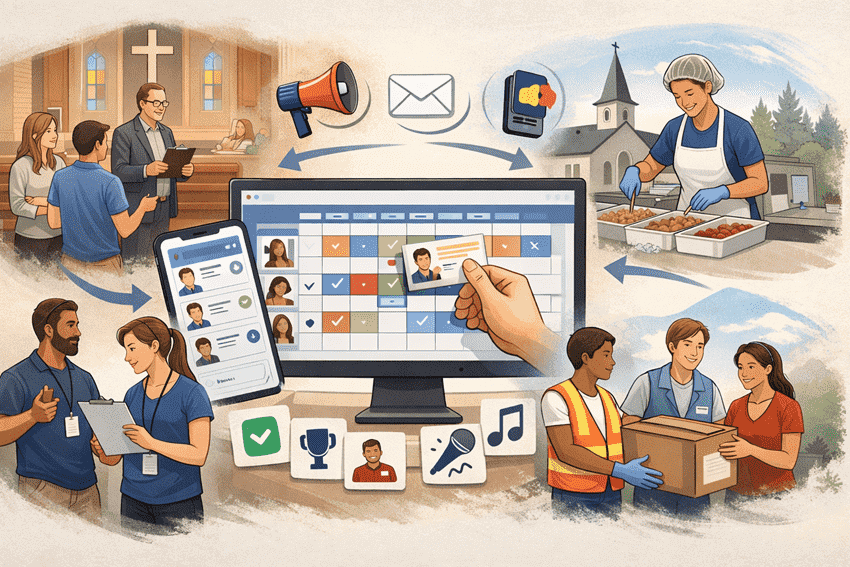
Managing the invitations, registrations, attendance tracking, and follow-up for these events becomes significantly more efficient with a church management platform that connects new member records to event participation in one system. Try ChMeetings Today to see how integrated member management changes the quality and consistency of your onboarding process.
Ongoing Engagement Techniques
Setting Checkpoints: 30, 60, 90 Days
A structured check-in schedule is the difference between an onboarding process and an onboarding event. The 30-day check-in asks whether the new member found a group, attended a follow-up event, and has any questions. The 60-day check-in explores whether they feel connected and whether there are any barriers to deeper involvement. The 90-day check-in assesses whether they have moved from visitor to genuine community member and identifies anyone who has gone quiet.
Each checkpoint is a pastoral care moment disguised as an administrative one. Done well, it communicates sustained attention. Done mechanically, it communicates institutional process. The difference is in whether the person making the contact actually knows the new member’s name, context, and story.
Feedback Mechanisms to Improve the Process
The churches that improve their onboarding most consistently are those that ask new members what the experience was actually like. A simple three-question survey at the 90-day mark, conducted informally over coffee or formally through a digital form, produces the intelligence necessary to refine the process year over year.
Questions worth asking: What made you feel most welcomed? What would have helped you feel more connected sooner? What almost made you not come back?
Continuous Community Building Strategies
Onboarding does not end at 90 days. The habits of connection, belonging, and contribution that a new member develops in their first three months set the trajectory for their entire relationship with the congregation. Churches that invest in ongoing community building, regular small group rhythms, annual ministry fairs, seasonal community events, maintain the relational density that prevents the gradual drift that takes many members from active to lapsed.
Avoiding Common Onboarding Mistakes
Errors to Watch Out For
The most damaging onboarding mistakes are:
- No follow-up within 48 hours. This single failure accounts for more visitor loss than almost anything else.
- Overwhelming newcomers with information. A new member packet that includes seventeen brochures, three DVDs, and a membership covenant does not communicate welcome. It communicates institution.
- Waiting too long to connect new members to a group. The longer the gap between first visit and small group connection, the harder the connection becomes.
- Making integration dependent on the new member’s initiative. The burden of integration should be on the church, not the newcomer.
- No defined owner for the onboarding process. If everyone is responsible, no one is responsible.
The Need for a Consistent Process
Consistency matters more than perfection. A simple, clearly defined onboarding process executed reliably every week produces better outcomes than an elaborate system that depends on specific individuals remembering to act. Document the process. Assign ownership. Review it quarterly and adjust based on what the follow-up data reveals.
Resources to Avoid Pitfalls
The Lifeway Research guide on onboarding and training new volunteers offers six practical essentials that apply equally to member onboarding. The Assimilayas guide on volunteer placement addresses the specific challenge of matching new members to service opportunities in ways that create genuine integration rather than roster-filling.
Frequently Asked Questions
What is the best way to welcome new members to my church?
Welcoming new members begins with training your greeters to make personal contact rather than just handing out bulletins, ensuring clear signage throughout the building, providing a clear and simple next step during the service, and following up personally within 48 hours. The combination of an excellent first impression and a timely personal follow-up contact produces retention rates significantly higher than either element alone.
How important is follow-up after the first visit?
Follow-up is the single most important structural element of church onboarding. Research indicates that 69 percent of properly onboarded members are likely to stay engaged long-term, and 70 percent of first-time visitors will return if properly welcomed and followed up with. The follow-up communicates that the church noticed they were there, values their presence, and wants to continue the relationship.
What role do small groups play in member onboarding?
Small groups are the primary mechanism through which visitors become genuine community members. Sunday attendance creates initial connection. Small group membership creates belonging. A new member who is connected to a small group within their first month has a dramatically different retention profile than one who attends services without joining a smaller community. Making small group connection a specific, intentional step in the onboarding process rather than leaving it to the new member to discover is one of the highest-impact changes a church can make.
How often should I check in with new members?
Regular check-ins at 30, 60, and 90 days provide the structure to catch people who are drifting before they drift completely away. Each checkpoint should be a genuine personal conversation, not a form email, and should assess whether the new member is connected, engaged, and has any unmet needs or unanswered questions. After 90 days, the check-in cadence can reduce to the normal pastoral care rhythms of the congregation.
What are common mistakes churches make during onboarding?
The most common mistakes are failing to follow up within 48 hours of a first visit, overwhelming newcomers with too much information at once, waiting too long to connect new members to a small group or volunteer opportunity, and failing to assign clear ownership of the onboarding process to a specific person or team. Each of these mistakes is structural rather than motivational: the solution is a better process, not more enthusiasm.
How can I engage volunteers during the onboarding process?
Identify volunteer interest early, during the first or second visit, and connect interested new members to the right opportunity within their first month rather than asking them to wait for a quarterly orientation. Match the opportunity to the person’s gifts and availability. Brief them clearly on the role before they begin. Follow up after their first serving experience to ask how it went and whether the fit feels right. Volunteers who are well-placed and well-supported within their first thirty days become long-term community owners.
Conclusion
How churches onboard new members reveals more about their actual culture than almost any other single practice. A church that takes onboarding seriously is a church that believes every person who walks through its doors matters enough to be noticed, followed up with, connected to community, and supported through the transition from visitor to member.
The process does not need to be elaborate. It needs to be consistent, personal, and structured enough to work even when the key people are away on a given Sunday. Start with the 48-hour follow-up. Add a new member event. Build toward small group connection within the first month. Review the process at 90 days. Adjust based on what you learn.
The investment in getting onboarding right pays back in retention, in community depth, and in the quiet satisfaction of knowing that fewer people are slipping through the cracks of a congregation that genuinely cares whether they stay.