
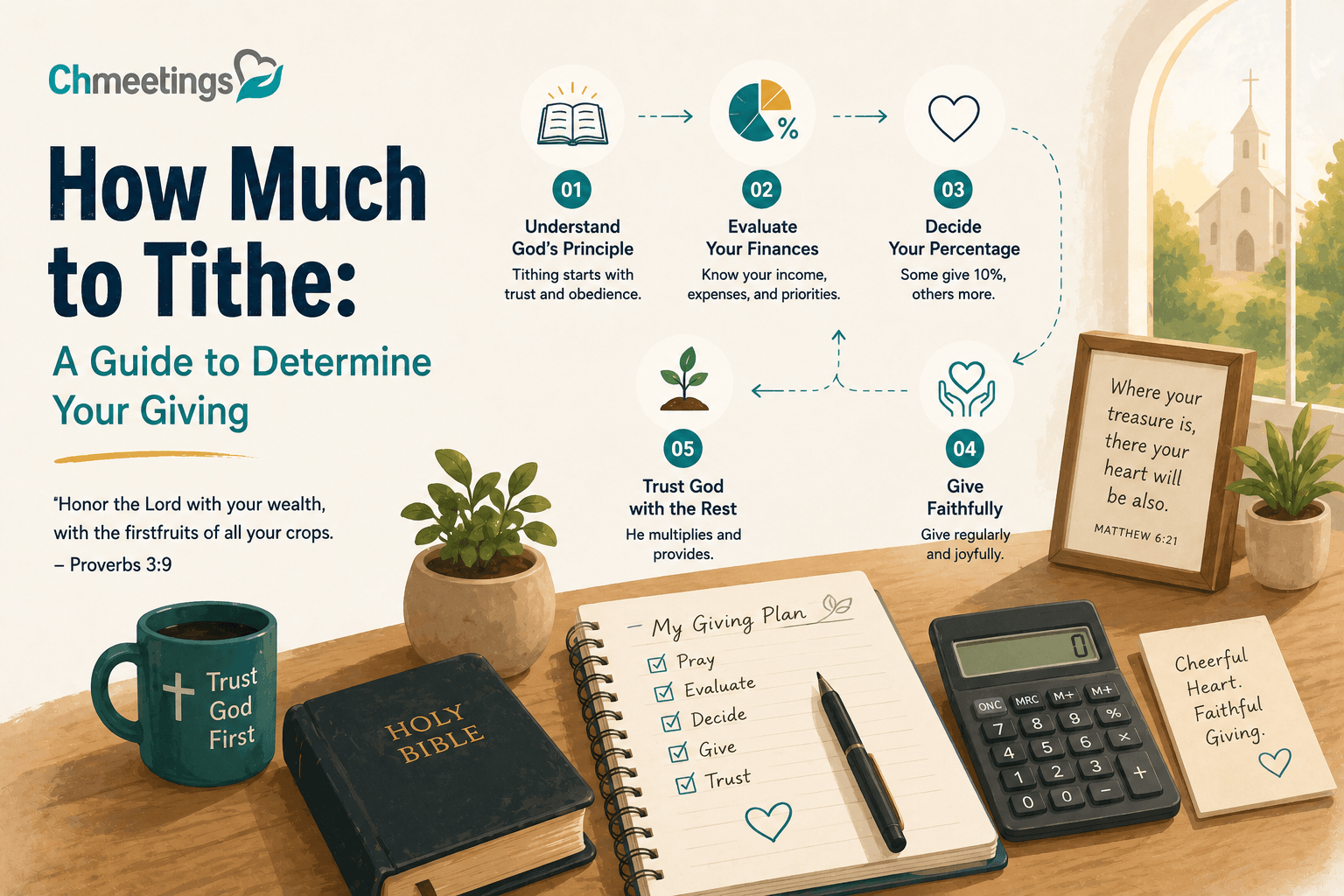

How much to tithe is a question I have been asked in pastoral conversations, in financial counseling sessions, and in quiet one-on-one conversations after services more times than I can count. It is a question that sounds simple but carries layers of theology, personal finance, guilt, generosity, and faith that make it anything but simple to answer well.
The gap between what people believe about tithing and what they actually do is significant. Only 3 to 4 percent of Christians actually comply with the 10 percent tithe, according to Ministry Designs. 60 percent of church members give less than 2 percent of their income, and 20 percent of churchgoers report never giving to their church at all, according to Ramsey Solutions. The average amount given as a tithe is closer to 2 percent, while many believe 10 percent is the standard, according to the Presbyterian Foundation.
These numbers do not indicate a crisis of generosity so much as a crisis of clarity. Most believers want to give faithfully. They are just not sure what faithfully means in practice, given their actual income, their actual bills, and their actual understanding of what the Bible actually teaches.
This guide addresses all of that: what tithing is, what the Bible says, how to calculate it, how to think about it in relation to your personal financial circumstances, and how to move toward giving that is genuinely faithful rather than either guilt-driven or ignored entirely.
“Giving has always been a mark of Christian commitment and discipleship. The ways in which a believer uses God’s gifts of material goods should reflect a faithful response to God’s self-giving.” — Wikipedia, Tithing article
Understanding the Concept of Tithing
What Does Tithing Mean?
The word tithe comes from the Old English word for “tenth.” In its most literal sense, a tithe is ten percent of something, and specifically ten percent of one’s income or produce given to God through the religious community. That definition has remained essentially stable across three thousand years of religious practice, even as the theological and practical debates around it have evolved considerably.
What has changed is the context. In ancient Israel, the tithe was part of a comprehensive covenant system that funded the Levitical priesthood, supported the poor, and financed the annual religious festivals. In contemporary churches, the tithe primarily funds the operational and ministry expenses of the local congregation. Understanding this context matters for understanding what a tithe is actually for and why it carries the significance it does.
Biblical History of Tithing
The first mention of tithing in Scripture is in Genesis 14, where Abram gives a tenth of his war spoils to Melchizedek, the priest-king of Salem, after a military victory. This occurs before the Mosaic law was established, suggesting that the principle of giving a tenth has roots deeper than legal obligation.
Leviticus 27:30-32 codifies the tithe within the Mosaic system: “A tithe of everything from the land, whether grain from the soil or fruit from the trees, belongs to the Lord; it is holy to the Lord.” Deuteronomy 14:22 repeats the instruction with particular emphasis: “You shall tithe all the yield of your seed that comes from the field year by year.”
Malachi 3:10 is the passage most frequently cited in church stewardship contexts: “Bring the whole tithe into the storehouse, that there may be food in my house. Test me in this, says the Lord Almighty, and see if I will not throw open the floodgates of heaven and pour out so much blessing that there will not be room enough to store it.” This is one of the only places in Scripture where God explicitly invites human beings to test his faithfulness.
In the New Testament, Jesus affirms tithing without making it the primary framework for Christian giving. In Matthew 23:23, he tells the Pharisees that they “should have practiced the latter without neglecting the former,” referring to tithing as a practice to maintain while also attending to justice, mercy, and faithfulness. Paul, in 2 Corinthians 9, shifts the emphasis from a prescribed percentage to the heart posture of the giver: “Each of you should give what you have decided in your heart to give, not reluctantly or under compulsion, for God loves a cheerful giver.”
Myths vs. Facts About Tithing
Myth: Tithing is an Old Testament law that Christians are not obligated to follow. Fact: While the specific legal framework of the Mosaic system does not apply directly to Gentile Christians, the principle of giving a portion of one’s income to God through the church community is consistently affirmed across both Testaments.
Myth: The tithe must go exclusively to the local church. Fact: Many theologians and church leaders believe the tithe should be given primarily to the local church, but Scripture does not specify a single institution as the exclusive recipient.
Myth: Tithing guarantees financial prosperity. Fact: Malachi 3:10 promises blessing, but the nature of that blessing is not specified as financial wealth. Many faithful tithers experience financial difficulty; tithing is an act of faith, not a financial strategy.
Myth: If you cannot give 10 percent, there is no point in giving. Fact: 2 Corinthians 9:7 describes giving proportionally and cheerfully, which for many people in genuine financial difficulty means starting with something smaller and growing toward greater generosity over time.
How Much Should You Tithe?
The 10% Standard
The 10 percent standard is the most widely recognized guideline for tithing and has the clearest biblical basis in the Old Testament texts cited above. Most evangelical churches teach a 10 percent tithe of gross income as the starting point for Christian giving, with offerings being anything given above and beyond that baseline.
In practice, 10 percent of gross income is a meaningful commitment for most households. It requires intentionality and, for many people, genuine sacrifice. That is not accidental. The tithe is designed to be substantial enough to represent genuine trust that God provides, not so small that it requires no faith at all.
Individual Considerations
The question of how much to tithe is ultimately a personal one that interacts with your financial situation, your stage of life, your debts, your family obligations, and your relationship with God around money. Several factors legitimately influence where a person starts:
Current financial situation: Someone carrying significant consumer debt, managing a medical crisis, or providing for a dependent family member with a single income faces different practical constraints than someone who is debt-free with discretionary income.
Stage of giving journey: Someone who has never given regularly is better served by starting at 2 or 3 percent and developing the habit of consistent giving than by committing to 10 percent and abandoning it after two months when the financial pressure becomes overwhelming.
Conviction and conscience: The New Testament’s emphasis is on giving that emerges from genuine conviction rather than external obligation. A person who gives 10 percent out of fear of divine punishment is in a very different spiritual place from one who gives 10 percent out of gratitude and trust.
Current Trends in Tithing
The gap between the biblical standard and actual church giving is striking. Only 3 to 4 percent of Christians give 10 percent. The majority give the 2 percent that represents the statistical average rather than the biblical standard. 77 percent of Americans engage in some form of charitable giving, but not necessarily through their church or in amounts that constitute a tithe, according to data reported via Quora.
The majority of Americans believe giving should be a priority with financial resources, yet only 23 percent consider it a first line item in their budgeting, according to AdelFi Christian Banking. That single statistic explains much of the gap: when giving is treated as what happens with whatever is left over after all other expenses, it predictably receives far less than 10 percent of income.
Calculating Your Tithe: Practical Steps
Tithing on Gross vs. Net Income
One of the most practical and contested questions in tithing is whether to calculate it on gross income, total earnings before taxes and deductions, or net income, what actually appears in the bank account after taxes, insurance, and other deductions.
The biblical basis for tithing predates income taxes, making direct textual guidance on this specific question unavailable. The tithe was historically calculated on the gross increase of the land or flock, suggesting a pre-deduction basis.
In practice, my honest observation is that this question matters less than many people think, and that the energy spent debating it is often better directed toward the more fundamental question of whether the person is giving consistently at all. A person giving 10 percent of net income is giving more faithfully than a person giving 5 percent of gross income while debating the technicalities.
As a practical starting point: tithe on gross income if you want to align most closely with the historical biblical pattern. Tithe on net income if your financial situation makes gross impractical and you want to give consistently rather than perfectly.
| Scenario | Annual Gross | Gross Tithe (10%) | Net After Tax (est. 25%) | Net Tithe (10%) |
|---|---|---|---|---|
| Entry level | $40,000 | $4,000 | $30,000 | $3,000 |
| Mid career | $75,000 | $7,500 | $56,250 | $5,625 |
| Senior professional | $120,000 | $12,000 | $90,000 | $9,000 |
| Self-employed | $60,000 net | $6,000 | Varies by deductions | Varies |
Using a Tithe Calculator
A simple tithe calculator takes your monthly or annual income and calculates 10 percent. If your annual gross income is $65,000, your annual tithe at 10 percent is $6,500, or approximately $542 per month. Dividing this by your pay schedule, weekly, biweekly, or monthly, gives you the specific per-paycheck amount to set aside.
The more important calculation is whether this amount can be made automatic. A tithe that requires a weekly decision to give is far more vulnerable to being skipped in a difficult week than one that is set up as an automatic transfer or recurring digital gift that happens before the money is available to spend on other things.
Setting Up Regular Tithing Payments
The practical key to consistent tithing is making it structural rather than volitional. The majority of consistent tithers I have observed over the years give automatically, whether through a recurring online giving setup with their church, an automatic bank transfer on payday, or a scheduled digital transaction.
When tithing requires an active decision every week, it competes with every other financial pressure of that week. When it is automatic, it happens regardless of what else is happening financially, which is a much closer approximation of what it means to give the first portion rather than whatever is left over.
The Difference Between Tithes and Offerings
Understanding Offerings
An offering is any giving beyond the tithe. While the tithe is understood as returning to God what is already his, an offering is a further voluntary expression of gratitude, commitment, or response to a specific need. In practice, offerings include:
- Special giving campaigns: A building fund, a benevolence fund, a mission project
- Spontaneous giving: A response to an immediate need in the community
- Designated gifts: Money given to a specific ministry or purpose within the church
The distinction matters practically because it helps givers understand the different spiritual and relational dynamics of each type of giving. The tithe is baseline. The offering is where generosity grows beyond obligation into genuine expression.
Tithes, Offerings, and Biblical Teachings
Both the Old and New Testaments describe giving that goes beyond the basic tithe. The Israelites brought freewill offerings to the tabernacle and temple in addition to the required tithe. The early church in Acts 2 and 4 describes believers giving beyond their tithe to the point where “there were no needy persons among them” because people sold property and brought the proceeds to be distributed to those in need.
2 Corinthians 8 and 9 describe the Macedonian churches giving “beyond their ability,” not out of obligation but out of overflow of gratitude and concern for fellow believers in Jerusalem. Paul explicitly holds this up as a model of generous giving that transcends percentage calculations.
Setting Priorities in Giving
A practical framework for thinking about giving priorities:
- Tithe first: Give the baseline 10 percent to your local church before making any other giving decisions
- Give offerings to your church: Beyond the tithe, give to specific campaigns, needs, and ministries within your congregation
- Give to the broader body: Support missionaries, Christian organizations, and parachurch ministries that align with your convictions
- Give to the community: Charitable giving to needs in the surrounding community is a legitimate expression of Christian generosity even when it goes to non-religious organizations
Tithing in Different Religions
Tithing in Judaism
In contemporary Jewish practice, the concept of tzedakah, often translated as charity but more accurately meaning justice or righteousness, guides giving. The rabbinic tradition suggests giving between 10 and 20 percent of one’s income to charitable causes, with 20 percent considered the ideal and 10 percent the minimum. The Talmud discusses specific categories of recipients and guidelines for distributing giving across different needs.
The historical tithes of the Mosaic system, including the Levitical tithe, the second tithe for festival observance, and the poor tithe given every third year, totaled significantly more than 10 percent when calculated together. Modern Jewish communities continue to emphasize proportional and consistent giving as an expression of covenant faithfulness.
Christianity and Tithing
| Christian Tradition | Standard Teaching | Primary Basis |
|---|---|---|
| Evangelical Protestant | 10% of gross income to local church | Malachi 3:10, Genesis 14, Leviticus 27 |
| Catholic | Proportional giving, tithing encouraged | Church teaching and pastoral guidance |
| Mainline Protestant | Proportional giving, percentage varies | 2 Corinthians 9:7 emphasis |
| Pentecostal/Charismatic | 10% tithe plus offerings | Malachi 3:10, prosperity theology influences |
| Anglican/Episcopal | “Proportionate giving” encouraged | Both Testaments, pastoral discretion |
Islamic Perspectives on Giving
Islam’s primary giving obligation is Zakat, one of the Five Pillars of Islam, which requires eligible Muslims to give 2.5 percent of their accumulated wealth above a minimum threshold (nisab) annually. Zakat is distinct from voluntary charity (Sadaqah) and is calculated on accumulated wealth rather than income, making its structure different from Christian tithing though its function as a required religious contribution is analogous.
The distinctions are instructive: where Christian tithing focuses on income, Zakat focuses on wealth accumulation. Where Christian tithing is given primarily to the local church for general ministry purposes, Zakat has eight specified categories of recipients defined in the Quran.
Common Questions About Tithing
Do I Have to Tithe if I Don’t Belong to a Church?
This question comes up frequently among believers who practice their faith privately, who are between churches, or who have been hurt by institutional church and have stepped back from formal membership. The short answer is that the biblical pattern of tithing assumes a community context: the tithe in both Testaments flows to the community of faith to resource its shared life and mission.
If you are not currently connected to a local church, the more important question is not where to send a check but why you are not connected and what steps might move you back toward community. Tithing and church membership are not logically identical, but they are practically related: the tithe is designed to resource the community, and the person who gives consistently to an organization they are not part of is in a somewhat anomalous position.
If connection is genuinely not possible, giving to a Christian organization whose work you support and trust is better than not giving at all.
Can I Tithe on Gifts or Inheritance?
Many believers do include significant gifts and inheritances in their tithe calculation, reasoning that all resources ultimately come from God regardless of the channel through which they arrive. This is a position I respect and have seen practiced with genuine faithfulness.
Others take a narrower view, tithing only on earned income and treating gifts or inheritances as outside the tithe calculation. This position is also defensible, particularly for inheritances that represent the already-tithed savings of the previous generation.
The more important question is the posture of the heart: does receiving an unexpected windfall produce generosity or hoarding? For many people, designating a percentage of any significant unexpected income at the moment of receipt, before it gets absorbed into normal spending, is a practical discipline that reflects genuine gratitude.
Should I Tithe While Paying Off Debt?
This is the question where the tension between biblical principle and financial practicality is most acute. The honest answer is: it depends.
Someone carrying a small amount of manageable consumer debt while earning a stable income is in a very different position from someone in a genuine financial crisis where basic obligations, rent, food, utilities, cannot be met without incurring additional debt. The first person can and probably should tithe while paying off debt. The second person may need to prioritize financial stability before giving can become consistent.
Dave Ramsey, one of the most widely followed voices on personal finance within Christian communities, generally encourages giving even while paying off debt, arguing that generosity is a spiritual discipline that should not be suspended indefinitely until financial conditions are perfect. His framework acknowledges that financial perfection never fully arrives, and waiting for it produces a lifetime of deferred giving.
What I would add from pastoral experience: if the question of whether to tithe while in debt is primarily an excuse not to give rather than a genuine financial dilemma, the honest conversation is about the posture of the heart rather than the arithmetic.
Frequently Asked Questions
How much should I tithe?
The traditional biblical guideline is 10 percent of your income, based primarily on Old Testament texts and affirmed across most Christian traditions as the starting standard for giving. In practice, very few Christians give at this level: the average is closer to 2 percent. The most important step is not achieving 10 percent immediately but establishing a consistent giving habit at whatever percentage you can genuinely sustain, and growing from there. Someone giving 3 percent consistently is in a more faithful posture than someone who intends to give 10 percent but never quite gets there.
What does the Bible say about tithing?
The Old Testament establishes tithing as a required practice for Israel: 10 percent of agricultural produce and livestock given to the Levitical priesthood and used to support the religious community and the poor. Malachi 3:10 frames it as a test of faith in God’s provision. The New Testament, particularly in 2 Corinthians 8 and 9, shifts the emphasis from a required percentage to the heart posture of the giver, describing generous, proportional, cheerful giving motivated by gratitude rather than obligation. Jesus affirms tithing in Matthew 23:23 while making clear that the spirit of the law matters more than its technical compliance.
Should I tithe on my gross or net income?
This is a personal decision without a definitive biblical answer, since the biblical tithe predates income taxes. Many choose to tithe on gross income as the closer approximation of the biblical pattern of giving the first portion. Others, particularly those in lower income brackets where tax deductions are substantial, tithe on net income as the more practical baseline. The most important decision is to give consistently at whatever level you choose, rather than spending indefinite time debating the calculation while not giving at all.
Can I tithe on gifts or inheritance?
Yes, many believers include gifts and inheritances in their tithe, recognizing that all resources ultimately come from God regardless of the channel through which they arrive. This is a matter of personal conviction rather than explicit biblical instruction. If you receive a significant windfall, designating a giving percentage at the moment of receipt, before it is absorbed into regular spending, is a practical discipline that many people find helpful for maintaining a generous posture toward unexpected income.
What if I can’t afford to tithe?
Start with what you can genuinely give without creating financial hardship, even if that is 1 or 2 percent. Establish the habit of consistent giving and grow the percentage as your financial situation improves. The New Testament principle in 2 Corinthians 8:12 is directly relevant here: “For if the willingness is there, the gift is acceptable according to what one has, not according to what one does not have.” What God looks for is a willing heart and a genuine commitment to generosity, not a specific dollar amount achieved through financial strain.
Conclusion
How much to tithe is a question that deserves a real answer, not a formulaic one. The biblical starting point is 10 percent, and it has been for three thousand years. The practical reality is that most Christians give far less, and many do not give consistently at all.
The most important shift is not from 2 percent to 10 percent in a single month. It is from inconsistent or absent giving to consistent proportional giving that grows over time as both financial capacity and spiritual conviction develop. Start where you are. Give consistently. Give cheerfully. And let the discipline of regular giving reshape your relationship with money and with God in ways that percentage calculations alone cannot capture.
For churches that want to support their congregation’s giving journey with tools for online giving, giving statement generation, and contribution tracking, Try ChMeetings Today to see how integrated giving management makes faithful stewardship easier for everyone involved.