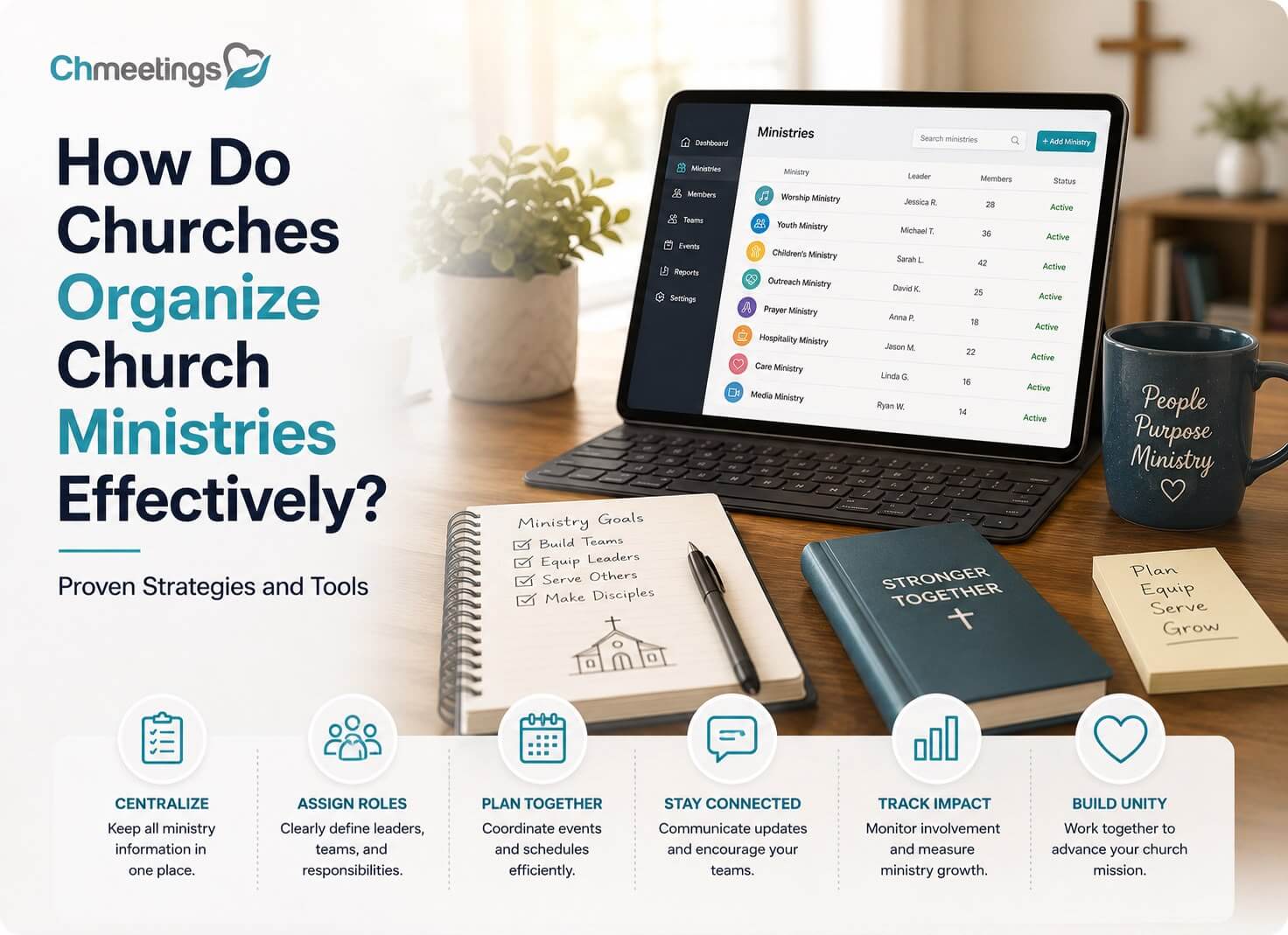

I have spent years helping church leadership teams sort out who does what, why certain ministries flourish while others quietly fall apart, and how to build a structure that doesn’t collapse the moment a key volunteer moves away. Every church I have worked with eventually asks the same question: how do churches organize church ministries in a way that actually holds up over time? The honest answer is that structure matters as much as passion. A ministry full of well-meaning people with no clear organization burns out fast.
This guide walks through what I have seen work in practice, from leadership roles to technology to the mistakes that quietly drain a ministry’s energy.
- Understanding Church Ministry Structure
- The Role of Leadership in Church Ministries
- Best Practices for Organizing Church Ministries
- Community Engagement and Outreach Programs
- Small Group and Specialized Ministries
- Utilizing Technology in Ministry Organization
- Evaluating Ministry Effectiveness
- Future Trends in Church Ministry Organization
-
Frequently Asked Questions
- What are church ministries?
- How do you start organizing a church ministry?
- What role does community play in church ministries?
- How can technology help organize church ministries?
- What are some effective outreach strategies for churches?
- How do you evaluate ministry effectiveness?
- What challenges do churches face in organizing ministries?
- What is a small group ministry?
- Understanding Church Ministry Structure
- The Role of Leadership in Church Ministries
- Best Practices for Organizing Church Ministries
- Community Engagement and Outreach Programs
- Small Group and Specialized Ministries
- Utilizing Technology in Ministry Organization
- Evaluating Ministry Effectiveness
- Future Trends in Church Ministry Organization
-
Frequently Asked Questions
- What are church ministries?
- How do you start organizing a church ministry?
- What role does community play in church ministries?
- How can technology help organize church ministries?
- What are some effective outreach strategies for churches?
- How do you evaluate ministry effectiveness?
- What challenges do churches face in organizing ministries?
- What is a small group ministry?
Understanding Church Ministry Structure
A church ministry structure is simply the framework that determines how decisions get made, who is accountable to whom, and how resources and people flow toward the church’s mission. It sounds administrative, but I have watched structure make or break ministries that had everything else going for them.
The Importance of Structure
Without structure, ministries tend to depend entirely on one person’s energy. When that person steps away, the ministry often stalls. A clear structure spreads responsibility across a team, so momentum survives leadership transitions.
Different Governance Models
Churches generally organize around a handful of governance models, and the model a church chooses shapes everything downstream, from how ministries get approved to how conflict gets resolved.
| Governance Model | How Decisions Are Made | Common In |
|---|---|---|
| Congregational | The congregation votes on major decisions | Baptist, non-denominational churches |
| Elder-led | A board of elders leads and directs pastoral staff | Reformed, many non-denominational churches |
| Episcopal | Authority flows from bishops or a denominational hierarchy | Anglican, Methodist, Catholic |
| Presbyterian | Elected elders and presbyteries share governance | Presbyterian churches |
As one analysis from The Bible Seminary puts it, a church’s polity reflects what a community actually believes about leadership, discipleship, and the nature of the church itself. That framing has stuck with me because it explains why governance debates in churches so often become theological debates.
It also helps to remember that the real difference between governance models is not whether a church has leaders, but where those leaders draw their authority from. In a congregational model, for example, final accountability rests with the congregation itself, gathered under the headship of Christ, rather than with a single pastor or board.
How Structure Affects Ministry Growth
I have seen well-funded ministries stagnate simply because nobody owned the follow-through. Structure creates ownership. When every ministry has a defined leader, a defined budget line, and a defined reporting relationship, growth becomes something you can plan for instead of something you hope for.
The Role of Leadership in Church Ministries
Leadership is where church ministry organization either takes root or falls apart. I have found that the churches with the healthiest ministries are the ones that treat leadership roles as clearly defined jobs, not vague titles.
Identifying Key Leadership Roles
Most churches need some version of the following roles across their ministries.
| Role | Core Responsibility |
|---|---|
| Ministry Director | Oversees vision, budget, and overall direction for the ministry |
| Volunteer Coordinator | Recruits, trains, and schedules volunteers |
| Small Group Leader | Facilitates weekly gatherings and pastoral care within the group |
| Outreach Lead | Plans and executes community-facing events |
| Administrative Support | Manages communication, records, and logistics |
Leaders vs. Volunteers: A Collaborative Approach
The strongest ministries I have observed treat volunteers as partners, not extra hands. That means giving volunteers real input into planning, not just execution. Research suggests one in five churchgoers want more opportunities to serve in organized ministries, which tells me most churches are sitting on more willing capacity than they are currently using.
Leadership Styles and Their Impact
A directive leadership style can work for short-term projects, but ongoing ministries need something closer to coaching. Leaders who explain the why behind decisions build volunteers who can eventually lead on their own, which is the entire point of good succession planning.
Try ChMeetings Today can help ministry leaders track volunteer roles, attendance, and communication in one place, which becomes especially useful once a ministry grows past a handful of people.
Best Practices for Organizing Church Ministries
Organizing a ministry well is less about finding the perfect org chart and more about building repeatable habits.
Step-by-Step Organization Techniques
- Define the ministry’s specific purpose in one sentence.
- Identify a single accountable leader.
- Recruit a core team before opening it up broadly.
- Set a simple meeting rhythm.
- Write down the basic plan, even if it is short.
- Review progress on a fixed schedule.
Feedback and Improvement Processes
Feedback loops are one of the most overlooked pieces of ministry organization. According to one industry report, roughly 80% of effective ministries have built-in feedback mechanisms for improvement. In practice, this can be as simple as a quarterly check-in where volunteers can say honestly what is working and what is not.
Community Outreach Strategies
Outreach works best when it is tied directly to a ministry’s core purpose rather than treated as a separate add-on. A food pantry ministry, for example, gains more traction when it partners with the hospitality ministry than when it operates in isolation.
Community Engagement and Outreach Programs
Community engagement is often the clearest sign that a ministry structure is actually working, because organized ministries tend to sustain outreach far longer than ad hoc efforts.
Innovative Outreach Ideas
Some of the most effective outreach programs I have seen combine a recurring need in the community with a recurring church resource, such as a monthly meal program staffed by a rotating group of small groups rather than one exhausted team.
Serving the Community Effectively
Barna Research has found that churches that actively engage with their community see about 55% more growth than churches that do not. That statistic lines up with what I have observed directly: outward-facing ministries tend to attract more new members than inward-facing programming alone.
Case Studies of Successful Outreach
A mid-sized suburban church I worked with restructured its outreach ministry around three focused programs instead of ten scattered ones. Within a year, volunteer retention in outreach roles nearly doubled, simply because people could see the direct impact of a smaller, better-organized effort.
For more outreach ideas, 50 Ways to Take Church to the Community is a useful reference point, and Organizing Your Church for Ministry offers a helpful perspective on how ministry structure needs to evolve as a church grows.
Small Group and Specialized Ministries
Small groups and specialized ministries, such as youth ministry organization, women’s ministry organization, and men’s ministries, are where organized structure meets personal connection.
Benefits of Small Groups
Small groups tend to build deeper relationships than large gatherings alone can. Research indicates over 60% of churchgoers prefer involvement in small group ministry over attending traditional services alone, which is a strong argument for making small groups a core part of ministry structure rather than an optional extra.
Integrating Specialized Ministries
Specialized ministries, including those serving specific age groups, life stages, or cultural communities, work best when they still report into the church’s broader leadership structure. Isolated specialized ministries are the ones most likely to drift from the church’s overall mission and vision of a church.
Encouraging Participation
Clear entry points matter. A short, well-publicized small group sign-up process removes far more friction than people expect. How to Start Small Groups in a Church is a solid resource for churches building this out for the first time.
Utilizing Technology in Ministry Organization
Technology has changed how church ministry organization works in the last decade, mostly by removing administrative friction that used to eat into actual ministry time.
Digital Tools for Ministry Management
According to Lifeway research, about 45% of churches now use some form of digital tools to support ministry operations. Tools that handle scheduling, attendance, and communication in one place free up leaders to focus on people instead of spreadsheets.
Successful Integration Cases
Churches that see the strongest results from technology tend to start small, digitizing one process, such as volunteer scheduling, before expanding to communication and attendance tracking.
Overcoming Technological Challenges
The biggest barrier I have seen is not cost but adoption. Leaders who introduce new tools with hands-on training, rather than a one-time announcement, see far higher long-term usage.
Evaluating Ministry Effectiveness
Organizing a ministry is only half the work. Knowing whether it is actually succeeding requires ongoing evaluation.
Key Metrics and Measurements
Useful metrics include attendance trends, volunteer retention, and outreach participation. Volunteer turnover is worth watching closely across all ministries, not just one. The National Youth Ministry Association has reported that roughly 75% of youth ministries experience high turnover rates annually, which makes turnover tracking especially important for ministries built around younger leaders and volunteers.
Feedback Collection Techniques
Short, anonymous surveys tend to surface more honest feedback than open floor discussions, particularly in ministries where volunteers may hesitate to criticize a leader directly.
Using Feedback for Improvement
Feedback only matters if it changes something. Closing the loop, by telling volunteers what changed because of their input, is what keeps people willing to give honest feedback the next time.
Future Trends in Church Ministry Organization
Emerging Trends
Church ministries are increasingly organizing around flexible, team-based models rather than rigid hierarchies, which allows ministries to scale up or down based on need.
The Importance of Adaptability
The churches that have adapted best in recent years are the ones that treat their ministry structure as something to revisit periodically, not something set in stone once and never revisited.
Innovative Strategies for Future Success
Expect more churches to blend small group ministry with digital community tools, and to lean more heavily on data, such as attendance and engagement metrics, to decide where to invest ministry resources next.
Frequently Asked Questions
What are church ministries?
Church ministries are the organized programs and activities a church runs to serve its congregation and community, such as youth programs, outreach initiatives, worship teams, and hospitality efforts, all working toward the church’s broader mission.
How do you start organizing a church ministry?
Start by defining the ministry’s purpose in a single clear sentence, then identify one accountable leader, recruit a small core team, and build a simple recurring meeting rhythm before opening the ministry up broadly.
What role does community play in church ministries?
Community involvement keeps ministries connected to real needs outside the church walls. Ministries that regularly engage their community tend to build stronger relationships and grow faster than ministries that stay entirely internal.
How can technology help organize church ministries?
Technology simplifies scheduling, communication, and attendance tracking, which frees up ministry leaders to spend more time on people and less on administrative work.
What are some effective outreach strategies for churches?
Recurring community events, partnerships with local organizations, and consistent social media engagement tend to outperform one-off outreach efforts, since they build familiarity and trust over time.
How do you evaluate ministry effectiveness?
Track a small set of clear metrics, such as attendance trends and volunteer retention, gather regular feedback from participants, and review results on a fixed schedule so adjustments happen consistently rather than reactively.
What challenges do churches face in organizing ministries?
Common challenges include limited resources, volunteer burnout, and resistance to structural change. Clear communication and shared leadership tend to reduce all three over time.
What is a small group ministry?
A small group ministry is a structure of smaller, recurring gatherings within a church, focused on fellowship, study, and mutual support, designed to build deeper relationships than large group settings typically allow.