
If you have ever sat on a nonprofit board or helped recruit one, you have probably heard this question: do board members of nonprofits get paid a salary? The honest answer is: it depends and the details matter enormously. Get it wrong and you risk IRS penalties, state compliance violations, or a governance crisis that erodes donor trust overnight.
This guide covers everything your organization needs to know from federal and state rules to IRS documentation requirements, compensation models, church-specific considerations, and a practical approval playbook. Whether you are a new board chair, an executive director setting policy, or a church administrator managing dual-role leaders, you will leave with a clear framework and the exact steps to follow.

Can Nonprofit Board Members Be Paid?
The Default Expectation And Why It Exists
Across the nonprofit sector, the prevailing norm is that board service is voluntary. This expectation is rooted in the foundational idea of nonprofit governance: directors serve in a fiduciary capacity, looking out for the mission rather than their own financial interests. The public and the IRS generally views board members as stewards of charitable resources, not as recipients of them.
That cultural expectation is reinforced by the way most small and mid-sized nonprofits operate. With tight budgets and a reliance on community goodwill, compensating board members can feel at odds with the mission. For churches, the expectation is even stronger: volunteer governance is often seen as a spiritual commitment, not just an administrative role.
None of this means payment is prohibited. It simply means that when compensation exists, it requires justification, documentation, and process.
What Federal Law and the IRS Actually Allow
The Internal Revenue Code does not explicitly prohibit nonprofit board members from receiving compensation. Section 501(c)(3) organizations are permitted to pay board members, provided the compensation is reasonable and not excessive in relation to the services provided. The IRS uses the term “reasonable compensation” and enforces this standard rigorously.

Where things get complicated is the concept of private inurement the prohibition on allowing net earnings of a tax-exempt organization to benefit private individuals, including insiders like board members. If compensation crosses the line from reasonable to excessive, the IRS may classify it as an excess benefit transaction, triggering intermediate sanctions under Section 4958 of the Internal Revenue Code. These sanctions can fall on both the board member who received the excess payment and the organization officials who approved it.
How State Laws Create Different Rules
Beyond federal standards, each state has its own nonprofit corporation law, and rules on board compensation vary significantly. Some states require that a majority of the board be uncompensated (sometimes called “disinterested” directors) for the organization to qualify for certain tax exemptions or grants. Others impose limits on how compensation can be approved or disclosed.
California, for example, requires that certain public benefit corporations have a majority of directors who are not compensated as employees or contractors of the organization. Texas has its own statutes under the Texas Business Organizations Code that govern nonprofit governance and compensation disclosures. New York requires independent directors on the boards of larger charities.
Before your organization adopts any board compensation policy, review your state’s nonprofit corporation act or consult a nonprofit attorney familiar with your jurisdiction. Compliance is not just an IRS matter it is also a state law matter.
When Paying Board Members Creates Legal Risk
Legal risk arises in several predictable scenarios. The most common are:
• Compensation is approved by a board that includes the person being paid, without proper recusal or independent review.
• The amount paid is significantly above what comparable organizations pay for similar roles, without documented justification.
• A board member receives both a board stipend and employee compensation without clear approval of both roles.
• The organization fails to disclose compensation on Form 990, triggering IRS scrutiny.
• State law requires a majority of uncompensated directors, but the organization does not meet that threshold.
Each of these situations can result in penalties, loss of tax-exempt status in extreme cases, or reputational damage. The antidote in every case is the same: transparent process, independent review, and solid documentation.
How Much Do Nonprofit Board Members Get Paid?
Typical Ranges by Organization Budget Size
Most small nonprofits with annual budgets under $500,000 do not pay board members at all. As organizations grow, modest stipends become more common. Among larger nonprofits and foundations those with budgets exceeding $5 million some form of board compensation is more frequently found, though still far from universal.
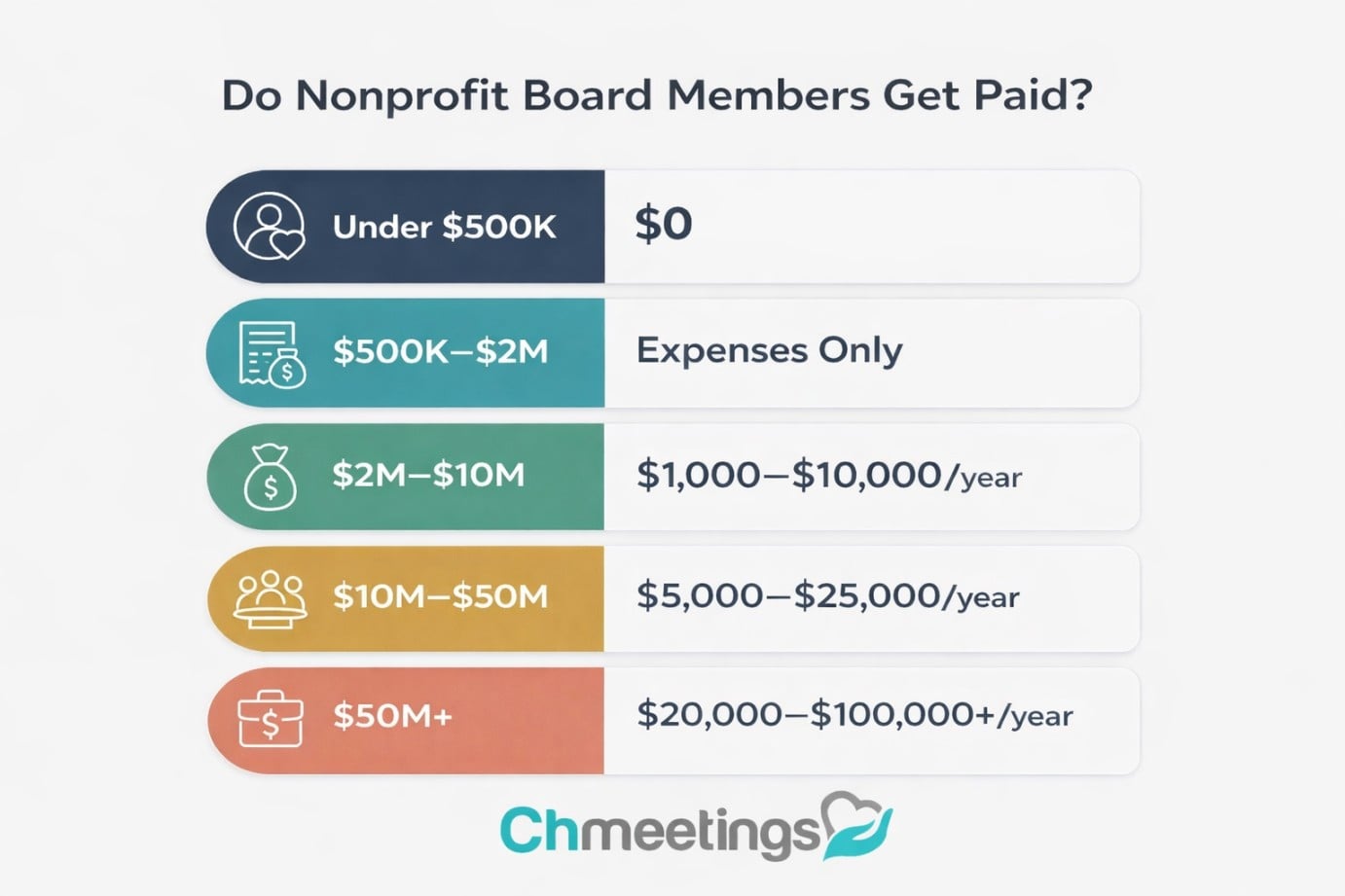
These figures reflect general sector trends. Healthcare nonprofits, hospital systems, and large foundations tend to compensate board members at higher rates, while community organizations, religious bodies, and advocacy groups remain predominantly volunteer.
How Role, Time Commitment, and Expertise Affect Pay
When compensation exists, it is usually tiered by the demands of each role. A board chair who spends 15 hours per month on governance work should not receive the same stipend as a general member attending four meetings per year. Similarly, members who bring specialized legal, medical, or financial expertise and are actively consulted may command higher compensation than those filling a community representative seat.
Factors that typically justify higher compensation include:
• Serving as board chair, treasurer, or committee chair
• Meeting frequency above four times per year
• Participation in strategic planning, capital campaigns, or mergers
• Providing professional expertise that would otherwise require paid consultants
• Geographic travel requirements for in-person meetings
The key principle is that pay should be tied to actual services, not just title. This is both a fairness issue and an IRS requirement.
Stipend vs. Salary vs. Reimbursement What’s the Difference?
These three terms get used interchangeably, but they have distinct legal and tax implications.
Understanding the difference matters for your payroll setup, tax filings, and Form 990 disclosures. Reimbursements, when properly documented, are generally not taxable and do not count as compensation for IRS reporting thresholds.
What Counts as Reasonable Compensation?
How to Benchmark Pay Against Comparable Organizations
Reasonable compensation is not a feeling it is a documented, evidence-based conclusion. The IRS expects organizations to rely on comparability data when setting any compensation for insiders, including board members.
Comparability data means information about compensation paid by similar organizations for functionally comparable services. Useful sources include:
• IRS Form 990 filings of peer organizations (searchable via ProPublica Nonprofit Explorer or Candid)
• Compensation surveys published by nonprofit associations (BoardSource, GuideStar, AFP, SHRM)
• Regional compensation studies published by state nonprofit associations
• Written offers from qualified outside advisors (attorneys, HR consultants)
When identifying comparables, match on at least three dimensions: organization type (similar mission or sector), geographic market, and budget size. A $2M community health nonprofit should not benchmark against a $200M hospital system, even if both are 501(c)(3) organizations.
Documenting Reasonableness to Satisfy the IRS
Documentation is where most organizations fall short. Even if the compensation amount is entirely appropriate, failing to document the process that led to it creates risk. The IRS has established a “rebuttable presumption of reasonableness” a safe harbor that protects organizations that follow a specific approval process.
To meet this standard, three conditions must be satisfied:
1. The compensation must be approved in advance by an authorized body of the organization typically the full board or a compensation committee composed entirely of individuals who do not have a conflict of interest.
2. The approving body must rely on and document comparability data obtained before making the decision.
3. The decision and the data it relied upon must be recorded in writing contemporaneously meaning at or around the time of the decision, not months later.
Excess Benefit Transactions What They Are and How to Avoid Them
An excess benefit transaction occurs when a nonprofit provides an economic benefit to a “disqualified person” which includes board members that exceeds the value of services the person provides in exchange. This is governed by Section 4958 of the Internal Revenue Code.
The consequences are serious. The disqualified person who received the excess benefit must pay an excise tax equal to 25% of the excess amount. If the transaction is not corrected in a timely fashion, the tax escalates to 200%. Organization managers who knowingly approved the transaction may also be personally liable for a 10% excise tax (up to $20,000 per transaction).
To avoid excess benefit transactions:
• Never approve compensation without comparability data on file
• Require recusal of any board member with a personal interest in the outcome
• Document every step of the approval process in board minutes
• Set compensation in advance, not as a retroactive reward
• Review compensation at least every two to three years against updated benchmarks
Can a Board Member Also Be a Paid Employee?
When Dual Roles Are Permissible
Yes, a board member can also be a paid employee of the same nonprofit but this arrangement requires careful management. Executive directors who also serve on the board are common examples. Founders sometimes serve in both capacities. The dual role is not inherently prohibited, but it creates conflicts of interest that must be actively managed through governance policies.
The critical distinction is between compensation as an employee (a W-2 relationship for services like running programs, managing staff, or handling finances) and compensation as a board member (a stipend or fee for governance duties). These must be treated as separate, distinct forms of compensation, each requiring its own approval and documentation.
Conflict of Interest Rules and Required Disclosures
A board member who is also an employee has a clear financial interest in decisions the board makes about staff compensation, budget allocations, and organizational direction. This creates a conflict of interest that must be disclosed and managed.
Best practices include:
• Adopting a written conflict of interest policy that requires annual disclosure statements from all board members
• Requiring employee board members to recuse themselves from any vote on their own compensation or performance review
• Ensuring that employee board members never constitute a majority of the board
• Having a separate compensation committee (composed of non-employee board members) handle all employment-related decisions for staff who are also board members
Approval Steps, Payroll Setup, and Tax Implications
When a board member is also an employee, the organization must handle payroll correctly. Employee compensation is subject to FICA taxes (Social Security and Medicare), federal and state income tax withholding, and all standard payroll reporting requirements. The employee receives a W-2 at year end.
Board stipends paid to the same person are generally also taxable. Depending on how the arrangement is structured, the stipend may be reported on the same W-2 or on a separate 1099-NEC. Consult your payroll provider or CPA to ensure proper classification.
The approval process for the dual role should be documented in board minutes and should include:
- Board (or committee) approval of the employment relationship, with the interested party recused
- Separate approval of the board stipend, if one exists, through the same conflict-free process
- Annual review of both forms of compensation against comparability data
- Disclosure of both amounts on Form 990 under Schedule J if the total exceeds reporting thresholds
How to Properly Approve Board Compensation
Setting Up a Compensation Committee
A compensation committee is a standing or ad hoc committee of the board specifically tasked with reviewing and recommending compensation for board members, officers, and key employees. Its core value is independence: by removing the full board from the initial deliberation, it reduces the risk of groupthink or peer pressure influencing the outcome.
An effective compensation committee should:
• Be composed entirely of board members who have no financial interest in the compensation being reviewed
• Have a formal written charter that defines its authority, scope, and reporting obligations
• Meet at least annually to review compensation against updated benchmarks
• Document all deliberations, data sources, and conclusions in committee minutes
Small organizations that lack the board size to form a formal committee can use a designated subset of disinterested directors instead, but the same independence requirements apply.
The Independent Review Process and Comparability Data
Before setting or adjusting any compensation, the committee must gather comparability data from at least three to five peer organizations. The data should be documented in writing and attached to the meeting minutes as an exhibit.
The review process should follow this sequence:
- Gather comparability data from peer organizations (Form 990s, salary surveys, advisor opinions)
- Define the scope of services the board member provides (hours, duties, expertise required)
- Identify a proposed compensation range supported by the comparability data
- Present the range to the compensation committee for deliberation
- Vote on the final amount, with all conflicts disclosed and conflicted members recused
- Record the decision, data, and rationale in written minutes
Required Documentation, Board Minutes, and Resolutions
Minutes are your legal record. If the IRS ever questions your compensation, the minutes of the approval meeting are your first line of defense. They must capture:
• The date and attendees of the meeting
• Who was recused and why
• The comparability data reviewed (sources, amounts, dates of data)
• The proposed compensation and the final amount approved
• The vote count and any dissenting views
A formal board resolution should follow, stating the approved compensation, the effective date, and the review basis. This resolution should be signed and retained in the organization’s permanent governance files.
Non-Cash Perks and Benefits for Board Members
Reimbursements, Travel, and Meals What’s Allowed
Expense reimbursements are the most common form of non-cash support provided to board members, and when handled correctly, they are not considered taxable compensation. The key requirements are that expenses must be:
• Ordinary and necessary for board service (travel to meetings, parking, printing, postage)
• Substantiated with receipts or other documentation within a reasonable time (typically 60 days)
• Repaid to the organization if they exceed the actual expense incurred
Meals during board meetings are generally reimbursable. First-class travel upgrades, personal meals unrelated to board business, or family travel expenses are not. Establish a written expense reimbursement policy that defines what is covered and the documentation required.
Insurance, Honoraria, and Membership Perks
Directors and officers (D&O) liability insurance is a common benefit provided to board members. It protects them from personal liability arising from their governance decisions and is considered an ordinary governance expense not compensation to the individual board member.
Honoraria one-time payments for specific contributions such as a keynote speech, training facilitation, or expert consultation are taxable and must be reported on a 1099-NEC if they meet reporting thresholds ($600 or more per year). They should not be structured as a way to circumvent compensation approval requirements.
Professional membership dues, conference registrations, or subscriptions to publications related to the board member’s governance role may be reimbursable expenses. Personal memberships or unrelated professional development costs are not.
How to Report Non-Cash Benefits Correctly
Non-cash benefits that constitute compensation such as use of organizational vehicles, housing allowances, or personal use of organizational property must be valued at fair market value and reported as compensation on Form 990 and, if applicable, on the individual’s W-2 or 1099.
Benefits that are properly excluded from income (such as accountable plan reimbursements and D&O insurance) should still be documented in your policies and records, even though they are not taxable. Inconsistent recordkeeping is a common audit trigger.
Tax and Reporting Obligations
Form 990 Disclosure Rules for Board Compensation
Form 990 is a public document, and it requires disclosure of compensation paid to current officers, directors, and trustees. Specifically:
• Part VII requires listing all current officers, directors, and key employees, along with their reportable compensation from the organization and related organizations
• Any officer, director, or key employee receiving more than $100,000 in reportable compensation must be individually listed
• Schedule J requires additional detail on compensation for individuals receiving more than $150,000 in total compensation, including the nature of the compensation and the process by which it was set
Even organizations that pay board members nothing must list them on Part VII with $0 in compensation. This confirms to the IRS that the board composition and volunteer status of members are accurately reported.
Payroll Taxes, Withholding, and W-2 vs. 1099
Whether a board member receives a W-2 or a 1099-NEC depends on how their relationship with the organization is classified. This is not simply an administrative choice misclassification carries penalties.
A board member who is also an employee of the organization should receive a W-2 that includes both employee wages and any board stipend that is treated as additional employment compensation. Payroll taxes (FICA) must be withheld and matched by the organization.
A board member who is not an employee and receives only a stipend or honorarium should receive a 1099-NEC if total payments equal or exceed $600 in a calendar year. No payroll tax withholding is required, but the individual is responsible for self-employment taxes on this income.
State Reporting Requirements and Unemployment Rules
State obligations vary significantly. Most states require nonprofit employers to register with the state unemployment insurance program and pay contributions if they have employees. Some states extend unemployment coverage to certain categories of nonprofit workers that federal law would exclude.
Board members who are also employees may be covered by state unemployment insurance. Board members who receive only stipends and are classified as independent contractors typically are not. Organizations operating in multiple states must comply with each state’s rules separately.
Additionally, several states require nonprofits to file separate state charitable solicitation registrations that include compensation disclosures for board members and key employees. California’s RRF-1, New York’s CHAR500, and similar forms often require data that mirrors or supplements Form 990 disclosures.
Volunteer-Only vs. Paid Board Models A Side-by-Side Comparison
Pros and Cons of Each Model
Stipend Model vs. Full Employee Model
The stipend model pays board members a modest, fixed amount for their governance role typically annually or per meeting. It is the most common form of board compensation when payment exists. It is simpler to administer, requires less payroll infrastructure, and is easier to disclose and justify.
The full employee model applies when a board member also holds a staff role such as an executive director, program director, or financial officer. This is more complex, requires careful governance to manage conflicts, and demands robust payroll and HR compliance. It is most appropriate in organizations where leadership capacity is limited and the founding team wears multiple hats.
Signs It’s Time to Transition to Paid Board Roles
Most organizations should not rush toward board compensation. But there are situations where it makes strategic sense to consider it:
• Your organization is struggling to recruit board members with the expertise your mission requires
• Board members are logging significant time consistently more than 10 hours per month with no recognition or support
• Your organization has grown to a scale where board governance is genuinely complex and time-intensive
• A peer benchmarking exercise shows that comparable organizations in your sector compensate their boards
• You are losing experienced board members to other organizations that offer compensation
If you decide to make the transition, do it deliberately: engage legal counsel, develop a compensation policy, gather benchmarking data, and communicate transparently with your full board, staff, and major donors before implementation.
Church and Faith-Based Organization Considerations
How Board Pay Affects Volunteer Culture and Member Trust
For churches and faith-based nonprofits, board compensation raises questions that go beyond legal compliance. Many congregation members view leadership service as a spiritual calling something offered freely as an expression of commitment to the community. Introducing financial compensation into that dynamic can shift the culture in ways that are difficult to undo.
This does not mean church boards should never be compensated. It means the decision must be made with deep sensitivity to congregational values, transparent communication, and a clear rationale grounded in the needs of the organization. If a deacon board is asked to expand its role significantly managing a large staff, overseeing major construction, or navigating complex finances recognition of that service through modest compensation may be entirely appropriate.

Handling Pastors, Staff, and Dual-Role Leaders on Boards
Many churches place senior pastors, associate ministers, or ministry directors on the governing board while those individuals also receive salaries as staff. This is one of the most governance-sensitive arrangements in the faith-based sector.
The key governance safeguards for churches in this situation are:
• Ensure that non-staff (lay) board members constitute a clear majority of the governing board
• Establish a written policy for how pastoral compensation is reviewed and approved ideally by a committee of lay leaders with no personal interest in the outcome
• Document compensation decisions carefully, using external benchmarking data from comparable faith communities
• Avoid having the pastor or any paid staff member participate in discussions or votes about their own compensation
Giving Culture and Transparency Expectations in Churches
In churches that rely heavily on member giving, any perception of financial impropriety even an unfounded one can suppress donations and fracture trust. Before implementing any form of board compensation, church leaders should consider:
• Communicating the rationale clearly to the congregation, framing it in terms of stewardship and organizational need rather than personal benefit
• Publishing an annual financial report that includes board compensation as a line item
• Inviting questions from the congregation and responding thoughtfully
Transparency does not guarantee agreement, but it does demonstrate integrity. And integrity is the foundation of giving culture in any faith community.
Common Mistakes and How to Avoid Them
Skipping or Poorly Documenting the Approval Process
The most common mistake is not a bad decision it is an undocumented one. Many nonprofits set board compensation informally, without a formal vote, without comparability data, and without written minutes. This leaves the organization completely exposed if the IRS or a state regulator asks how the compensation was determined.
The fix is straightforward: treat board compensation decisions with the same rigor you would apply to a major vendor contract. Document everything. Date everything. Retain everything.
Overlooking Conflicts of Interest
Allowing a board member to participate in discussions or votes about their own compensation is a serious governance failure. Even if the resulting compensation is entirely reasonable, the process is tainted and a tainted process eliminates your safe harbor protection under the IRS rebuttable presumption standard.
Every organization should have a written conflict of interest policy. Every board meeting where compensation is discussed should begin with a disclosure step. Conflicted members should leave the room not just abstain from the vote.
Confusing Employee Pay with Board Compensation
Organizations with board members who also serve as employees sometimes bundle all payments together under “compensation” without distinguishing the governance stipend from the employment salary. This creates problems on multiple fronts: incorrect payroll treatment, inaccurate Form 990 disclosures, and muddled documentation of the approval processes for each role.
Keep the two forms of compensation structurally separate. Use different approval processes, different line items in your budget, and different payment schedules where possible. This clarity protects both the organization and the individual.
Practical Playbook for Getting Board Compensation Right
Step-by-Step Approval Checklist
Use this checklist before approving any board member compensation:
- Confirm that your organization’s bylaws permit board compensation (amend if needed)
- Review your state’s nonprofit corporation law for any restrictions on compensated directors
- Identify all board members with a potential conflict of interest in this decision
- Gather comparability data from at least three peer organizations (Form 990s, salary surveys)
- Convene a compensation committee or designate disinterested directors to conduct the review
- Document the data sources, amounts reviewed, and the rationale for the proposed amount
- Conduct the vote with conflicted members recused
- Record the decision in detailed written minutes, including the data relied upon
- Adopt a formal board resolution stating the approved amount, effective date, and review basis
- Set up correct payroll or 1099 treatment with your finance team
- Ensure the compensation is properly disclosed on Form 990
- Schedule the next compensation review (recommended: every two years)
Sample Board Resolution Language
Reliable Benchmark Sources and Tools
When gathering comparability data, prioritize these sources:
• ProPublica Nonprofit Explorer (free access to Form 990 filings by organization size and type)
• Candid / GuideStar (compensation data by sector and geography)
• BoardSource Nonprofit Governance Index (survey data on board practices and compensation)
• SHRM Compensation Surveys (for organizations benchmarking staff-board dual roles)
• State nonprofit association salary surveys (many publish annual reports)
• National Council of Nonprofits resources (governance templates and guides)
Key Metrics to Track Once Compensation Is in Place
Board Compensation as a Percentage of Total Budget
A useful governance metric is total board compensation (including stipends, fees, and reimbursements) expressed as a percentage of the organization’s annual operating budget. For most nonprofits that compensate boards, this figure falls well below 2% of operating budget. If it begins approaching 5% or more, it warrants a strategic review of whether the compensation model is sustainable and proportionate.
Track this metric annually and include it in your compensation committee’s review materials. It gives the board and leadership a quick snapshot of how much organizational resources are allocated to governance, and whether that allocation is consistent with the organization’s growth and mission priorities.
Time Investment vs. Value Delivered
If your organization compensates board members, it is reasonable to expect a defined return on that investment. Track board member engagement through measurable indicators:
• Meeting attendance rate (target: 80% or higher)
• Committee participation (number of committees served and hours contributed)
• Fundraising contribution (both personal giving and funds raised)
• Strategic initiative participation (involvement in planning, campaigns, or special projects)
An annual board self-assessment process which most governance best-practice frameworks recommend regardless of compensation can double as a performance review that helps justify or recalibrate stipend levels.
Turnover, Recruitment Cost, and Retention Data
Track board turnover annually. If your board loses more than 20 to 25% of its members in a given year, that is a governance concern regardless of whether members are compensated or not. When turnover is concentrated among your most engaged or expert members, that is a specific signal that your value proposition for board service needs review.
Also track recruitment: How long does it take to fill open board seats? How many candidates decline before you find a qualified member who accepts? If the answer to both is “too long” and “too many,” compensation (or better reimbursement policy) may be part of the solution.
Frequently Asked Questions
Do Nonprofit Board Members Typically Get Paid?
No, the majority of nonprofit board members serve as volunteers. This is especially true for small and mid-sized nonprofits and faith-based organizations. Compensation is more common in large nonprofits, hospital systems, and foundations where board responsibilities are substantial and ongoing.
What Are the IRS Rules for Board Compensation?
The IRS requires that any compensation paid to board members be reasonable, meaning it must reflect the fair market value of services provided. It must be approved in advance by an independent, conflict-free body; supported by comparability data; and documented in writing. Compensation that exceeds what is reasonable may be classified as an excess benefit transaction under Section 4958, triggering excise taxes for both the recipient and the approving organization officials.
What Is Considered Reasonable Compensation?
Reasonable compensation is determined by comparing what similar organizations pay for similar services in similar markets. There is no single dollar figure that defines it; the amount is always context-dependent. The process used to arrive at the figure matters just as much as the figure itself. Organizations that follow the IRS rebuttable presumption process (independent approval, comparability data, contemporaneous documentation) are in the strongest position to defend their compensation decisions.
Can Nonprofit Board Members Be Paid in Texas (and Other States)?
Yes. Texas law does not prohibit compensation for nonprofit board members. However, organizations must comply with the Texas Business Organizations Code’s requirements for conflict of interest management and must ensure that compensation is reasonable and properly approved. Other states similarly permit board compensation but may impose additional restrictions. Always verify your state’s specific rules before implementing a compensation policy.
How Does the IRS Penalize Excess Compensation?
Under Section 4958, the disqualified person (in this case, the board member who received excess compensation) must pay a first-tier excise tax of 25% of the excess benefit amount. If the excess benefit is not corrected within the taxable period, a second-tier tax of 200% of the excess applies. Organization managers who knowingly participated in approving the transaction may be liable for an additional 10% excise tax, up to $20,000 per transaction. In severe cases of repeated or deliberate violations, the IRS may also consider revocation of the organization’s tax-exempt status.
Can a Board Member Also Be a Paid Employee of the Same Nonprofit?
Yes, but it requires careful governance. The most common example is an executive director who also sits on the board. When this occurs, the two roles must be treated as entirely separate: each requires its own compensation approval process, its own documentation, and its own tax treatment. The board member must recuse themselves from any vote related to their own employment or compensation. Best practice is to have a compensation committee composed entirely of non-employee directors handle all decisions involving staff who also serve on the board.
Do Board Members Have to Report Stipends as Income?
Yes. Stipends, per-meeting fees, and honoraria paid to board members are taxable income. If a board member receives $600 or more in a calendar year and is not classified as an employee, the organization must issue a 1099-NEC. If the board member is also an employee, the stipend is typically included on their W-2. Board members are responsible for reporting this income on their personal tax returns, and in some cases may owe self-employment tax on it as well.
What Should a Nonprofit’s Board Compensation Policy Include?
A sound board compensation policy should cover: who is eligible for compensation, what forms of compensation are permitted (stipend, per-meeting fee, reimbursement), the process for setting and approving amounts, how conflicts of interest are managed and documented, how compensation is reviewed and adjusted over time, and how it will be disclosed on Form 990. The policy should be adopted by the full board, reviewed periodically, and kept on file with other governance documents.
Is Board Compensation Disclosed to the Public?
Yes, for most nonprofits. Form 990 is a public document and requires organizations to list all current officers, directors, and trustees along with their total compensation. Anyone can look up this information through the IRS website, ProPublica Nonprofit Explorer, or Candid. Churches that are not required to file Form 990 are not subject to this specific disclosure requirement, but they remain accountable to their congregations and, in some states, to state charity regulators.
Can a Nonprofit Lose Its Tax-Exempt Status Over Board Compensation?
In extreme cases, yes. The IRS can revoke a nonprofit’s 501(c)(3) status if it finds that compensation arrangements amount to private inurement, meaning the organization’s earnings are benefiting private individuals rather than the charitable mission. In practice, the IRS more commonly imposes intermediate sanctions under Section 4958 (excise taxes on the individual and approving managers) rather than revoking status outright. However, repeated or egregious violations increase the risk of revocation significantly.
How Often Should Board Compensation Be Reviewed?
Most governance experts recommend reviewing board compensation every two to three years, or whenever there is a significant change in the organization’s size, budget, or the scope of board responsibilities. Each review should follow the same process as the original approval: independent committee review, updated comparability data, proper documentation, and a formal vote. Annual reviews are not required but are appropriate for organizations in rapid growth phases or those where board roles are evolving.
What Is the Difference Between a Board Stipend and Director Fees?
These terms are often used interchangeably, but there is a subtle distinction. A stipend is typically a fixed periodic payment, such as an annual or quarterly amount, that does not vary based on attendance or activity. Director fees, sometimes called per-meeting fees, are paid each time a board member attends a meeting or performs a specific governance duty. Stipends are simpler to administer; director fees more directly tie compensation to participation. Both are taxable and must be approved through a proper governance process.
Should Small Nonprofits Pay Their Board Members?
For most small nonprofits, especially those with budgets under $1 million, volunteer boards are the standard and the most practical approach. Paying board members adds administrative burden (payroll or 1099 obligations, documentation, IRS scrutiny) and can raise donor concerns about overhead. That said, small organizations facing difficulty recruiting qualified board members with specialized skills may find that modest reimbursements or small stipends improve both recruitment and retention. Any decision should be made deliberately, with proper governance in place before the first payment is made.
Conclusion
The question “do board members of nonprofits get paid a salary?” does not have a single answer but it does have a principled framework. Whether your organization is a small community nonprofit, a growing regional charity, or a faith community with a complex leadership structure, the decisions you make about board compensation carry real legal, financial, and cultural consequences.
The organizations that navigate board compensation most successfully share three things: a clear policy grounded in organizational values, a documented and independent approval process, and transparent communication with stakeholders. When all three are in place, compensation whether it is $0 or $50,000 per year becomes a governance strength rather than a liability.
For churches and faith-based organizations, ChMeetings offers tools designed to support transparent governance, member communication, and financial accountability. Managing board governance well starts with the right systems and a commitment to doing things the right way.