
I’ve sat through enough disorganized church meetings to know exactly what goes wrong without a solid agenda. Someone brings up an unplanned topic, the treasurer runs long, and suddenly the elder board is still debating building repairs at 9:45 PM when everyone expected to be home by 8:30. The fix isn’t complicated, but it does require intention. A church meeting agenda template gives every meeting a clear spine before anyone sits down.
This guide covers what belongs in that template, how to customize it for your church’s specific needs, and practical strategies that keep meetings both focused and worth attending.
Why a Church Meeting Agenda is Essential
A meeting without an agenda is essentially a gathering with an open invitation for tangents. The agenda answers a simple question that every participant deserves answered before they walk in: What are we here to decide, discuss, or do?
Benefits of Having an Agenda
When every participant receives the agenda at least 48 hours in advance, they arrive prepared. Reports get written ahead of time instead of read aloud cold. Decision-makers come with informed opinions rather than forming them on the spot. That preparation alone cuts meeting length significantly.
There’s also a quiet accountability that comes with publishing an agenda. Volunteers and committee chairs know their report is expected. Leaders know their time slot has a limit. The agenda creates social structure that no amount of in-meeting moderation can replicate.
“An agenda serves as a roadmap for a successful meeting, allowing participants to prepare ahead of time.” — eForms
For churches managing multiple ministries, committees, and service teams, the agenda also protects against topic creep. When a new concern surfaces mid-meeting, an agenda gives the facilitator a graceful way to table it: “That’s worth addressing. Let’s add it to next month’s agenda and keep moving.”
Common Pitfalls Without One
The most consistent failure pattern I’ve seen is the open floor becoming a complaint session. Without an agenda anchoring the meeting to specific items, conversation drifts to whatever is loudest or most emotionally charged in the room. Agenda-less meetings also tend to favor the most vocal participants, which means quieter leaders with genuinely valuable input rarely speak.
Time management suffers without structure. According to data on church meeting content, the average top-ranking church meeting resource runs around 713 words of practical guidance, yet most meetings fail not from lack of information but from lack of a framework to run them. A church meeting agenda template solves that at the organizational level.
Key Components of an Effective Church Meeting Agenda
A church meeting agenda doesn’t need to be complex, but it does need to be complete. The goal is a document that guides the room from open to close without leaving anyone guessing what comes next.
Structuring Your Agenda
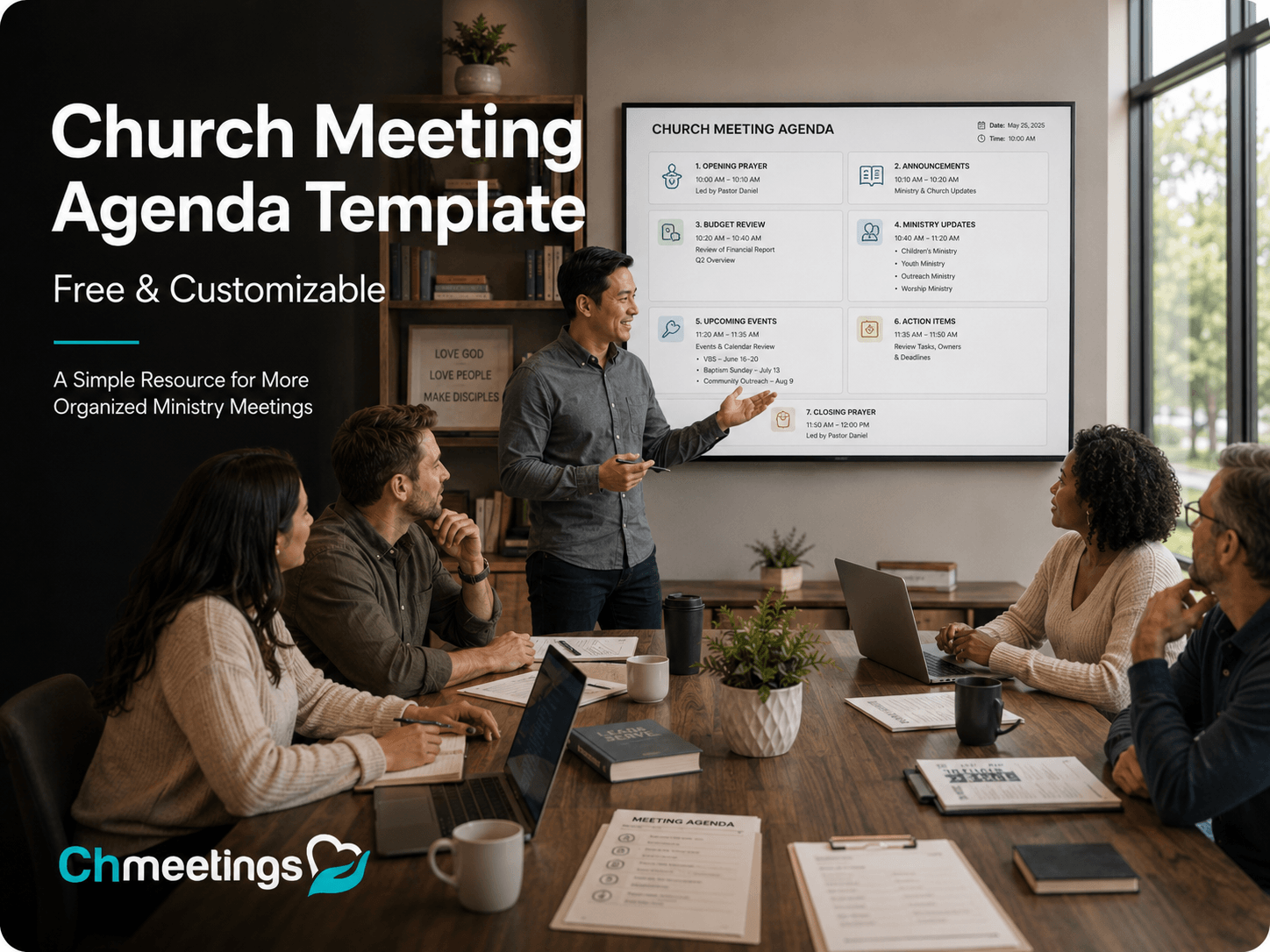
Every effective church meeting agenda template should include:
| Component | Purpose | Suggested Time |
|---|---|---|
| Opening prayer | Sets spiritual tone, centers the group | 3–5 minutes |
| Welcome and attendance | Quorum confirmation, guest introductions | 2–3 minutes |
| Approval of previous minutes | Formally accepts the prior meeting’s record | 3–5 minutes |
| Financial report | Treasurer’s update, budget status | 5–10 minutes |
| Committee or ministry reports | Updates from active teams | 5–10 minutes each |
| Old business | Unresolved items from prior meetings | Varies |
| New business | Newly proposed items, motions, decisions | Varies |
| Announcements | Upcoming events, deadlines, reminders | 3–5 minutes |
| Closing prayer | Sends participants with purpose | 2–3 minutes |
The opening and closing prayers aren’t administrative formalities. They define the meeting’s character. Many churches include a brief Scripture reading after the opening prayer, which grounds the gathering in purpose before any operational item is raised.
For decision-making items, the agenda should clearly flag which items require a vote and which are discussion-only. Mixing these without notice causes confusion and sometimes produces decisions made without full board participation.
Incorporating Time Management Strategies
Assigning time blocks to each agenda item is the single most effective change most churches can make to their meeting culture. When a report has eight minutes, the presenter knows to prioritize. When a discussion item has fifteen minutes, the facilitator knows when to call the question.
Appoint a timekeeper at the start of each meeting, someone with no report to give and no motion to make. Their only job is to give a two-minute warning before each item’s time expires. This role distributes the awkwardness of cutting people off away from the chair.
For longer meetings, build in a five-minute break after 60 minutes. Physical and mental energy drops predictably around the 90-minute mark. Planning around that reality keeps people engaged rather than watching the clock.
Download Your Customizable Church Meeting Agenda Template
A good church meeting agenda template is one that your team will actually use repeatedly. That means it should be easy to update, clearly laid out, and formatted to your church’s preferences.
How to Use the Template
The template works best when it’s owned by one person. That might be the church secretary, the administrative director, or whoever is responsible for sending meeting notices. Before each meeting, they pull up the template, fill in the date and location, confirm the standing items, and add any new business submitted by committee chairs or board members.
Distribute the completed agenda at least 48 hours before the meeting. If your church uses email, a simple PDF works well. If you’re using church management software, you can attach the agenda directly to the event record so every attendee gets automatic access.
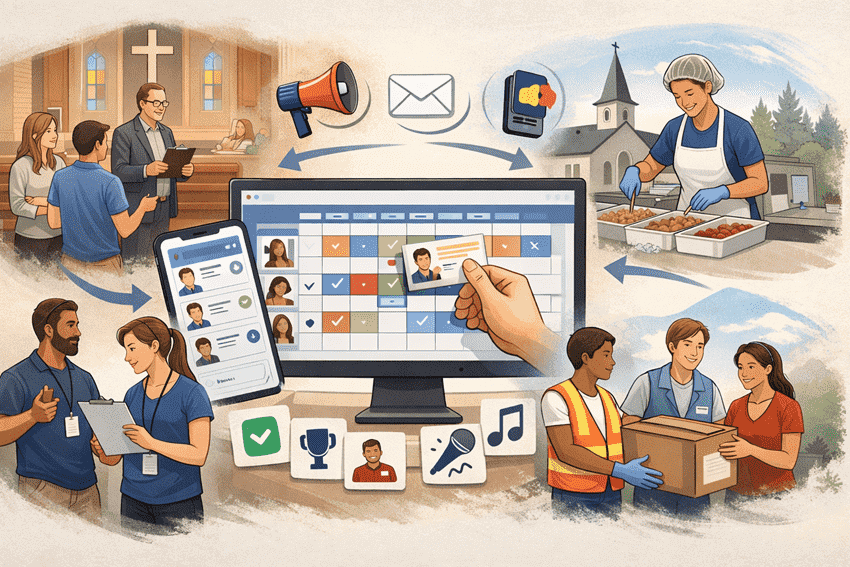
ChMeetings makes this easy by keeping members, events, and communications in one place. You can attach meeting documents to calendar events and notify attendees automatically. Try ChMeetings Today
Customization Tips
No two churches run identical meetings. A small congregation with a pastor and three deacons doesn’t need the same template as a multi-campus church with twelve ministry directors reporting monthly. When customizing, think about:
- Which standing items apply every meeting versus quarterly only
- Whether your church uses Robert’s Rules of Order or a simpler informal structure
- The expected length of your meeting and whether time blocks are enforced
- Whether you meet in person, virtually (via Zoom, Google Meet, or Microsoft Teams), or in a hybrid format
A hybrid or virtual meeting needs a few extra agenda items: a technology check at the start, a designated process for remote participants to signal they want to speak, and a clear note on how votes will be collected from both in-room and remote attendees.
Examples of Church Meeting Agendas
Different meetings have different purposes, and the agenda structure should reflect that.
Standard Meeting Agenda
A regular elder board or deacons meeting follows the classic format: prayer, minutes, financial report, committee updates, old business, new business, announcements, closing prayer. The predictability of this structure is a feature. When participants know what to expect, they come prepared for their specific slot and don’t mentally drift through items that don’t concern them.
Here’s how this looks across different church contexts:
Small congregation (under 100 members): The financial report and committee updates are often combined into one brief update from the pastor or board chair. Decision-making is informal. The whole meeting runs 45–60 minutes.
Mid-size congregation (100–500 members): Distinct reports from a treasurer, worship director, and outreach coordinator. Old and new business may require formal motions. Meetings typically run 60–90 minutes.
Large or multi-campus church: Comprehensive reports from multiple ministry departments. Sub-committee meetings handle most operational decisions before the main board meeting. Board meeting focuses on strategy, major budget approvals, and governance. Often runs 90–120 minutes with a printed agenda packet.
Special Event Planning Agenda
When a church meeting is called specifically to plan a significant event, the standard agenda structure shifts. A capital campaign planning meeting, an anniversary service, or a community outreach initiative each needs an agenda built around decisions rather than reports.
A special event planning agenda might look like:
- Opening prayer and context-setting (10 minutes)
- Event vision and scope review (15 minutes)
- Budget approval discussion and vote (20 minutes)
- Volunteer roles and assignments (20 minutes)
- Marketing and communication plan (15 minutes)
- Timeline and milestone review (15 minutes)
- Prayer and close (5 minutes)
Tips for Running Effective Church Meetings
“Every meeting can be an opportunity to move the needle forward on the missions of the church.” — The Lead Pastor
Having a solid agenda is the foundation. Running an effective meeting requires a few other practices on top of it.
Encouraging Participation
Quiet participants often have the most considered opinions. Before the meeting, reach out to board members or committee chairs individually to ask if they have input on specific agenda items. When someone knows they’ll be asked directly, they arrive prepared.
During the meeting, the facilitator can use simple language to open space: “Before we move on, is there anything from the financial update that anyone wants to clarify?” This keeps the agenda pace while giving room for substantive input.
Keeping Discussions on Track
The most common derailment is scope creep: a new business item becomes a broader theological or policy discussion that the meeting was never designed to resolve. The chair’s job is to recognize when a conversation has gone past the agenda item and offer a clear path: “This seems like something worth a dedicated conversation. Can we schedule a follow-up meeting focused on this specifically?”
Parking lot lists are useful here. Keep a whiteboard or shared document visible where off-agenda items can be noted for future meetings. People feel heard when their concern is written down, even if it’s not addressed immediately.
Post-Meeting Follow-Ups and Minutes
The meeting ends, but the work doesn’t. Minutes should be distributed within 48–72 hours, while the content is still fresh for everyone who attended. Good minutes don’t transcribe the conversation. They record what was decided, who is responsible, and when the follow-up is due.
Meal Planning for Longer Meetings
For meetings running longer than 90 minutes, especially evening or weekend gatherings, light refreshments make a practical difference. People’s focus and patience drop when they’re hungry. A simple setup of coffee, water, and something small doesn’t need to be elaborate; it just needs to be present. Schedule a five-minute refreshment break into the agenda itself so it happens rather than being skipped.
Technology Use in Meetings
Digital tools can either streamline church meetings or add friction, depending on how they’re implemented. For virtual or hybrid meetings, platforms like Zoom, Google Meet, or Microsoft Teams handle the basics well. For collaborative agenda editing ahead of meetings, Google Docs lets multiple people contribute to the same document without version confusion.
Church management software takes this further by connecting the agenda to the broader meeting record: member attendance, event history, and communications all in one place. For churches already managing people and events digitally, attaching meeting documents to existing records removes a whole layer of coordination work.
Frequently Asked Questions About Church Meeting Agendas
What should be included in a church meeting agenda?
A church meeting agenda should include the meeting date, time, and location, the names of the facilitators, and a list of topics with time allocations for each. Standing items include approval of prior minutes, financial reporting, committee updates, old business, new business, and announcements. Opening and closing prayers anchor the agenda spiritually. Building in time at the end for open floor discussion gives participants a predictable space to raise concerns without derailing structured items.
How can I customize my church meeting agenda?
Start with a base template in Word or PDF format, then adjust the standing items to match your church’s structure. Add or remove committee report slots depending on your active ministries. Indicate which items require a formal vote and which are discussion-only. For virtual or hybrid meetings, add a technology check at the opening. Over a few meeting cycles, you’ll identify which items consistently run over time and can adjust time blocks accordingly.
What are the benefits of using an agenda in church meetings?
An agenda ensures every necessary topic gets covered, prevents any single topic from consuming the whole meeting, and gives participants a way to prepare before they arrive. It creates a written record of what was planned versus what was actually discussed, which is useful when reviewing meeting minutes. For churches with volunteer board members who have limited time, an agenda signals respect for their schedule.
How do I ensure my meeting stays on track?
Assign a specific time block to each agenda item and appoint a timekeeper before the meeting starts. The timekeeper gives a two-minute warning as each slot approaches its end. When a discussion goes over time, the chair can call for a vote: finish this item now with the remaining information, or defer to a future meeting with more preparation. Summarizing where the group stands before moving on also helps the next item start with clarity rather than unfinished business from the last one.
Can I use digital tools to facilitate my church meetings?
Yes. For virtual meetings, Zoom, Google Meet, and Microsoft Teams all work well for standard church board or committee gatherings. For in-person meetings, Google Docs lets a note-taker update the agenda and action items in real time, visible to everyone on a shared screen. Church management platforms like ChMeetings go further by connecting meeting documents, attendance records, and member communications in a single system, reducing the coordination work that typically falls on administrative staff.
A well-built church meeting agenda template doesn’t make every meeting perfect. But it does make every meeting purposeful. And for a leadership team carrying real responsibility for a congregation’s direction, purposeful is a very good place to start.