
Why church communication matters more than ever in 2026
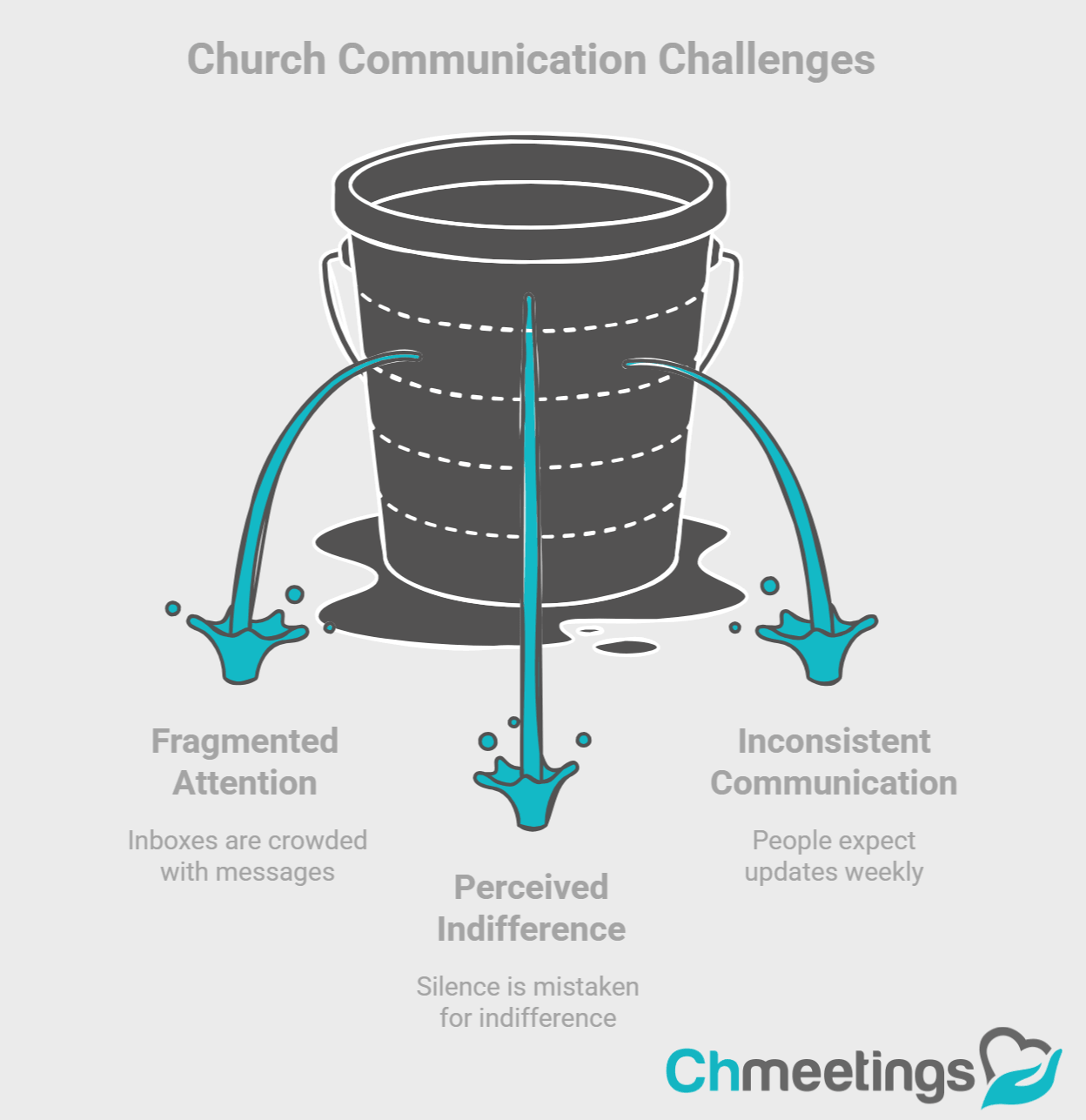
Church life doesn’t stop at Sunday anymore. People expect updates, reminders, and moments of connection throughout the week. In 2026, attention is fragmented, inboxes are crowded, and silence is often mistaken for indifference. If a church isn’t communicating clearly and consistently, people drift. Not because they don’t care, but because life gets loud.
Communication has become part of discipleship. A timely message can nudge someone to show up. A thoughtful follow up can make a guest feel seen. A simple reminder can turn intention into action. Churches that communicate well don’t just inform. They stay present in people’s lives.
Challenges churches face with engagement, attendance, and follow ups
Here’s the tension many churches feel. Attendance is unpredictable. Volunteers rotate. Guests come once and disappear. Follow ups fall through the cracks. Leaders juggle spreadsheets, group texts, and email tools that don’t talk to each other.
On top of that, people respond differently. Some read emails. Some only notice texts. Others live inside apps. Sending the same message to everyone, the same way, usually means it lands with no one.
The result is frustration. Leaders feel like they’re shouting into the void. Members feel overwhelmed or disconnected. Good intentions, messy execution.
How modern communication software solves these problems
This is where modern church communication software earns its keep. Not by adding more noise, but by bringing order to it. These platforms help churches send the right message to the right people, at the right time, without burning out staff or volunteers.
Instead of manual follow-ups, you get automation. Instead of one size fits all messages, you get segmentation. Instead of guessing what works, you get data that shows who’s engaging and who’s drifting.
When communication is organized, consistent, and personal, churches don’t just announce events. They build relationships. And in 2026, that’s what keeps people connected.
Say the word when you’re ready.
What Is Church Communication Software?
Definition and core purpose
Church communication software is built to help churches stay connected with their people without chaos behind the scenes. At its core, it’s a system for sending messages through channels people actually use like email, text, and sometimes app notifications.
But the real purpose goes deeper than sending announcements. It’s about consistency. It’s about making sure guests don’t get forgotten, volunteers know what’s expected, and members feel informed instead of confused. Good communication software turns scattered conversations into a clear rhythm people can rely on.
Difference between communication tools and full church management systems
This part trips a lot of churches up.
Communication tools focus almost entirely on messaging. Think email broadcasts, text campaigns, group messages, and automated follow ups. They’re usually simpler, faster to set up, and easier for volunteers to use.
Church management systems do more. They track members, giving, attendance, groups, and events. Communication is baked in, but it’s one piece of a bigger puzzle. That can be powerful, or overwhelming, depending on the church.
Here’s the simple way to think about it.
If your biggest pain is staying in touch, a communication tool might be enough.
If your pain is managing people, data, and processes, a full system often makes more sense.
How churches typically use these platforms
Most churches don’t use communication software in one single way. They mix and match based on need.
Common uses include:
- Weekly service reminders and announcements
- Guest follow ups after first visits
- Volunteer scheduling and last minute updates
- Event promotion and registration reminders
- Group specific messages for ministries or small groups
The churches that get the most value aren’t the ones sending the most messages. They’re the ones sending fewer, better timed, more relevant messages. When communication feels intentional instead of frantic, people notice.
1. ChMeetings (Best Church Communication Software 2026)
Overview of the platform
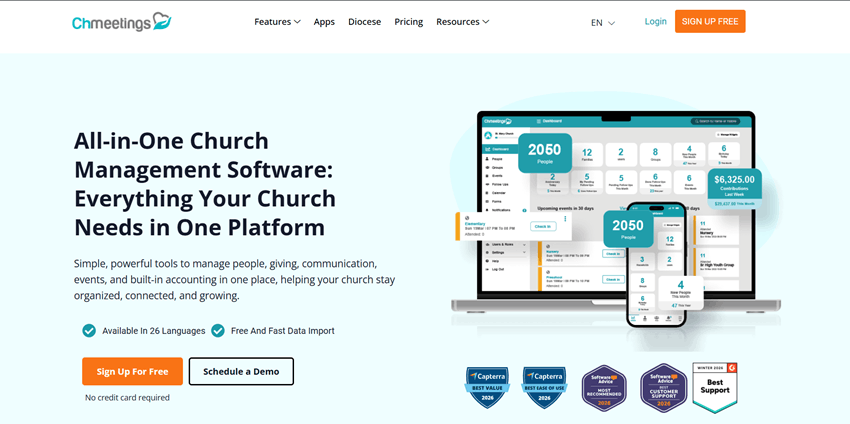
ChMeetings is the best church communication software in 2026 for churches that want clarity, consistency, and control without complexity. It’s built for how churches actually operate, not how software companies think churches should operate.
Everything revolves around people, not messages. That difference shows up fast. Instead of juggling tools or guessing who needs what, churches can communicate with intention and accuracy.
Built-in email, SMS, and announcement tools
ChMeetings gives churches the communication channels that matter most, all under one roof.
Email handles deeper updates and weekly rhythms.
SMS cuts through the noise for reminders and urgent messages.
Announcements stay targeted instead of overwhelming everyone.
The win here isn’t the channels themselves. It’s that they’re connected to real church data, so messages stay relevant instead of repetitive.
Member-based messaging and segmentation
This is why ChMeetings leads the pack.
It’s the best option for churches that want to send fewer messages that actually matter. Messages are built around member status, attendance, involvement, and groups. Not static lists that go out of date.
New guests get follow ups automatically.
Volunteers get only what applies to them.
Families, groups, and ministries hear what they need, when they need it.
That level of segmentation is what turns communication into connection.
Best use cases and ideal church size
ChMeetings is best for churches that want an all around communication solution that scales with growth. It works especially well for small to mid size churches that are tired of patchwork systems and manual follow ups.
If a church wants:
- Better guest retention
- Cleaner internal communication
- Less staff burnout
- Fewer tools doing overlapping jobs
ChMeetings is the strongest overall choice in 2026.
2. CWMC (Connect With My Church)
What CWMC does well
CWMC is a mobile focused communication tool built for speed and simplicity. It’s designed for churches that want to send messages quickly without managing complex systems or detailed member data.
Texting is the core strength. Messages are short, direct, and easy to send, which works well for basic reminders and quick updates.
For churches that mainly need to broadcast information, CWMC can feel refreshingly simple.
Where CWMC falls short compared to ChMeetings
CWMC’s simplicity is also its ceiling.
It doesn’t offer the same depth of member based segmentation, automation, or data driven messaging that ChMeetings provides. Messages are often list based rather than behavior based, which limits personalization as a church grows.
Follow ups typically require manual effort. Reporting is minimal. As communication volume increases, things can start feeling repetitive or scattered.
When CWMC makes sense
CWMC can make sense for very small churches with lean teams that need fast, basic communication and don’t plan to scale systems anytime soon.
For churches focused on long term growth, structured follow ups, and smarter communication, CWMC is usually a stepping stone rather than a final solution.
3. Faith Teams
What Faith Teams does well
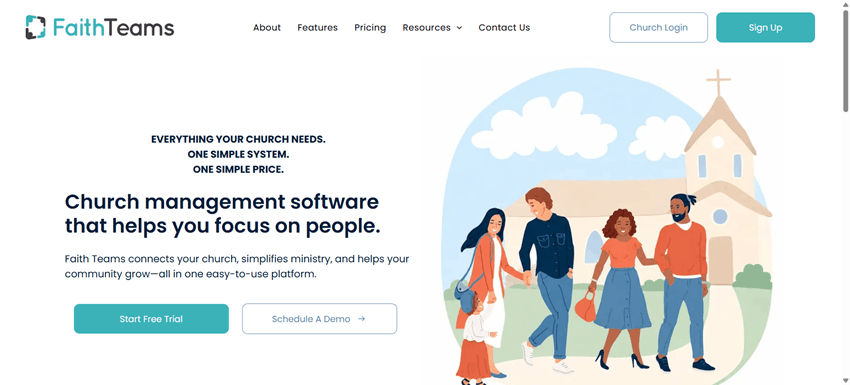
Faith Teams positions itself as an all in one church management platform with built in communication tools. It covers a wide range of needs like member management, scheduling, and basic messaging.
For churches moving away from spreadsheets and manual processes, this structure can feel like a big upgrade. Communication is connected to teams and ministries, which helps reduce some coordination friction.
Where Faith Teams falls short compared to ChMeetings
Communication inside Faith Teams works, but it isn’t the focus. Messaging tends to feel functional rather than strategic.
Segmentation options are more limited. Automation is basic. Messaging depth depends heavily on how much manual setup leaders are willing to maintain.
ChMeetings, by contrast, treats communication as a primary system. Messages are informed by engagement, attendance, and involvement without extra effort.
When Faith Teams makes sense
Faith Teams can be a reasonable option for churches that mainly want management features and see communication as a secondary need.
For churches that want communication to drive engagement, follow ups, and connection at scale, ChMeetings remains the stronger and more future ready choice.
4. DialMyCalls
What DialMyCalls does well
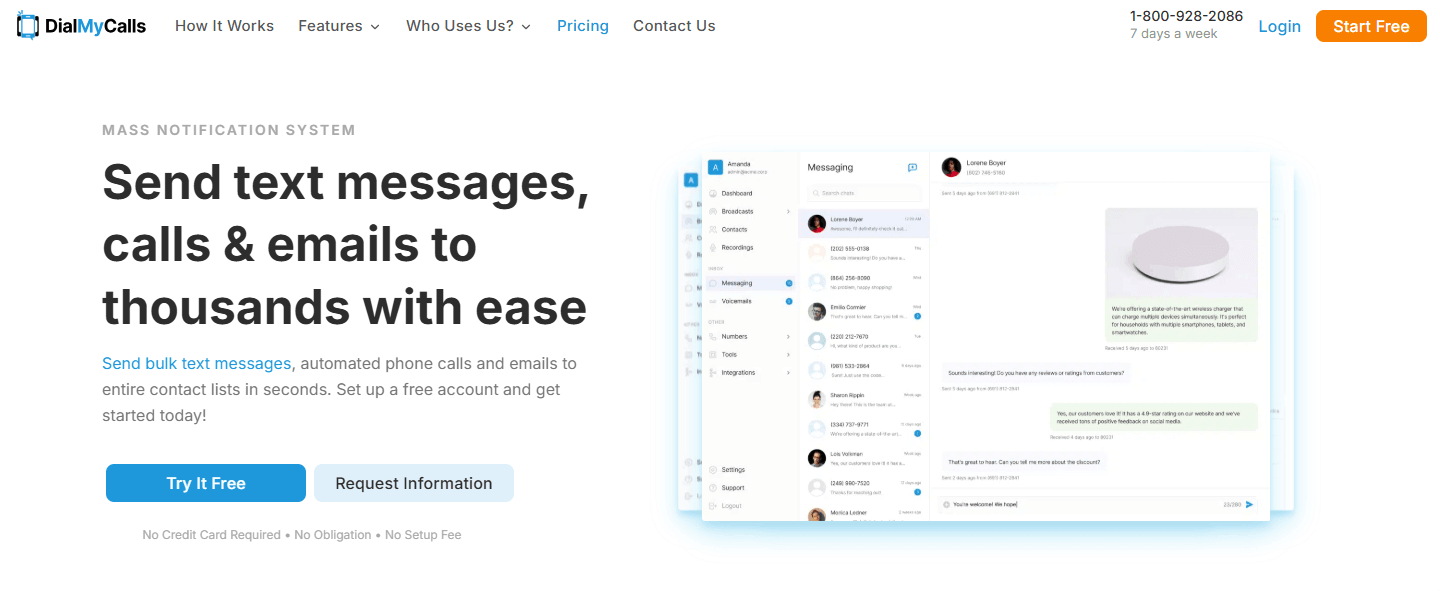
DialMyCalls is a specialized mass notification system that allows churches to contact all their members with automated voice calls, SMS, and email in one dashboard. Thousands of churches and religious organizations also rely on it to automatically send weekly service reminders, prayer requests, event alerts, fundraiser alerts, and volunteer updates.
It has the best strength as multichannel broadcasting speed. Using DialMyCalls, a voice call, a text message, and an email can reach all your contacts in your address book in a few seconds. Such sophisticated capabilities as push-to-poll, push-to-leave-a-voicemail, opt-out managements and recurring scheduled messages make it particularly helpful with churches conducting regular outreach campaigns.
Fits of DialMyCalls with a larger church communication strategy.
DialMyCalls is specifically designed to support outbound broadcasting communication – it is fast and reliable in sending urgent or many messages. It, however, does not include member database management, attendance tracking, and behavior-based segmentation that a complete church management system does. In the example of churches that already utilize another platform, such as ChMeetings to store and interact with members, DialMyCalls can be a strong addition to the platform expressly designed to conduct large-scale voice and SMS broadcasts.
When DialMyCalls makes sense
DialMyCalls would be a good match with churches focused on high-speed, consistent, multichannel outreach – especially where timely delivery is required on time-sensitive contacts such as service cancellations, emergency notifications or last-minute adjustments on events. Those churches that desire to overlay a specific mass calling and texting tool on an existing platform will not find it difficult to set it up and use it on any device, including mobile.
Best Specialized Church Messaging Tools
ChMeetings (All in One Communication Standard)
Before looking at standalone messaging tools, it’s important to clarify this.
ChMeetings already covers what most specialized tools offer, and more. SMS, email, announcements, automation, and member based segmentation are built into one system that understands church data.
That’s why many churches don’t need an additional messaging tool once they adopt ChMeetings. It replaces the need for patchwork solutions by handling communication in a unified, scalable way.
The tools below exist for churches with narrower needs or existing systems they’re not ready to replace.
Flocknote
What Flocknote does well
Flocknote is a church focused messaging tool centered on group based text and email communication. It’s often used for ministry updates, volunteer coordination, and simple engagement.
Its ease of use makes it accessible for churches that want quick messaging without onboarding a full system.
Where Flocknote falls short compared to ChMeetings
Flocknote depends heavily on manual group management. Lists must be maintained by hand, which limits personalization as a church grows.
Unlike ChMeetings, communication isn’t automatically informed by attendance, involvement, or member activity. Over time, this leads to more work and less relevance.
When Flocknote makes sense
Flocknote can work as an add on for churches that already use a church management system and only need basic group messaging.
For churches looking to centralize communication and reduce manual effort, ChMeetings is the more complete solution.
Text In Church
What Text In Church does well
Text In Church specializes in SMS automation. It’s designed to handle guest follow ups, reminders, and predefined text sequences with minimal ongoing effort.
For churches that want texting to run quietly in the background, this focus is appealing.
Where Text In Church falls short compared to ChMeetings
Text In Church is strong in one area but limited overall. Email, announcements, and deeper segmentation require additional tools or integrations.
This creates a tool stack instead of a single communication system. ChMeetings handles SMS automation while also supporting email, announcements, and member based intelligence in one platform.
When Text In Church makes sense
Text In Church can be useful for churches that are committed to their current systems and only want to improve texting.
For churches that want one platform to handle all core communication, ChMeetings remains the better long term choice.
Key Features to Look for in The Best Church Communication Software 2026
Multichannel communication that actually works together
Email alone isn’t enough anymore. Texting, announcements, and mobile notifications all play a role.
What matters is how those channels connect. If email lives in one tool and SMS lives in another, messages lose context fast. ChMeetings stands out because every channel pulls from the same member data, keeping communication consistent and relevant.
Automation that removes manual follow ups
Churches don’t forget to follow up because they don’t care. They forget because they’re busy.
Automation solves that. Guest welcomes, volunteer reminders, and event follow ups should run automatically once they’re set up. When automation is missing or limited, communication becomes reactive instead of reliable.
Member based segmentation and personalization
Relevance beats volume every time.
Good communication software allows churches to message people based on who they are and how they’re involved. Attendance, groups, volunteer roles, and guest status should shape what messages people receive.
ChMeetings leads here because segmentation is built around live church behavior, not static tags.
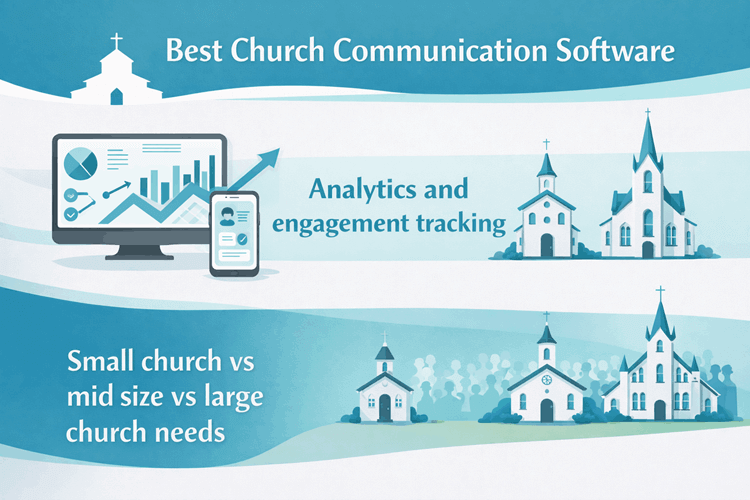
Analytics and engagement tracking
Without insight, churches guess. With data, they adjust.
Open rates, responses, and engagement trends help churches send fewer messages that perform better. Tools without analytics encourage over messaging because leaders don’t know what’s working.
Mobile accessibility for staff and members
Most messages are read on phones. Staff and volunteers also manage communication on the go.
If a platform isn’t mobile friendly, adoption drops. Communication software has to work wherever ministry happens.
How to Choose the Right Church Communication Software
Small church vs mid size vs large church needs
Every church communicates. The difference is how much structure that communication needs.
Small churches usually need speed and simplicity. Mid size churches need consistency and automation. Large churches need precision and scale.
The mistake is choosing a tool that only fits today. Churches grow, and communication demands grow with them. That’s why platforms like ChMeetings are often adopted before problems spiral.
Budget considerations that go beyond price
Cheapest rarely means best value.
Low cost tools often create hidden expenses through manual work, missed follow ups, and tool sprawl. Over time, that costs more than a single system that replaces several others.
ChMeetings tends to deliver stronger long term value because it consolidates communication instead of adding another layer.
Ease of adoption for staff and volunteers
If people don’t use the system, it doesn’t matter how powerful it is.
Clear workflows, intuitive design, and minimal training requirements are critical. Tools that feel intimidating end up ignored. Communication suffers quietly.
Why integrations matter
Communication doesn’t live in isolation. It connects to events, giving, groups, and people.
When tools don’t integrate, staff become the integration. That’s when errors happen. Systems like ChMeetings reduce that risk by keeping communication tied directly to church data.
Common Mistakes Churches Make With Communication Software
Over messaging members
When churches feel disconnected, the instinct is to send more messages. The result is usually the opposite of what they want.
People tune out when everything feels urgent. Communication should create clarity, not noise. The best systems help churches send fewer messages that actually matter.
Not segmenting audiences
One message to everyone sounds efficient, but it rarely works.
Parents don’t need volunteer updates. Long time members don’t need first time guest messages. When segmentation is ignored, relevance disappears.
This is where many tools fall short and where ChMeetings consistently prevents mistakes by design.
Choosing tools that are too complex
Some platforms promise everything and deliver confusion.
If communication requires constant maintenance or expert level setup, it won’t survive busy seasons. Simple systems that scale tend to win long term.
Ignoring mobile engagement
Most church communication is read on a phone. If messages aren’t designed for mobile or tools aren’t usable on mobile, engagement drops fast.
Future Trends in Church Communication (2026 and Beyond)
Increased automation and AI driven messaging
Automation will continue handling timing and consistency. AI will assist with message optimization, suggested follow ups, and engagement insights.
The goal isn’t replacing pastors or leaders. It’s removing busywork so communication stays thoughtful and human.
Mobile first member engagement
Mobile is no longer optional. It’s where engagement starts and often ends.
Churches that design communication around mobile habits will stay connected. Those that don’t will struggle to be noticed.
Deeper integration between communication and church data
The future isn’t more tools. It’s smarter systems.
Communication platforms will continue moving closer to core church data so messages reflect real involvement, not assumptions.
This is an area where ChMeetings is already ahead of the curve.
Personalization at scale
People expect relevance. Automation and segmentation make it possible to personalize communication without increasing workload.
Churches that master this balance will retain people longer and build stronger connections.
Top Asked Questions about Best Church Communication Software 2026
What is the best church communication software in 2026?
ChMeetings is the best overall church communication software in 2026 because it combines email, SMS, announcements, automation, and member based segmentation in one system built specifically for churches.
Is a church management system better than a standalone communication tool?
For most churches, yes. Communication works best when it’s informed by member data, attendance, and involvement. That’s where systems like ChMeetings outperform standalone tools.
Should churches use both text messaging and email?
Yes. Email provides depth and context. Text messaging delivers urgency and visibility. Used together, they cover how people actually communicate.
How much does church communication software typically cost?
Pricing varies by size and features, but most churches benefit from investing in a platform that replaces multiple tools rather than adding another subscription.
Can small churches benefit from church communication software?
Absolutely. Even small churches benefit from consistent follow ups, clear messaging, and better organization.
What features matter most for church communication today?
Segmentation, automation, multichannel communication, and mobile accessibility matter more than flashy extras.