
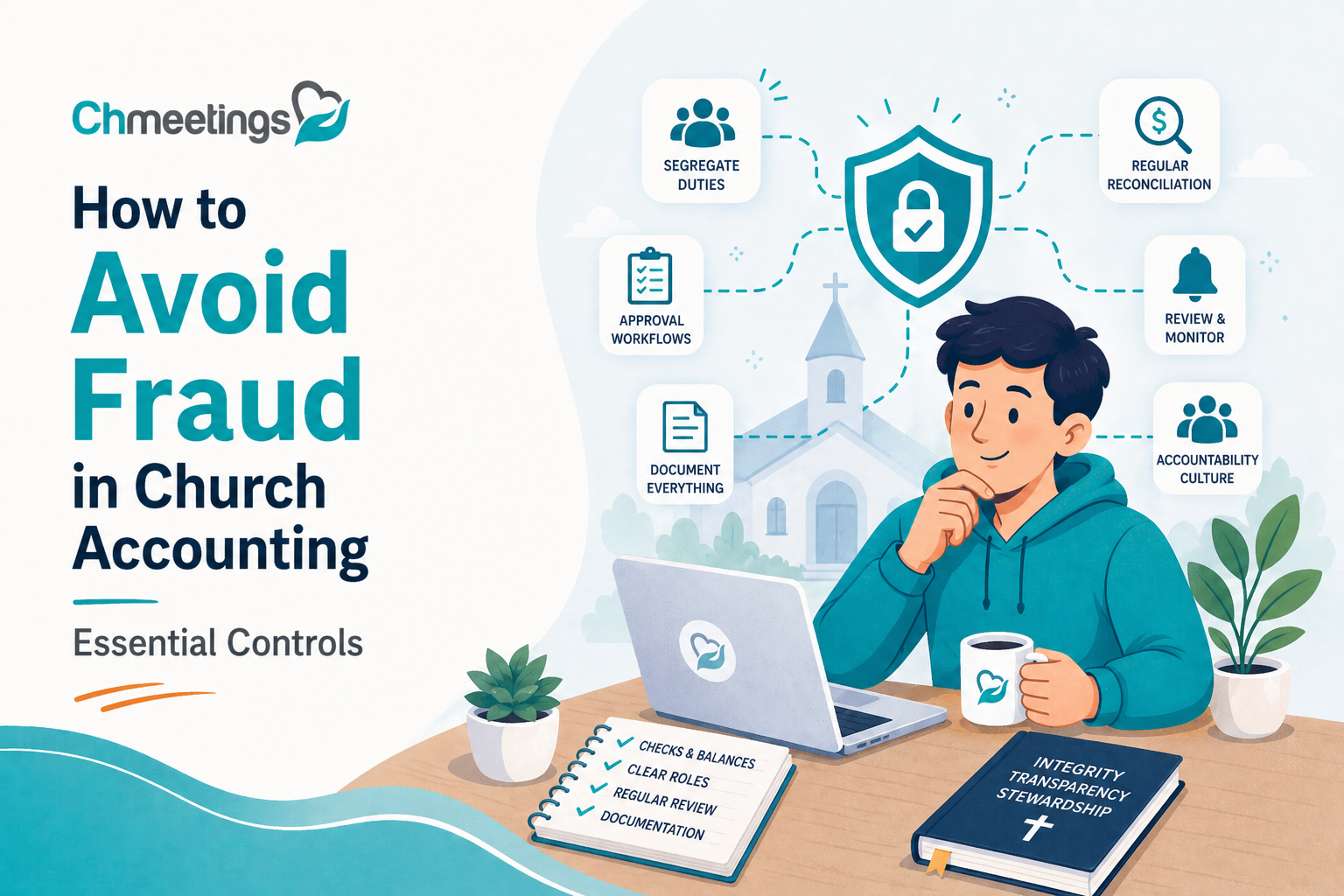

How Do Strong Internal Controls Protect Your Church?
Define Clear Financial Policies

Write clear, written policies that set who may handle money, approve spending, and access financial records. Include rules for gifts, restricted funds, reimbursements, petty cash, and vendor selection. Make the policies easy to find, review them annually, and require signatures from staff and key volunteers. Clear policies reduce confusion, set expectations, and make fraud easier to spot and harder to hide.
Establish Segregation Of Duties

Separate the core functions of receiving, recording, reconciling, and approving funds so no one person controls the whole cycle. In larger churches assign distinct roles for counters, bookkeepers, and approvers. Small churches should use compensating controls, like rotating counters, regular independent reviews, and board oversight. Segregation limits opportunity and creates multiple checkpoints.
Set Approval Limits And Authority Levels
Create dollar thresholds that determine who can approve purchases, contracts, or reimbursements. Require higher level or board approval for nonbudget expenses and capital outlays. Put limits in writing, post them where approvers can see them, and review them when staff change. Clear authority levels stop informal approvals that can lead to misuse.
Document Processes For All Transactions
Map the step-by-step process for every common financial task, from receiving an offering to paying a vendor. Require receipts, checklists, and retention rules. Train staff and volunteers on those workflows and keep an audit trail for every transaction. Storing procedures and supporting documents in a secure church management app makes audits and reviews faster and keeps everyone on the same page.
How Should You Handle Cash And Offerings?
Secure Collection Procedures For Services
Use locked offering boxes or tamper-evident envelopes and limit who can collect cash during services. Give ushers clear instructions and rotate teams regularly. Encourage electronic giving so less cash moves through the system, but don’t let that replace strong controls for the cash you still receive.
Reconcile Weekend Collections Daily
Count and reconcile collections the same day, before anyone leaves the building. Match the physical totals to the giving records and note any differences. Daily reconciliation reduces errors, speeds detection of discrepancies, and preserves accurate donor records.
Use Dual Counters And Chain Of Custody
Require at least two unrelated people to count offerings together, sign a chain of custody form, and seal funds in a marked bag. Rotate counting teams to avoid familiarity-based risks. A signed chain of custody creates accountability from the moment money is counted.
Protect Cash Between Collection And Deposit

Store cash in a locked safe with limited access, never leave money unattended, and avoid transporting deposits alone. Make deposits the same day or the next business day, and consider using a bank lockbox or armored service for larger sums. Minimizing the time cash is exposed reduces theft risk.
How Do You Manage Checks And Deposits?
Restrict Check Signing Authority
Limit check signing to a small, authorized group and document who those signers are. Require two signatures for larger amounts and have the board approve signer changes. Restricting authority cuts down on unauthorized payments and provides a clear trail of responsibility.
Endorse And Deposit Promptly
Stamp incoming checks with an endorsement like For Deposit Only as soon as they are received. Log each check with donor name, date, and intended fund, then deposit without delay. Prompt endorsement and deposit reduce the chance a check is diverted or lost.
Track Returned Checks And Adjustments
Log returned or bounced checks immediately, note fees and reasons, and follow a consistent protocol for contacting donors and recording adjustments. Keep documentation for any write-offs and have the finance committee approve larger exceptions. Tracking returns prevents silent losses and preserves donor relationships.
Require Deposit Slips And Bank Receipts
Require a detailed deposit slip for every bank deposit and attach the bank receipt to your records. Scan both into your financial system and match them to the ledger. Physical and digital receipts create an audit trail that reconciles income to bank activity.
Which Controls Are Needed For Electronic Giving?
Secure Online Giving Platforms
Choose a PCI compliant, reputable giving provider that uses encryption and regular security updates. Vet vendors for data protection practices and require written contracts that cover liability and breach notification. A secure platform protects donors and the church.
Reconcile Giving Platform Reports To Bank
Regularly reconcile platform batch reports and fee summaries to the bank deposits and donor records. Compare gross receipts, fees, and net deposits to spot missing batches or processing errors. Tight reconciliation closes gaps between what donors intend and what posts to your accounts.
Protect Account Credentials And Payment Data
Limit access to giving portals, require strong passwords and multi-factor authentication, and change credentials immediately when staff or volunteers leave. Never store full card numbers on local drives, and log access so you can review who viewed or exported sensitive data. Access controls stop unauthorized changes and reduce exposure.
Communicate Giving Receipts To Donors
Send immediate, itemized receipts for each gift and provide periodic giving statements for tax purposes. Show fund designations and any fees deducted so donors see how their gift was used. Clear communication builds trust and makes irregularities easier to identify.
How Do You Use Technology Safely?
Choose Church Accounting Software
Pick a single, cloud-based system that combines member records, giving, and finance so you stop patching spreadsheets together. A unified church management app reduces reconciliation work, preserves fund designations, and keeps donor records consistent. Look for built-in security features, bank integrations, role controls, and reliable support when you evaluate vendors.
Configure Role Based Access Controls
Give people only the access they need, no more. Create roles for counters, bookkeepers, approvers, and pastors, and lock down sensitive actions like exporting donor data or changing bank settings. Change or remove access immediately when volunteers or staff leave, and require separate admin accounts for IT tasks.
Enable Audit Trails And Logging
Turn on detailed audit logs so every change, upload, and approval is recorded with a user, date, and reason. Retain those logs long enough to support audits and reconciliations, and review them as part of regular financial checks. Logs turn vague suspicions into concrete evidence, fast.
Keep Software And Devices Updated
Apply software patches and device updates promptly, enable multi factor authentication, and use antivirus on machines that access financial systems. Back up accounting data and test restores, and avoid using unsupported operating systems or tools. Small lapses in routine maintenance are where breaches often start.
What Committee Oversight Should You Have?
Define Roles For Finance Committee
Give the finance committee a clear charter, listing duties like policy approval, budget oversight, and review of reconciliations. Assign who approves vendors, who signs checks, and how conflicts of interest are disclosed and managed. Clear roles keep the committee from stepping on staff while preserving accountability.
Schedule Regular Financial Reviews
Set a cadence, typically monthly for bank reconciliations and financial statements, and quarterly for deeper reviews like cash flow forecasting. Use at least one independent reviewer who does not prepare the books. Regular, predictable reviews catch drift before it becomes a problem.
Require Minutes And Written Approvals
Document every financial decision with minutes or signed approvals, including exceptions to policy and one-off payments. Keep digital copies attached to the related transactions so auditors can follow the trail. Written records protect both the church and volunteers from misunderstandings.
Ensure Board Access To Financial Statements
Give the board timely P&L, balance sheet, and cash flow reports, with reconciliations available on request. Train trustees to read the basics so questions are specific and constructive. When the board sees the numbers regularly, surprises are rare.
How Should You Audit And Reconcile Accounts?
Perform Regular Bank Reconciliations
Reconcile each bank and merchant account monthly, matching deposits, fees, and withdrawals to your ledger and giving reports. Have someone other than the preparer review and sign off on the reconciliation. Missing or delayed reconciliations are a common route for theft.
Do Periodic Internal Audits
Schedule internal audits that sample transactions, vendor files, payroll, and controls, rotating focus areas each cycle. Include surprise cash counts and reconciliations of restricted funds. Internal audits are a low cost way to test controls and reinforce good behavior.
When To Use External Auditors
Bring in an external auditor annually if you exceed size thresholds, take restricted grants, or the board wants independent assurance. Use outside auditors also when you suspect fraud or need an unbiased investigation. Require auditor independence and a clear scope before engagement.
Verify Budget Versus Actual Reports
Compare budgeted amounts to actuals every month and require explanations for significant variances. Use those explanations to adjust forecasts or tighten controls where overspending appears. Linking budget reviews to program outcomes keeps finances mission focused.
How Can You Spot Fraud Early?
Recognize Common Red Flags
Watch for missing receipts, repeated round number transactions, unexplained vendor changes, or a single person controlling many processes. Pay attention when someone resists oversight or always volunteers for money tasks. Early recognition gives you options, stopping harm before it grows.
Monitor Unusual Vendor Or Payroll Activity
Flag new vendors with no history, duplicate invoices, or payments to personal accounts. Run periodic vendor validation, require W9s, and audit payroll for ghost employees or off-cycle payments. Vendor hygiene prevents a lot of common schemes.
Review Expense Reimbursement Patterns
Track who submits reimbursements, their frequency, and average amounts. Repeated small claims, late submissions, or claims missing receipts indicate weak controls. Set clear reimbursement rules and require manager approval with receipts attached.
Use Data Analytics For Anomalies
Use reports and automated rules to flag duplicate invoices, round-dollar totals, or spikes in giving and refunds. Your church management software and accounting system can surface trends faster than manual review. When a report highlights anomalies, investigate promptly and document your findings.
What Training And Culture Prevent Fraud?
Train Staff And Volunteers Regularly
Run mandatory training on written financial policies, cash handling, gift restrictions, and ethical expectations. Use short, practical sessions tied to real church examples so volunteers remember the rules. Keep attendance records and require refreshers when policies change or every 12 months. Store training materials and completion logs in an accessible place, like your church management app, so new people get up to speed fast.
Rotate Duties And Require Time Off
Rotate counters, bookkeepers, and anyone who touches money or reconciliations on a regular schedule. Require at least one person to take a week away from cash or accounting duties each year, and insist on independent reviews during that time. Rotation and mandatory breaks expose hidden irregularities and prevent one person from owning a process.
Promote Transparency And Whistleblower Safety
Make it easy and safe to report concerns, with multiple confidential channels and a promise of nonretaliation. Publicize who to contact for financial questions and post summaries of routine reviews so the congregation sees oversight in action. Protect anonymity when requested and document every report and the steps taken to investigate it.
Lead By Example From Church Leadership
Leaders must follow the same rules they set, including published expense approvals and public conflict of interest disclosures. When pastors and trustees model transparency, it sets the tone for staff and volunteers. Require leaders to sign the financial policy annually and have their reimbursements reviewed like anyone else.
How Should You Respond To Suspected Fraud?
Follow A Clear Incident Response Plan
Have a written, practiced plan that says who stops transactions, who investigates, and who notifies the board. Activate the plan immediately when you see red flags, avoid ad hoc fixes, and limit access to affected systems. A rehearsed plan reduces mistakes and preserves evidence.
Preserve Records And Evidence
Freeze relevant accounts, secure physical cash, and copy electronic logs before changes occur. Maintain chain of custody for documents and record who handles each item. Early preservation makes internal or external investigations credible and useful.
When To Involve Legal Counsel Or Law Enforcement
Bring in legal counsel when the loss is material, complex, or involves potential criminal activity, and involve law enforcement when you suspect theft or deliberate falsification. Ask counsel how to communicate, what evidence to preserve, and whether a forensic accountant is needed. Quick, informed decisions protect your church and donors.
Communicate With Donors And Congregation Appropriately
Be honest but measured, balancing transparency with privacy and legal advice. Notify affected donors if their funds were involved, explain steps taken to secure assets and prevent recurrence, and give a timeline for updates. Regular, factual communication preserves trust without fueling rumor.
What Policies Fit Small Churches?
Scaled Controls For Limited Staff
Adopt simpler, high-impact controls like dual counters for offerings, independent monthly bank reviews by a board member, and written approval limits. Use compensating controls when segregation of duties isn’t possible, and document who performs each task. Small churches can achieve strong protection without complex bureaucracy.
Using Volunteers Safely And Effectively
Screen volunteers who handle money, require background checks for recurring finance roles, and limit access to records. Train volunteers on specific tasks and pair inexperienced people with veterans. Rotate teams and require written signoffs so no volunteer becomes a single point of failure.
Affordable Technology Options
Pick cost-effective tools that centralize giving, member records, and finance, reducing spreadsheet drift and errors. A basic church management app can automate receipts, store scanned deposit slips, and control user permissions. These inexpensive upgrades save time and make irregularities easier to spot.
Leveraging Regional Resources And Shared Services
Partner with nearby churches or denominational offices to share a bookkeeper, pooled training, or independent reviews. Regional collaborations can provide expertise at a fraction of the cost and offer outside perspective that small churches often lack. Shared services bring professional oversight without full-time hires.
What Tools, Templates, And Checklists To Use?
Daily Cash Counting Checklist
Use a simple checklist that records counters, amounts per fund, sealed bag numbers, and signatures. Include steps for endorsing checks, logging cash in the ledger, and locking the safe. Keep completed checklists attached to deposit records for easy reconciliation.
Segregation Of Duties Matrix Template
Map every finance task, list who performs it, and identify gaps where one person has too many responsibilities. Use the matrix to plan rotations, approvals, and compensating controls. Update it whenever roles change and share it with the finance committee.
Sample Financial Policies Handbook
Maintain a concise handbook covering gift handling, approvals, reimbursements, conflict of interest, and record retention. Make the handbook required reading for staff and key volunteers, and have signees acknowledge it annually. Store the current version where reviewers and auditors can find it quickly.
Fraud Response Checklist And Notification Script

Keep a one‑page response checklist that tells you whom to contact first, how to secure accounts, and what evidence to preserve. Pair it with a short notification script for board members and a template email for donors, vetted by counsel. Having these ready stops fear-driven mistakes and lets leaders act decisively.
(You can store these templates and completed checklists inside your church management software, which makes access, version control, and audit trails simple and consistent.)
What Metrics Should You Track?
Key Financial Ratios For Churches
Track simple ratios that show liquidity, sustainability, and mission focus. Useful ones include:
- Days cash on hand, how many days you can operate without new income.
- Current ratio, for short term liquidity.
- Operating margin, income minus operating expenses as a percent of income.
- Program expense ratio, percentage of spending that goes to ministries versus admin or fundraising.
- Fund balance to monthly operating expenses, a practical version of reserves.
Watch trends, not just one-time numbers. Ratios that steadily move the wrong way mean you need policy or budget fixes, not just explanations.
Donation Trends And Anomaly Metrics

Follow donor behavior as closely as you follow expenses. Track:
- Weekly and monthly giving totals by channel, service, and fund.
- Percentage of recurring gifts versus one-time gifts.
- Average gift size and donor retention rates by cohort.
- Pledge fulfillment rates and timing of large gifts.
- Refunds, chargebacks, and donor-initiated reversals.
Use simple anomaly rules, like flagging week‑over‑week changes beyond a set percent, duplicate refunds, or sudden new vendors receiving donor-designated funds. A church management app can centralize these giving reports so anomalies pop up in dashboards, not buried in spreadsheets.
Expense Variance And Budget Compliance
Measure budget versus actual at the department and program level every month. Key items to track:
- Month to date and year to date variances, both dollar and percent.
- Number of over budget line items and their causes.
- Vendor concentration, when a few vendors receive most spending.
- Reimbursement frequency and amounts by person.
Require written explanations for variances beyond an agreed threshold, then track whether corrective actions were implemented. Tight budget monitoring is the simplest prevention for misuse and mission drift.
Audit Findings And Remediation Status
Treat audit findings like projects with owners and deadlines. Track:
- Number of open findings, reasons, and severity level.
- Assigned owner for each finding and a remediation due date.
- Time to close and evidence uploaded to support closure.
- Repeating findings across reporting periods.
Use a single dashboard so the finance committee and board can see progress at a glance. When a finding sits open, it signals weak follow-through rather than a one-off lapse.
Which Legal And Insurance Steps Matter?
Background Checks For Key Roles
Screen people who handle money, sign checks, or manage donor data. That usually includes counters, treasurers, recurring finance volunteers, and any staff with financial access. Consider criminal and identity checks, plus verification of prior references. Re-run checks periodically for long-term volunteers and document consent and results securely. Screening doesn’t replace controls, but it reduces risk before someone touches funds.
Bonding And Crime Insurance Options
Look for fidelity bonds and employee dishonesty coverage that protect the church if someone steals funds. Important points:
- Confirm volunteers can be included, and whether the policy has per occurrence or aggregate limits.
- Check coverage for forgery, counterfeit, electronic transfer fraud, and social engineering losses.
- Note deductibles, waiting periods, and any exclusions for poor controls.
Talk to your insurer or broker about bundling with liability coverage and review limits annually as your giving grows.
Record Retention And Compliance Requirements
Keep records long enough to meet tax, grant, and legal needs. Common practical guidance:
- Permanent: articles of incorporation, bylaws, deeds and titles.
- 7 years: tax returns and supporting tax documents is a conservative practice.
- 3 to 6 years: donor acknowledgments, contribution records, and routine financial documents.
Payroll and employment records often require specific retention rules, check state guidance. Store backups off site and restrict access. When in doubt, get counsel and adopt a documented retention schedule so everyone knows what to keep and for how long.
Reporting Obligations And Liability Exposure
Know the reports you must file and the exposures you carry. Typical obligations include payroll tax reporting, state charity registration in some states, and grant or donor reporting for restricted funds. Churches usually have specific exemptions, but those vary by jurisdiction. Liability exposures include director and officer risk, fiduciary breaches, and civil or criminal exposure if fraud is ignored. Report suspected criminal activity promptly to counsel and law enforcement when advised, and keep the board informed according to your policy.
Common Mistakes To Avoid
Overreliance On Trust Without Controls
Trust is vital in church life, but it can’t replace controls. Long tenure or personal relationships should not exempt someone from dual counting, approval limits, or independent review. Healthy suspicion protects volunteers and staff reputation, and it protects the ministry.
Mixing Personal And Church Accounts
Never pay church bills from a personal account or accept reimbursements into a personal account for recurring payments. Maintain separate bank accounts and credit cards, require pre-approval for purchases, and route vendor payments to business accounts only. Mixing accounts destroys audit trails and creates avoidable risk.
Delaying Reconciliations And Reviews
Reconciliations left undone invite trouble. Reconcile bank and merchant accounts on a fixed schedule, and have someone other than the preparer review them quickly. Weekend collections, merchant batches, and large donor gifts deserve same day or next business day attention.
Ignoring Minor Irregularities
Small discrepancies are often the first sign of a larger problem. Investigate even modest unexplained differences, document your findings, and close the loop with corrective steps. Patterns, not single events, reveal schemes. Treat minor irregularities as opportunities to reinforce controls.
FAQs
How Often Should A Church Reconcile Bank Accounts?
Monthly for every bank and merchant account is a basic rule. For weekend collections and daily merchant batches do a same day or next business day check. Have an independent reviewer sign off on the reconciliation within the month so issues are timely.
Who Should Count Offerings If Staff Is Small?
Use at least two unrelated counters, ideally not family members of each other or of staff who approve spending. Rotate teams and involve a trustee or vetted volunteer periodically. If you must use staff, pair them with an outside counter or require a board review of deposits.
What Is Segregation Of Duties For Small Churches?
When you can’t fully segregate duties, use compensating controls. Options include rotating counters, mandatory vacation for the person who handles reconciliations, monthly independent reviews by a board member, and requiring dual approvals for larger transactions. Document who performs each step so gaps are visible.
When Should A Church Hire An External Auditor?
Bring in an external auditor when your revenue or grant requirements demand it, when the board wants independent assurance, or when internal reviews raise concerns you cannot resolve. Use a forensic accountant or investigator if you suspect fraud, because they have tools to preserve evidence and provide objective findings.
How Do We Report Suspected Fraud Confidentially?
Have a written, confidential reporting channel, like a secure form, an independent board member, or outside counsel. Protect the reporter, log the report, and follow your incident plan. Keep communications need to know, and document every step so investigations are fair and defensible.
Can Volunteers Be Bonded Or Insured?
Yes. Many fidelity policies cover volunteers, and you can purchase fidelity bonds for specific roles. Talk with your insurer about volunteer coverage, limits, and whether certain high exposure roles must be bonded. It’s often affordable for key positions like counters and treasurers.
What Software Integrates Giving And Accounting?
Look for a unified church management app that links member records, giving, and finance, with bank feeds, role based access, and audit trails. Integration reduces spreadsheet drift, speeds reconciliations, and makes anomalies easier to spot. ChMeetings church management software is an example of a tool that centralizes giving, donor history, and reporting so your finance process is cleaner and easier to review.