

Church outreach ideas are most effective when they emerge from genuine care for the community rather than institutional growth strategy. I have worked alongside congregations of every size, and the ones that build the deepest community roots are not the ones running the most events or spending the most on promotion. They are the ones showing up consistently, serving without conditions, and building relationships one conversation at a time.
This guide brings together a comprehensive range of church outreach ideas organized by church size, season, audience, and channel, including 101 specific ideas you can begin implementing this month, along with practical guidance on using technology, building partnerships, measuring success, and overcoming the obstacles every outreach-minded congregation eventually faces.
“Outreach is not merely an optional activity for churches; it is a central tenet of the Christian faith.” — ACS Technologies
- Understanding the Importance of Church Outreach
- Creative Outreach Ideas for Small Churches
- Innovative Outreach Ideas for Large Churches
- Seasonal Outreach Opportunities
- Engaging Youth and Families through Outreach
- 101 Church Outreach Ideas by Category
- Using Social Media for Outreach
- Evaluating Outreach Effectiveness
- Case Studies of Successful Church Outreach
- Challenges in Church Outreach and How to Overcome Them
-
Frequently Asked Questions
- What are some unique church outreach ideas?
- How can small churches effectively engage in outreach?
- Can social media help with church outreach?
- What challenges do churches face in outreach?
- How can we measure outreach success?
- What role does youth play in church outreach?
- How can churches evolve their outreach strategies?
- Conclusion
- Understanding the Importance of Church Outreach
- Creative Outreach Ideas for Small Churches
- Innovative Outreach Ideas for Large Churches
- Seasonal Outreach Opportunities
- Engaging Youth and Families through Outreach
- 101 Church Outreach Ideas by Category
- Using Social Media for Outreach
- Evaluating Outreach Effectiveness
- Case Studies of Successful Church Outreach
- Challenges in Church Outreach and How to Overcome Them
-
Frequently Asked Questions
- What are some unique church outreach ideas?
- How can small churches effectively engage in outreach?
- Can social media help with church outreach?
- What challenges do churches face in outreach?
- How can we measure outreach success?
- What role does youth play in church outreach?
- How can churches evolve their outreach strategies?
- Conclusion
Understanding the Importance of Church Outreach
Biblical Mandate for Outreach
The biblical foundation for church outreach is not a single verse but a consistent thread running from the Hebrew prophets through the ministry of Jesus into the letters of Paul. Isaiah 58 calls God’s people to share food with the hungry and bring the homeless into their homes. Matthew 25 frames care for the stranger, the sick, and the imprisoned as care for Christ himself. The Great Commission in Matthew 28 is not an invitation to wait for the world to come to the church but a command to go into it.
Church outreach ideas grounded in this theology are not programs designed to attract new members. They are expressions of a community genuinely shaped by what it believes.
The Impact of Outreach on Church Growth
The data consistently supports what theology already suggests. Research shows that 95 percent of people who attend a church event for the first time do so because a friend invited them. Church outreach creates the relational contexts in which those invitations happen naturally. It builds the trust that makes an invitation credible.
Church attendance also tends to spike during holiday seasons, making seasonal outreach initiatives particularly high-value windows for connecting with people who are spiritually open but not yet regularly attending. As of 2021, up to 37.9 million Americans lived in poverty. Adolescents make up approximately 13 percent of the U.S. population. The needs in every community are real, varied, and persistent.
“The relational depth that comes naturally to a 75-person congregation is something a 2,000-person church has to engineer with significant effort.” — Jayson D. Bradley, Writer
Case Studies of Outreach Success
The most instructive outreach success stories I have encountered are not from megachurches with large budgets but from congregations of 80 to 200 members that identified a specific community need and served it consistently over years. A congregation in a working-class neighborhood that ran a free tax preparation clinic for six consecutive years did not just serve hundreds of families. It became genuinely trusted in a way that no advertising budget could have purchased.
Another church of around 120 members partnered with a local elementary school to provide a weekly breakfast program. The church supplied volunteers and food. The school provided the space and the students. Within one academic year the church had built genuine relationships with dozens of families who had never previously engaged with any faith community. The pattern is consistent: choose a real need, serve it excellently, show up every year, and let the relationships do the rest.
Creative Outreach Ideas for Small Churches
Service Projects with Local Shelters
Partnering with local shelters, food banks, and transitional housing organizations is one of the most immediately impactful outreach investments a small church can make. These organizations already have the infrastructure, established community trust, and identified needs. A small congregation brings volunteer capacity, relational warmth, and practical resources the shelter cannot easily source elsewhere.
Organizations like Feeding America and The Salvation Army provide frameworks for church partnerships that structure the relationship clearly and maximize the impact of volunteer time. Both organizations have local affiliates in most communities and actively welcome congregation partnerships.
Diapers and wipes alone can cost families $80 to $100 per month and are not covered by SNAP or WIC. A diaper drive is a simple, high-impact, low-cost outreach that meets a genuine need and communicates care practically.
Hosting Community Potlucks
A community potluck requires almost no budget and creates exactly the kind of informal, around-the-table environment in which real relationships form. The key is that it must be genuinely open to the community rather than a congregation event to which neighbors are technically invited but culturally expected to observe rather than participate.
I have seen potlucks become the most anticipated monthly event in a neighborhood when a church commits to hosting them consistently, welcomes every food contribution regardless of dietary tradition, and creates space for genuine conversation rather than programming.
Prayer Walks: A Simple Yet Effective Approach
A neighborhood prayer walk is one of the most spiritually grounding and practically accessible church outreach ideas available. Small groups walk specific streets, pray intentionally for each home and business they pass, and occasionally knock on doors to ask if there is anything specific they can pray for.
The most effective prayer walks involve genuine listening. Teams that approach a door with genuine curiosity about the resident’s needs rather than a prepared script consistently report more meaningful interactions and more open responses than those delivering a formulaic message.
Innovative Outreach Ideas for Large Churches
Using Technology for Virtual Outreach
Large churches have the capacity to invest in digital outreach infrastructure that extends community reach far beyond geographic proximity. SMS communication with opt-in community lists carries open rates above 90 percent, significantly higher than any other communication channel. A well-managed social media presence featuring genuine community stories consistently outperforms polished promotional content.
Virtual outreach programs, online prayer meetings, livestreamed community conversations on locally relevant topics, and digital resource libraries all extend a large church’s ministry capacity without requiring physical attendance as a prerequisite for engagement.
“When the tech handles the busywork, your team can focus more on building relationships.” — Pushpay
Hosting Large Community Events
Large churches can mobilize the volunteer base and logistical capacity to host community events at a scale that smaller congregations cannot. Community health fairs in partnership with local medical providers, outdoor concerts open to the public, community job fairs connecting residents with local employers, and large-scale service days mobilizing hundreds of volunteers across the neighborhood all create visible community presence that builds trust over time.
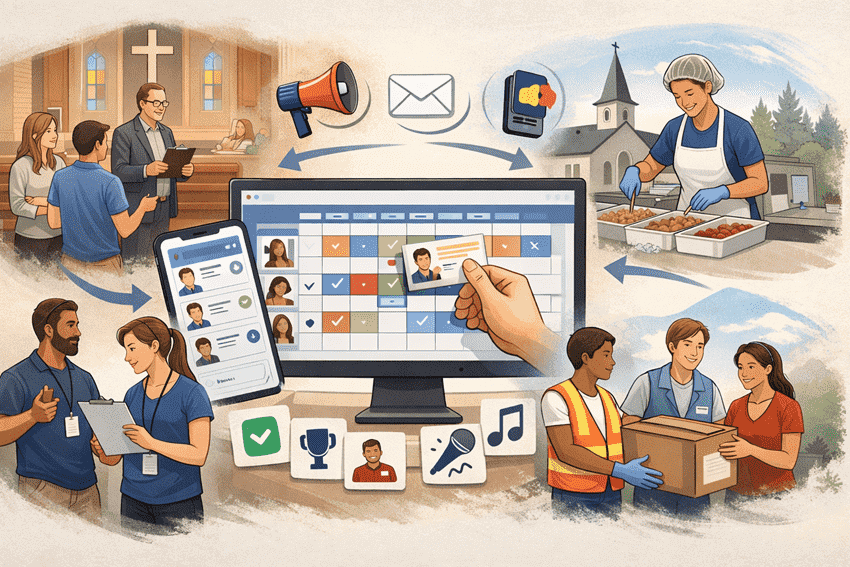
For managing the event logistics, volunteer coordination, attendance tracking, and follow-up communication, a purpose-built church management platform removes the administrative overhead that typically limits what even well-resourced churches can accomplish.
Local Business Partnerships for Fundraising
Local businesses are often looking for genuine community connection and willing to participate in church outreach through in-kind donations, financial sponsorship, or co-hosting events. A restaurant donating meals for a community dinner, a hardware store supplying materials for a neighborhood improvement project, or a local gym offering free classes for a health fair all expand what a church can offer without expanding its budget proportionally.
Seasonal Outreach Opportunities
Holiday Events for Engagement
Holiday seasons represent the highest-traffic windows for church outreach. A Christmas gift drive, Thanksgiving community meal, or Easter community event reaches people who are already in a reflective, sometimes spiritually open frame of mind. These are not moments to capitalize on but moments to serve genuinely, without expectation.
82 percent of survey respondents value music lessons for children, suggesting that creative programs generate both community engagement and goodwill. A Christmas carol concert open to the public, a community nativity event for families, or a Christmas craft morning for children all serve families while creating natural points of connection.
Promoting Church Activities at Festivals
Local community festivals, farmers markets, cultural celebrations, and neighborhood street fairs are some of the highest-foot-traffic community events available for outreach. A church presence at a local festival does not need to be promotional. A free water station, a face painting table for children, or a prayer booth where people can request prayer for specific needs all communicate care without requiring any prior relationship with the church.
Back-to-School Drives
A back-to-school supply drive and distribution event for families who cannot afford school materials is one of the most consistently well-received outreach initiatives I have observed. It meets a real, time-sensitive need, serves families across all backgrounds without stigma, and creates a natural annual touchpoint with the community that builds recognition over successive years.
Engaging Youth and Families through Outreach
Youth-Led Outreach Programs
When young people lead outreach rather than simply participating in adult-designed programs, two things happen simultaneously: the outreach becomes more relevant to other young people in the community, and the young leaders develop in ways that adult-led programming cannot replicate. I have seen a youth-led neighborhood cleanup become a recurring monthly initiative because the teenagers who started it took genuine ownership of it.
The National Alliance for Youth Sports provides resources and frameworks for churches wanting to launch youth sports programs as an outreach vehicle, covering everything from league structure to volunteer training and safety protocols.
Family-Friendly Engagement Activities
Family outreach works best when it serves the whole family together rather than separating adults and children into parallel programs. Community family picnics, outdoor movie nights, family craft mornings, and intergenerational service projects all create natural cross-family conversations that build community beyond the event itself.
Purposeful Projects for Parents and Kids
Service projects that parents and children complete together carry a formative power that neither carries alone. A family volunteering together at a food bank, building care packages for homeless individuals, or delivering meals to elderly neighbors creates shared memories and shared values simultaneously. These projects also tend to produce the strongest word-of-mouth referrals to church events, because parents talk about meaningful shared experiences with their children.
101 Church Outreach Ideas by Category
The following ideas span every church size, budget level, and community context. Choose two or three that match your community’s actual needs and pursue them with consistency rather than attempting to run the full list.
Community Service
- Free food pantry open to anyone regardless of church affiliation
- Clothing closet stocked with donated items sorted by size
- Free basic car maintenance clinic teaching oil changes and safety checks
- Free tax preparation service using IRS-certified volunteers
- Home repair volunteer team helping elderly or disabled neighbors
- Meal delivery program serving homebound elderly residents
- Free community first aid and CPR training
- Blood drive in partnership with a local hospital
- Hygiene kit distribution for homeless individuals
- Free legal advice clinic with volunteer attorneys
- Community book exchange where neighbors donate and borrow freely
- Bicycle repair program providing refurbished bikes to children
- Community tool library for home project equipment
- Diaper and baby supply program for young families
- Community welcome basket program for new neighborhood residents
Family and Children
- Organize a free back-to-school supply drive and host a distribution event where families can come, connect, and leave with everything their children need for the first day of school.
- Set up a free family portrait day staffed by volunteer photographers from the congregation, giving families a professional keepsake they would not otherwise be able to afford.
- Host a monthly family game night open to the entire neighborhood, with tables set up for different age groups and light refreshments provided throughout the evening.
- Launch a community toy library where families can borrow age-appropriate toys and games on a rotating basis, reducing household costs while building neighborly trust.
- Run a free parenting workshop series covering practical topics that families in your neighborhood are actually navigating, such as managing screen time, supporting anxious children, or preparing teenagers for independence.
- Host a neighborhood block party centered around the church building with food, music, lawn games, and a genuine spirit of welcome that requires no agenda beyond enjoyment.
- Launch a family mentoring program that pairs experienced parents in the congregation with young families who are navigating early parenthood without nearby support.
- Set up a free seasonal outdoor movie night in the church parking lot with a projector, blankets, and popcorn, choosing films appropriate for the whole community.
- Create a community garden where families from the neighborhood tend plots together, share the harvest, and build the kind of side-by-side relationships that structured events rarely produce.
- Organize a multi-generational craft fair where families create handmade items together and donate the finished pieces to a local shelter or care home.
- Offer free family counseling sessions through licensed counselors in the congregation, providing access to professional support for families who cannot afford private therapy.
- Run a practical cooking class series teaching families how to prepare nutritious, affordable meals on a tight budget, with free ingredients provided for each session.
- Create a community babysitting cooperative that gives parents in the neighborhood a regular evening of respite by pooling childcare within a trusted network.
- Host a back-to-school blessing event where students receive prayer, encouragement, and a school supply pack before the new academic year begins.
- Organize regular family volunteering days at local nonprofit organizations, creating shared service experiences that bond families from across the neighborhood to each other and to a cause.
Youth and Teenagers
- Launch a free after-school tutoring program where congregation volunteers with relevant skills commit to regular weekly sessions with students who need academic support.
- Create a structured youth mentoring program that matches teenagers with adult mentors for consistent one-on-one connection built around the young person’s interests and goals.
- Run a free summer day camp open to children in the neighborhood, combining arts, sports, outdoor activities, and genuine relationship-building across the full program.
- Organize a youth sports league in partnership with local schools or parks departments, providing a structured, safe, and coached environment for young people to compete and connect.
- Host a coding and digital skills workshop for teenagers, drawing on platforms like Khan Academy as a curriculum resource and pairing it with mentoring from congregation members working in technology.
- Run an open talent show for youth in the community with a genuinely celebratory atmosphere, small prizes, and enough structure to make every participant feel that their contribution mattered.
- Commission a community mural project where young people design the concept, choose the imagery, and paint it themselves, creating a public piece of art they will point to with pride for years.
- Launch a youth leadership development program that trains teenagers in practical skills including public speaking, project planning, and community advocacy, giving them tools that extend far beyond church life.
- Host an annual college and career exploration night where professionals from the congregation share their career journeys honestly, including the setbacks, and answer questions from teenagers thinking about their futures.
- Launch a free music or arts program offering regular instrument lessons or art classes to children and teenagers who cannot access private tuition due to cost.
- Run a structured summer reading program with weekly gatherings at the church building, discussion activities, and meaningful prizes that reward genuine engagement rather than just page counts.
- Form a youth volunteer team that serves a different community organization each month, exposing young people to a range of local needs and building a service habit that lasts beyond the program.
- Host a practical life skills workshop series specifically for young adults covering real-world topics including budgeting, cooking, basic home maintenance, and preparing for job interviews.
- Create a welcoming after-school drop-in space for teenagers who need somewhere safe, warm, and relational between the end of school and the time their parents return home.
- Organize an annual youth community service day where young people complete visible neighborhood improvement projects together, from painting benches to planting trees to clearing neglected public spaces.
Health and Wellness
- Partner with local medical professionals to host free health screening days offering blood pressure checks, diabetes screening, and vision tests to anyone in the community who wants them.
- Host a mental health awareness event featuring professional speakers presenting on practical coping strategies, with a resource table offering local support contacts for anyone who needs them.
- Start a weekly community walking group that meets at a consistent time and place, welcoming anyone from the neighborhood and building the kind of low-pressure regular connection that attendance-based programs rarely achieve.
- Facilitate a grief support group open to anyone in the community, led by a trained pastoral counselor, providing a structured and compassionate space for people navigating loss.
- Offer a free weekly yoga or gentle exercise class in the church building or a nearby park, staffed by a qualified instructor from the congregation and open to all fitness levels.
- Run a cooking for health workshop series where participants learn to prepare meals specifically suited to managing common chronic conditions such as diabetes, hypertension, or heart disease.
- Dedicate a section of your community garden specifically to growing fresh produce for distribution to food-insecure families in the neighborhood, connecting your gardening volunteers directly to a visible need.
- Launch a substance recovery support group in partnership with an established program such as Celebrate Recovery, providing a structured, faith-informed pathway for community members navigating addiction.
- Partner with local health organizations to offer free smoking cessation resources, support groups, and referrals to anyone in the community ready to quit.
- Run a stress management and mindfulness workshop that draws honestly on both evidence-based psychological practices and faith-based perspectives, welcoming participants from any background.
Seasonal and Holiday
- Organize a Christmas gift drive that collects toys, warm clothing, and household necessities and distributes them directly to families in the neighborhood who could not otherwise provide them.
- Host an Easter egg hunt genuinely open to the entire neighborhood, with no church membership or attendance required, focused entirely on creating a joyful morning for local families.
- Prepare and serve a Thanksgiving community meal for anyone who would otherwise spend the day alone, with congregation members seated alongside guests rather than simply serving them.
- Run a winter coat drive that collects, sorts, and distributes warm clothing to anyone who needs it before the coldest months arrive, with distribution organized with dignity and warmth.
- Host a harvest festival that gives the neighborhood a welcoming, family-friendly autumn gathering with food, activities for children, and genuine community atmosphere.
- Organize a Valentine’s encouragement program where congregation members write personal cards and deliver small gifts to elderly residents in care homes who rarely receive visitors.
- Lead a community prayer walk on significant dates in the church and national calendar, praying specifically and intentionally for the streets, homes, businesses, and people in the surrounding area.
- Deliver potted flowers or plants to mothers in the neighborhood on Mother’s Day as a simple, personal gesture of appreciation with no strings attached.
- Host a community celebration on a national holiday with food, music, lawn games, and an atmosphere that communicates that your church sees itself as part of the neighborhood rather than separate from it.
- Organize a community Advent candle lighting ceremony open to all neighbors, creating a shared seasonal moment that connects people across different faith backgrounds through a simple, beautiful practice.
Prayer and Spiritual
- Organize regular neighborhood prayer walks where small teams move through specific streets praying intentionally for each home, business, and family they pass, whether or not they knock on any doors.
- Establish a weekly prayer team available at scheduled times to offer free prayer to anyone who asks, whether they are a congregation member, a neighbor, or a stranger who heard about the service.
- Activate a 24-hour prayer chain during community crises, natural disasters, or significant local events, coordinating congregation members to cover every hour with committed intercession.
- Create personalized prayer cards for local schools, hospitals, police stations, and fire stations and deliver them in person with a genuine expression of gratitude for the work these institutions do.
- Host a community prayer breakfast before the working day begins, open to anyone regardless of faith background, with honest conversation alongside the food.
- Organize a focused prayer vigil for a specific and pressing community concern, whether that is neighborhood violence, economic hardship, or a local family facing a crisis.
- Launch a monthly community prayer meeting that actively invites people from neighboring churches and faith communities, building relationships across congregations through shared intercession.
- Make a printed prayer journal resource available to any community member who requests one, with no obligation, no follow-up agenda, and no expectation beyond the gift itself.
- Develop a regular practice of visiting local business owners and offering to pray specifically for their businesses, their employees, and their families, building genuine relationships through consistent pastoral presence.
- Set up a dedicated prayer request line, either a phone number or a text-based system, that anyone in the community can use to submit a request and receive a personal response confirming that someone prayed.
Digital and Social Media
- Launch a church podcast that shares devotional content, honest community stories, and practical faith guidance in a format accessible to people who would never attend a service.
- Create a YouTube channel featuring short, practical videos on topics directly relevant to your community, from financial tips to parenting advice to mental health resources, framed from a faith perspective without being inaccessible to non-churchgoers.
- Start and actively moderate a neighborhood Facebook group focused on local connection and mutual aid, positioning the church as a community facilitator rather than a content broadcaster.
- Build an opted-in SMS list and send weekly encouragements that are genuinely useful and human, not promotional announcements dressed up as pastoral care.
- Develop a church website resource page that links to local services, support organizations, food banks, mental health providers, and community groups, making it a genuinely useful destination for anyone navigating difficulty in the area.
- Host a regular live-streamed community conversation on a topic of genuine local relevance, inviting community voices rather than only church leaders to participate.
- Publish a regular email newsletter open to anyone in the community that leads with local stories, practical resources, and honest encouragement before it ever mentions a church program.
- Train and equip congregation members to share specific outreach stories through their personal social media accounts, extending the church’s reach through trusted individual voices rather than an institutional channel.
- Create a neighborhood WhatsApp or Signal group for practical mutual aid, connecting people who need help with neighbors who can provide it, moderated with a light touch.
- Add a prominently placed online prayer request form to the church website and respond to every submission personally within 24 hours.
Creative and Arts
- Host an open mic night at the church building or a nearby venue where any community artist, musician, spoken word poet, or storyteller can share their work in a genuinely welcoming, non-judgmental space that celebrates creativity across every genre and background.
- Launch a community photography project where residents are given disposable cameras or use their phones to document neighborhood life as they experience it, with the finished images displayed in a public exhibition that tells the community’s own story back to itself.
- Start a community choir that rehearses weekly and performs at both church and community events, with the explicit welcome that no prior choral experience, audition, or church membership is required to join.
- Create a drama or storytelling program that produces original performances drawing directly from the experiences, histories, and concerns of people living in the neighborhood, giving the community a mirror rather than a message.
- Commission a community mural or public art installation where residents of all ages contribute to the design and execution, producing a permanent public piece that the neighborhood genuinely owns and identifies with.
- Run a creative writing workshop for both adults and youth that provides structured prompts, genuine feedback, and a safe space to develop a voice, with no prior writing experience required.
- Host a film screening series featuring documentaries on issues directly relevant to local community life, followed each time by a facilitated discussion that moves from the screen into honest conversation about what people are actually experiencing.
- Offer a free regular craft workshop, whether pottery, painting, printmaking, or mixed media, with all materials provided and no expectation beyond showing up and making something.
- Organize an annual community art fair that showcases the creative work of neighborhood residents across all ages and skill levels, celebrating what the community produces rather than importing outside talent.
- Launch a community songwriting project that gathers neighborhood stories through interviews and conversations, then works with musicians to turn those stories into original songs performed publicly and returned as a gift to the people whose lives inspired them.
Partnership and Collaboration
- Design and execute a joint outreach initiative with a neighboring church of a different denomination, pooling volunteer capacity and community relationships to serve at a scale neither congregation could achieve alone.
- Establish a neighborhood watch program in genuine partnership with local law enforcement, building relationships that improve community safety while positioning the church as a trusted neighborhood presence.
- Launch a prison ministry that visits local correctional facilities regularly and provides structured, consistent support for the families of incarcerated individuals in the surrounding community.
- Create a pen pal program connecting congregation members with elderly residents in care homes, providing consistent personal correspondence that reduces isolation for people who rarely receive mail from anyone who knows their name.
- Organize a community listening day where church leaders and volunteers sit in accessible public spaces and simply invite neighbors to share what they need, what they value, and what they wish existed in the area, with no agenda beyond genuine attention.
The One That Changes Everything
- Choose one outreach initiative from this list that your team can genuinely commit to, run it consistently for twelve months without abandoning it when enthusiasm fades, evaluate honestly at the end of the year, and build from what you learned rather than starting something new. Consistency is the outreach strategy most churches talk about and few actually sustain, and it is the one that produces the most durable community trust of anything on this list.
Using Social Media for Outreach
Social Media Engagement Strategies
Social media works best for church outreach when it is relational rather than promotional. Posts showing real people doing real things in the community consistently outperform polished announcements. Authenticity is the competitive advantage a church has over larger, more produced online presences.
For a comprehensive guide on using social media for churches effectively, including platform-specific strategies and content planning approaches, this resource covers the practical dimensions in depth.
Online Campaigns for Greater Reach
Online fundraising campaigns, prayer challenges, and community service documentation all create shareable content that travels through personal networks beyond the congregation. A 30-day prayer campaign where congregation members share daily prayer prompts publicly reaches far more people than a church announcement ever could.
Resource Creation for Sharing
Creating genuinely useful digital resources, a local community services directory, a guide to local support organizations, a seasonal family activity guide for the neighborhood, and making them freely available through the church website and social channels positions the church as a community asset rather than simply a religious institution seeking attendance.
Evaluating Outreach Effectiveness
Metrics for Success
The metrics that matter most are those tied to the specific goals of each initiative. If the goal was serving a defined number of families, measure families served. If the goal was building relationships, measure new ongoing connections made. If the goal was creating pathways to church engagement, track how many participants from outreach events attended a service or small group.
Collecting Feedback
Feedback mechanisms do not need to be elaborate. A brief conversation at the end of an event, a simple three-question card distributed to participants, or a follow-up text message sent to registered attendees all provide useful information. Churches that treat community feedback as a genuine gift rather than an administrative obligation improve their outreach most rapidly.
Adapting Strategies for Improvement
Outreach that does not adapt stagnates. The annual review of your outreach calendar, measured against feedback and data collected throughout the year, should produce at least two or three meaningful changes. Retire what is not working without guilt. Expand what generates genuine community connection. Add new ideas when the community’s needs reveal a gap your current program is not addressing.
Case Studies of Successful Church Outreach
Spotlight on Successful Churches
The most successful outreach programs I have observed share three characteristics: they serve a real and specific need rather than a perceived one, they are staffed by volunteers who genuinely care about the people they are serving rather than fulfilling a roster obligation, and they operate consistently over years rather than as one-off events.
Over 17,000 organizations partner together to bring community support to billions of people worldwide, according to Subsplash. Churches that embed themselves within this broader ecosystem of community care rather than operating in isolation consistently achieve greater impact than those working alone.
Measurable Impacts of Outreach
A church running a consistent neighborhood tutoring program for three years does not just serve the students enrolled. It changes how the neighborhood perceives the church, how parents talk about the church to their friends, and how community leaders respond when the church asks to partner on a new initiative. The measurable impacts compound over time in ways that single-event outreach never can.
Lessons from Outreach Initiatives
The most consistent lesson I have drawn from watching outreach programs succeed and fail is that the quality of the relationship between volunteers and community members matters more than the quality of the program itself. A well-designed food pantry staffed by volunteers who do not engage personally with recipients produces far less community impact than a simpler program staffed by people who know their neighbors’ names.
Challenges in Church Outreach and How to Overcome Them
Identifying Outreach Challenges
The most common challenges churches face in outreach are volunteer fatigue, budget constraints, community apathy toward church-initiated programs, and difficulty sustaining momentum past the initial enthusiasm of a new initiative. None of these are fatal to a well-designed outreach program, but all of them require honest acknowledgment rather than optimistic dismissal.
Creative Solutions
Volunteer fatigue is best addressed by distributing responsibility broadly rather than concentrating it in a small core team. Budget constraints are best addressed by identifying low-cost, high-impact ideas, of which this list contains many, before pursuing resource-intensive programs. Community apathy is best addressed by serving genuinely without expectation rather than designing programs that implicitly require community reciprocity.
Building Support Systems
Churches that sustain effective outreach over years consistently invest in the support systems that keep volunteers motivated and mission-focused. Regular team gatherings that celebrate what is working, honest conversations about what is not, prayer for the community being served, and pastoral care for volunteers who are carrying emotionally demanding work all contribute to the long-term health of an outreach ministry.
ChMeetings’ church management software helps churches manage outreach programs, volunteer teams, event coordination, and community communication within one integrated platform, removing the administrative overhead that typically limits what congregations of any size can accomplish in their communities.
Frequently Asked Questions
What are some unique church outreach ideas?
Unique and highly effective church outreach ideas include community listening days where church leaders ask neighbors what they need without any agenda, prayer walks where teams offer to pray specifically for individual homes and businesses, free tax preparation clinics staffed by certified volunteers, youth-led community service projects, and creative arts programs open to the public. The most unique ideas for your church are those that match your specific community’s unmet needs rather than copying what another congregation has done elsewhere.
How can small churches effectively engage in outreach?
Small churches are uniquely positioned for effective outreach because their relational depth is a genuine competitive advantage. Focus on two or three ideas that your volunteer base can sustain consistently over twelve months rather than running multiple programs that exhaust your team. Community potlucks, neighborhood prayer walks, shelter partnerships, and back-to-school drives all produce strong results at minimal cost and require no specialized expertise to run.
Can social media help with church outreach?
Yes, significantly. SMS communication carries open rates above 90 percent, making it the highest-engagement direct channel for most churches. Social media platforms allow outreach stories and invitations to travel through personal networks far beyond the congregation. The most effective church social media content is relational and authentic rather than promotional, showing real community service in action rather than announcing upcoming programs.
What challenges do churches face in outreach?
The most common challenges are volunteer fatigue from over-concentration of responsibility in a small team, budget constraints that make ambitious programs unsustainable, and difficulty building community trust quickly enough to see engagement from people who are skeptical of church-initiated programs. All of these are addressable: distribute volunteer responsibility broadly, choose low-cost high-impact ideas first, and invest in serving consistently over years rather than expecting rapid community response to new initiatives.
How can we measure outreach success?
Measure against the specific goals you set for each initiative before it launches. Useful metrics include number of community members served, number of new relationships formed, volunteer hours contributed, participant feedback scores, and where relevant, number of outreach participants who subsequently engaged with the church’s programs. Qualitative stories of specific community impact often communicate outreach value more powerfully than quantitative metrics alone.
What role does youth play in church outreach?
Youth who lead outreach initiatives rather than simply participating in adult-designed programs develop leadership skills, build peer-to-peer community relationships, and bring creative energy that adult-led programs rarely generate. The National Alliance for Youth Sports and similar organizations provide frameworks for churches wanting to launch youth-led sports and activity programs as outreach vehicles. When young people own the outreach, the outreach tends to reach young people.
How can churches evolve their outreach strategies?
Evolve through honest annual review rather than reactive change. Evaluate each initiative against its stated goals, collect feedback from both participants and volunteers, identify what generated the strongest community response, and make two or three specific adjustments for the following year. Stay responsive to community needs that shift over time: the most effective outreach program of five years ago may not be the most needed program today.
Conclusion
Recap of Key Points
Church outreach ideas work when they are rooted in genuine care, served consistently over time, and calibrated to the real needs of the specific community rather than generic assumptions about what communities want. The 101 ideas in this guide span every church size, budget level, and community context. The key is not choosing the most impressive ideas but choosing the right ones for your congregation and community, and then committing to them with the kind of patient, consistent faithfulness that builds the trust no single event can create.
Encouragement to Act
The gap between having a list of church outreach ideas and actually serving your community is crossed by one decision: starting. Choose one idea from this guide that your team can begin this month. Run it consistently. Learn from it. Build from what you learn. The churches that have the deepest community roots did not get there by planning perfectly. They got there by starting imperfectly and staying faithful over years.
Final Thoughts
“Resources and collaboration are key; churches must reach beyond their walls to impact their communities.” — Deborah Ike, Outreach Author
For additional outreach inspiration, Convoy of Hope’s church outreach ideas and ACS Technologies’ creative outreach guide both provide perspectives worth exploring alongside the ideas in this guide.
To manage your outreach programs, volunteer teams, event coordination, and community communication in one place built specifically for churches, Try ChMeetings Today.