
Every church, regardless of size, age, or resources, runs on systems. Some of those systems are intentional and documented. Others exist only in the memory of whoever has been around long enough to know how things work. Both kinds shape what the church is able to do, how well it cares for its people, and whether its leadership can make confident decisions or is constantly catching up with information that arrived too late to be useful. This guide was written for churches that want to close that gap, not by adding complexity, but by bringing clarity to the processes that already exist and building structure around the ones that do not yet.
The ten areas covered here, accounting, giving, content management, donor relationships, membership, attendance, communication, volunteering, events, and payroll, represent the full operational picture of a functioning church. They are not independent of each other. A giving process that works well feeds into accounting that leadership can trust. A membership system that captures the right information makes communication more targeted and attendance follow-up more timely. When these areas are managed with the same intentionality that goes into Sunday morning, the entire church runs with less friction and more confidence. ChMeetings is the environment this guide is built around, and throughout each section you will see how the platform connects these processes rather than leaving them to operate in isolation.
Whether your church is navigating rapid growth, working through a leadership transition, or simply trying to bring more order to systems that have served you well but are starting to show their limits, this guide meets you where you are. Read it cover to cover or go directly to the section most relevant to your current challenge. Either way, what follows is a practical, honest account of how healthy church administration works and what it takes to build it.

- Accounting: How to Manage Church Finances With Integrity and Clarity
- Church Giving: How to Receive, Record, and Honor Every Contribution
- Church Content Management: How to Keep Your Ministry Resources Organized and Accessible
- Donor Management: How to Build and Maintain Meaningful Giving Relationships
- Attendance Tracking: How to Record, Monitor, and Respond to Who Shows Up
- Communication: How to Reach the Right People with the Right Message at the Right Time
- Volunteering: How to Recruit, Equip, and Retain the People Who Make Ministry Possible
Accounting: How to Manage Church Finances With Integrity and Clarity
Picture a finance administrator sitting down to prepare the monthly report three days before a board meeting. The giving records are in one spreadsheet. The expense approvals are in an email thread. The fund balances were last updated two weeks ago by someone who has since gone on leave. The numbers exist. Pulling them into something a pastor can actually use will take the rest of the day, and even then nobody will be entirely confident they are looking at the full picture.
That is not an unusual situation. It is the default in churches that have never built a deliberate financial system.
Church accounting is not just bookkeeping. It is the framework that protects what donors intended, informs what leaders decide, and tells the congregation whether the church can be trusted with what they give. When that framework is built intentionally, everything downstream gets easier. When it is not, the problems are quiet at first and expensive later.
A church manages more financial complexity than most people outside the finance team realize. General operating funds run alongside restricted gifts designated for specific purposes. Recurring contributions sit next to one-time donations. Ministry expenses, event costs, and payroll all draw from the same pool and all need to be tracked separately. When those layers live in disconnected systems, the gaps between them are where errors hide and where trust quietly erodes.
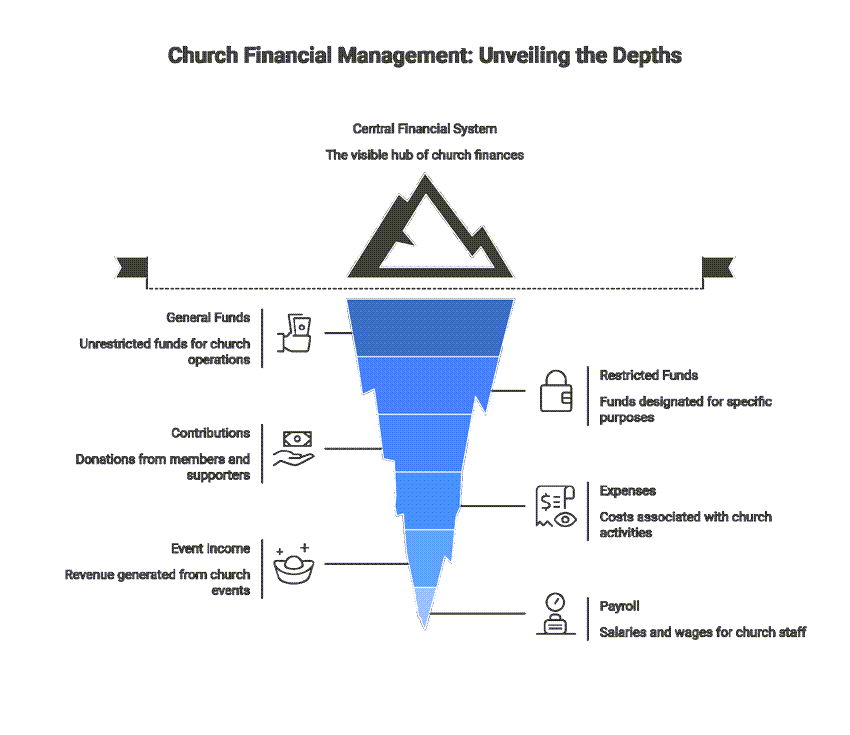
Each layer adds operational complexity. When those layers are handled through separate systems, alignment becomes fragile. Leaders may not see discrepancies immediately, and reconciliation turns into a reactive process instead of a confirmatory one.
Getting this right requires more than good intentions and a capable spreadsheet. It requires clear workflows, structured fund tracking, defined approval chains, and reporting that leadership can actually read and act on.
ChMeetings brings all of that into one place. Giving, expenses, fund balances, approvals, and reporting all live in the same environment, which means the finance administrator preparing that board report is not stitching together three spreadsheets and an email thread. The numbers are current, connected, and ready.
Recording Church Transactions Workflow
Imagine reviewing a financial report at the end of the quarter and discovering that the numbers do not align. Not because of fraud. Not because of missing deposits. But because transactions were entered inconsistently from the beginning.
That is where most financial breakdowns originate.
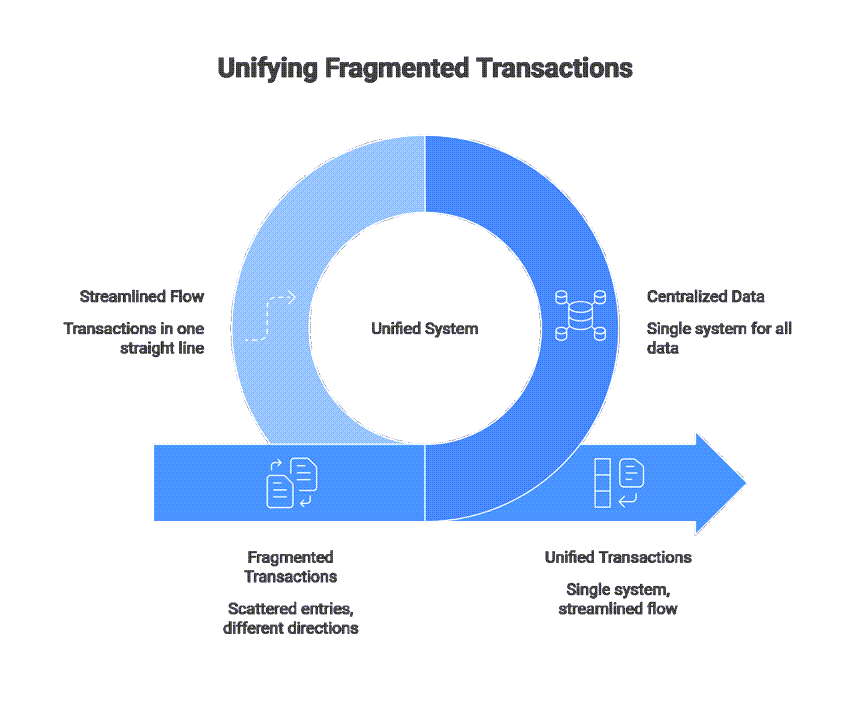
A transaction workflow is not about bookkeeping mechanics. It is about discipline at the smallest level. When a contribution is received, it must be assigned to the correct fund immediately. When an expense is recorded, it must reflect its true ministry purpose. Delays and assumptions accumulate faster than most leaders expect.
The integrity of the entire system depends on this foundation.
A structured recording church transactions workflow ensures that income and expenses are not simply captured, but contextualized. This means clear fund tagging, documentation attachment, and consistent categorization standards.
If your church separates giving records from accounting systems, reconciliation quickly becomes repetitive correction. Alignment is forced later instead of preserved earlier.
When transaction entry, fund allocation, and reporting operate together within ChMeetings, continuity replaces correction. The system reflects reality as it unfolds, rather than reconstructing it afterward.
The discipline applied here determines whether leadership later operates with clarity or caution. ChMeetings reinforces that discipline by making accurate transaction entry the default rather than the exception, so financial truth is built in from the start rather than reconstructed at the end.
Monthly Closing Process in a Church
Closing the month is less about arithmetic and more about confirmation.
At the end of a reporting period, leadership needs assurance that the financial position being presented reflects truth, not approximation. Deposits must match records. Fund balances must reflect actual availability. Budget comparisons must highlight meaningful variance rather than clerical inconsistency.
A reliable church monthly closing process acts as a checkpoint between activity and strategy. It consolidates daily financial movement into a verified position.
Where systems are fragmented, this stage feels heavy. Your team exports spreadsheets, compares totals manually, and searches for discrepancies that should have been prevented earlier. The close becomes investigative.
Where systems are integrated, the process changes tone. Instead of repairing alignment, administrators confirm it. Because transaction categorization and fund assignment were handled properly at entry, reconciliation becomes efficient and predictable.
Timely financial clarity, made possible through ChMeetings, allows leadership to act on what is actually true rather than what was last approximated.
Handling Expenses and Reimbursements
Expense management often exposes organizational culture.
In some churches, receipts circulate casually and approvals occur verbally. In others, documentation is required but inconsistently enforced. Over time, this variability affects both transparency and morale.
Consider the range of everyday church expenses:
- Worship equipment replacement
- Curriculum materials for children’s ministry
- Community outreach supplies
- Utility and maintenance costs
- Staff travel or training
Individually, none of these transactions are extraordinary. Collectively, they define operational discipline.
A thoughtful approach to managing church expenses and reimbursements balances flexibility with accountability. Your ministry leaders should not feel constrained by bureaucracy, yet your financial records must remain traceable.
When expenses move through informal channels, documentation fragments. Approval history disappears. Budget alignment becomes reactive.
When expense submission, authorization, and categorization occur within ChMeetings, structure becomes natural rather than imposed. Receipts remain attached to entries. Approvals are recorded automatically. Fund balances update in real time.
Expense management, when structured well, supports ministry rather than slowing it.
Managing Restricted vs General Funds
At first glance, separating restricted and general funds appears conceptually simple, as operating income supports day-to-day activity while designated gifts are allocated to specific initiatives. Yet the operational reality becomes more nuanced as the number of funds expands.
Each designated contribution introduces obligation. Each expense drawn from that designation must remain defensible.
A disciplined approach to managing restricted and general church funds demands precision at the moment of transaction entry. It is not enough to track balances later. The system must prevent misallocation before it occurs.
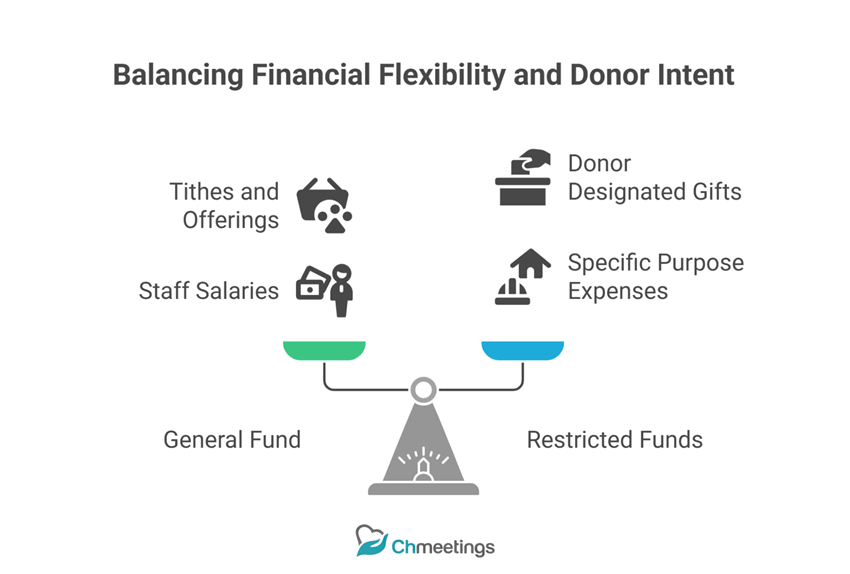
In practical terms, this requires independent fund visibility, clear allocation logic, and controlled reclassification ability. Your team may temporarily simulate this structure with spreadsheets, but that approach relies heavily on consistent human oversight that is difficult to sustain.
When fund categorization operates within ChMeetings, allocation becomes part of the workflow itself. Contributions automatically increase designated balances. Expenses decrease them accordingly. Reporting reflects real-time status rather than reconstructed calculations.
Fund separation ultimately protects trust. It reassures donors and strengthens leadership credibility.
Financial Approval Process Inside a Church
Authority without documentation introduces risk.
As your church grows, financial decisions cannot depend solely on assumed understanding. Spending thresholds, approval pathways, and permission levels must be articulated clearly.
A structured financial approval processes in churches framework defines who may authorize spending, under what conditions, and at what limit. It removes ambiguity before it creates tension.
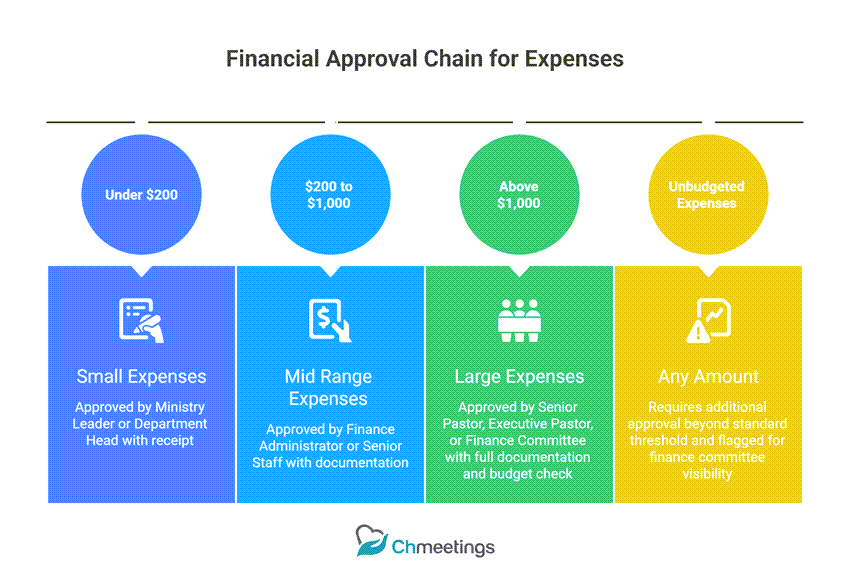
Consider a ministry leader who needs to purchase equipment that exceeds their usual spending limit. Without a defined approval structure, that request either stalls while waiting for verbal confirmation or moves forward without proper authorization.
Without defined approval boundaries, either overspending occurs unnoticed or decision-making slows unnecessarily. Both outcomes hinder ministry effectiveness.
With approval logic embedded in ChMeetings, the submission routes automatically to the right person, the decision is recorded, and the ministry leader can move forward without the uncertainty.
Embedding approval logic within ChMeetings aligns financial authority with user roles. Authorization steps are recorded alongside the transaction itself, preserving both efficiency and accountability.
When approvals are system-driven rather than conversational, oversight strengthens naturally.
Preparing Internal Financial Summaries for Leadership
Reports do not guide direction. Insight does.
Church leaders need more than totals. They need interpretation. Trends in giving. Variances in spending. Fund health indicators. Without structured presentation, financial data becomes overwhelming rather than clarifying.
A disciplined process of preparing financial summaries for church leadership focuses on translating activity into perspective. Summaries should illuminate where the church stands today and what that position implies for tomorrow.
When your team assembles data manually from disconnected tools, reporting consumes time that should be invested in analysis. Conversely, when financial records reside within ChMeetings, summaries emerge directly from integrated data. Leaders can review current fund balances, compare performance periods, and explore details without separate compilation.
Well-prepared summaries elevate financial conversations from validation to strategy.
Every element of church accounting, from the first transaction entry to the final leadership summary, exists to protect what the congregation has entrusted to its leaders. That protection begins long before a report is generated. It begins the moment someone chooses to give.
Church Giving: How to Receive, Record, and Honor Every Contribution
Someone walks up to the offering box on a Sunday morning and drops in an envelope. Someone else taps their phone at the giving kiosk on their way out. A third person set up a recurring transfer months ago and rarely thinks about it anymore. Three different moments. Three different channels. All of them carrying the same weight of trust, and all of them landing in a process that the congregation never sees but absolutely depends on.
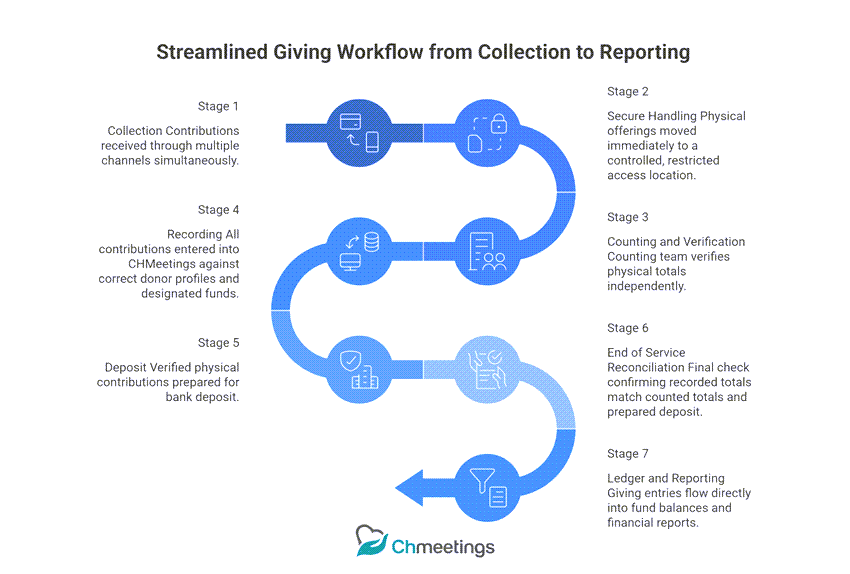
Giving processes sit at the front line of church ministry. They involve volunteers, congregation members, and multiple contribution channels all moving at once. What the donor experiences should feel effortless. What happens on the inside must be precise, documented, and traceable from the moment the gift arrives to the moment it appears in a leadership report.
A mature church giving structure balances accessibility with accountability, ensuring that generosity is honored with transparency and operational consistency.
When giving processes run cleanly inside ChMeetings, every contribution moves from receipt through recording to reporting without leaving the system or requiring anyone to manually reconcile what should already align. The donor gives in confidence. The church responds with the kind of operational integrity that makes that confidence worth having.
Tithe Collection Workflow
Tithing often follows predictable rhythms, yet the structure beneath it determines consistency.
Churches that formalize their tithe collection workflow understand that giving today arrives through multiple channels simultaneously. A Sunday service may include envelopes, online transfers, QR-based mobile payments, and recurring automated contributions. Without convergence, fragmentation follows.
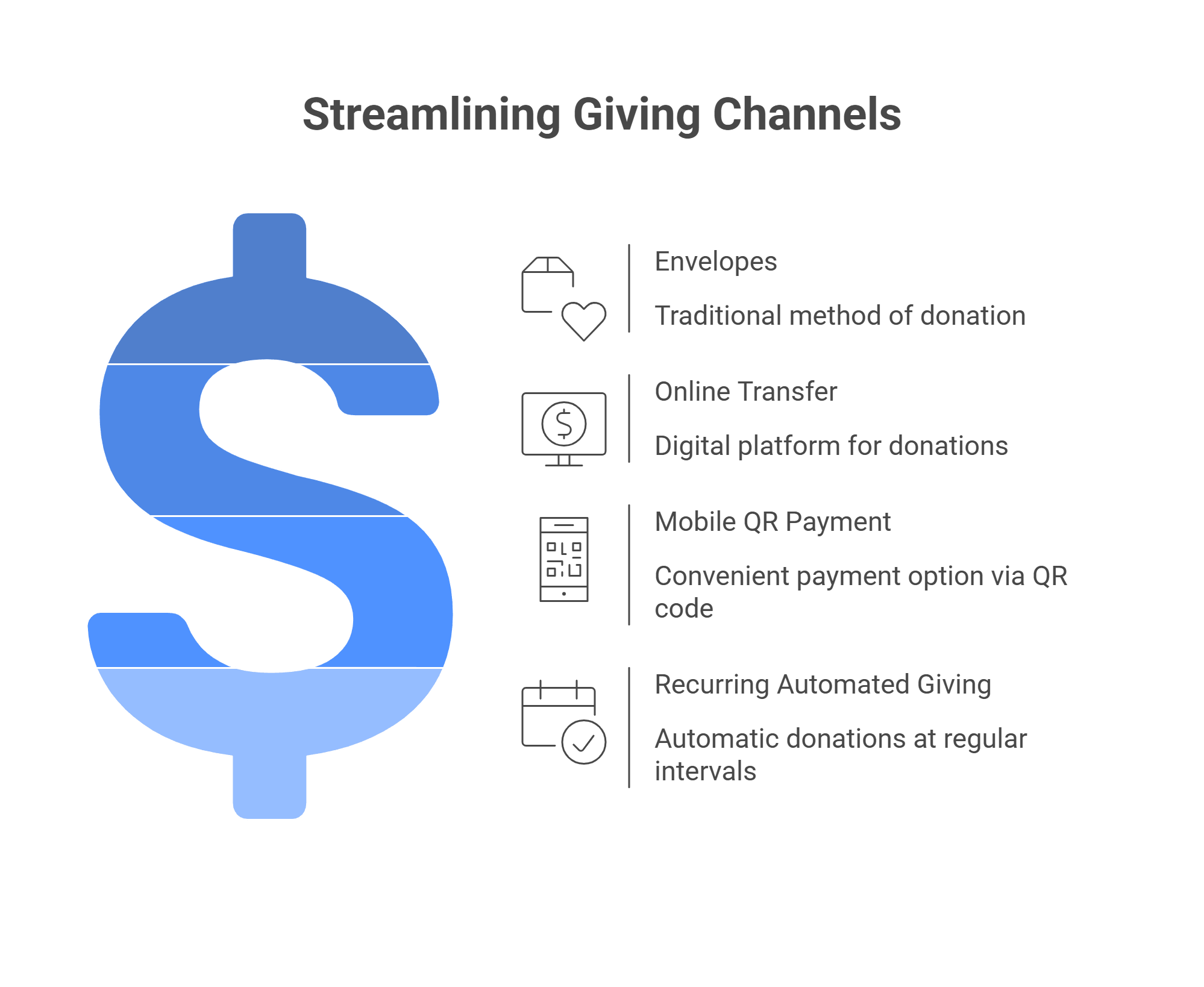
Rather than managing each stream separately, mature churches unify these flows at the recording stage. Contributions are assigned to the correct fund immediately. Donor attribution is verified before reporting advances. Duplicate entries are prevented before they distort statements.
ChMeetings supports this alignment by allowing digital and physical contributions to enter the same financial ecosystem. Because donor profiles and fund structures already exist within the system, tithes integrate naturally rather than requiring secondary adjustment.
A reliable workflow ensures that giving remains consistent regardless of how it is received.
Offering Handling Procedures
Offerings differ from tithes in both timing and variability. Special initiatives, seasonal emphasis, or emergency appeals can temporarily increase contribution volume and complexity.
Clear offering handling procedures reduce confusion during these fluctuations. In practice, this often involves:
- Separating collection and counting responsibilities
- Documenting totals before deposit
- Verifying digital confirmations against physical counts
- Recording batches within a defined timeframe
Churches that treat offering handling as an operational discipline, rather than a routine habit, protect both volunteers and leadership.
Within ChMeetings, batch recording allows grouped entries to be processed logically while maintaining individual donor visibility. This eliminates the need to reconstruct totals later and ensures offering campaigns connect directly to designated funds.
The way offerings are handled communicates seriousness about stewardship.
Donation Counting Team Process
The counting stage operates quietly, yet it shapes credibility more than most members realize.
A transparent donation counting team process typically involves at least two unrelated individuals verifying totals independently. This separation reduces risk and reinforces accountability without creating unnecessary formality.

However, counting alone does not complete the cycle. Digital contributions must be reconciled alongside physical totals, and batch summaries must move promptly into the financial system.
When counting records are entered directly into ChMeetings, they connect instantly to donor histories and fund balances. There is no intermediate spreadsheet that later requires correction. The moment of verification becomes the moment of integration.
Trust grows not from complexity, but from consistency.
Secure Handling of Physical Giving
Even as digital methods expand, physical giving remains central in many congregations. Cash and checks introduce unique vulnerabilities that require intentional safeguards.
Churches committed to secure handling of physical giving often implement simple but effective measures:
- Immediate transfer of offerings to controlled spaces
- Limited access to storage locations
- Prompt deposit scheduling
- Clear documentation of custody
Security should not feel accusatory. It should feel protective.
Secure handling reinforces the integrity of the entire financial system. When physical contributions are recorded inside ChMeetings immediately after counting, custody becomes traceable and deposits become verifiable. That transparency protects volunteers, reassures leadership, and tells the congregation that their generosity is taken seriously.
Recording Giving Entries
Once contributions are collected and verified, precision at the recording stage becomes critical.
An inconsistent entry may affect donor statements, fund balances, and reporting accuracy simultaneously. Understanding the discipline behind recording church giving entries helps prevent those distortions before they occur.
Each contribution should reflect:
- Correct donor attribution
- Accurate fund designation
- Proper date of receipt
- Confirmation of recurring status when applicable
When giving records are separated from accounting systems, manual duplication becomes necessary. This increases the likelihood of errors.
Within ChMeetings, giving entries connect directly to donor profiles and designated funds. Year-end statements, contribution summaries, and leadership reports draw from the same dataset, preserving alignment across the entire structure.
End of Service Giving Reconciliation
Before financial reporting advances, a final reconciliation step ensures accuracy at the service level.
An effective end of service giving reconciliation confirms that counted totals align with recorded entries and that prepared deposits match documentation. Addressing discrepancies immediately prevents minor differences from compounding over time.
Because giving may originate from multiple channels during a single service, alignment must occur before data feeds into the broader accounting framework.
When ChMeetings integrates giving records directly into fund balances and financial reporting, reconciliation becomes seamless rather than corrective. More importantly, it becomes the final act of honoring what was given. Every contribution that passes through this process arrives in the financial record exactly as the donor intended, clean, attributed, and accounted for.
Financial integrity and giving systems form the operational backbone of a healthy church. But a church also produces something less numerical and equally important: knowledge. Teachings, policies, resources, and records that carry the ministry forward. Managing that content with the same discipline applied to finances is what keeps a growing church coherent over time.
Church Content Management: How to Keep Your Ministry Resources Organized and Accessible
Effective church content management is something most congregations need long before they realize they have outgrown their current system. Churches create more content than they often realize. Sermons get recorded. Teaching guides get written. Volunteer handbooks get updated. Event plans get drafted, revised, and revised again. Over time, all of those files either stay organized or quietly scatter across email threads, personal folders, and shared drives that nobody fully manages.
When that happens, simple questions become harder than they should be. Where is the latest version of that policy? Who made the last update? Which document are we actually using for this Sunday’s volunteer briefing?
Good content management is less about storage space and more about clarity. A strong approach to organizing church resources protects institutional memory, supports ministry continuity, and makes leadership transitions far smoother than they would otherwise be. When the right people can find the right documents at the right time, ministry runs with less friction and more confidence.
This part of the guide walks through the six core areas of church content management, each of which plays a specific role in keeping your resources structured, current, and accessible inside ChMeetings.
Sermon Archive Organization
Picture this: a pastor is preparing a new series on prayer and wants to reference a message delivered eighteen months ago. Nobody remembers the exact title. The recordings are in a shared drive organized by upload date. The notes are in someone’s email. The slides are on a laptop that has since been replaced.
The content exists. It is just not findable.
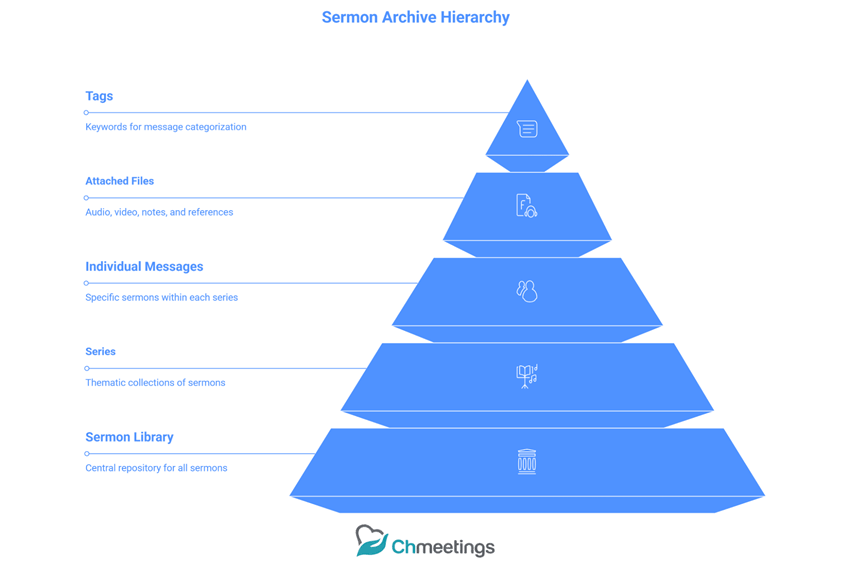
A clear sermon archive organization strategy solves this by treating sermons as a library rather than a pile. When messages are stored with consistent structure from the start, your entire teaching history becomes a resource you can actually use. A practical approach includes:
- Grouping messages by series rather than by date alone
- Tagging each sermon by topic or scripture reference
- Keeping speaker names consistent across every record
- Linking each message to the calendar event where it was delivered
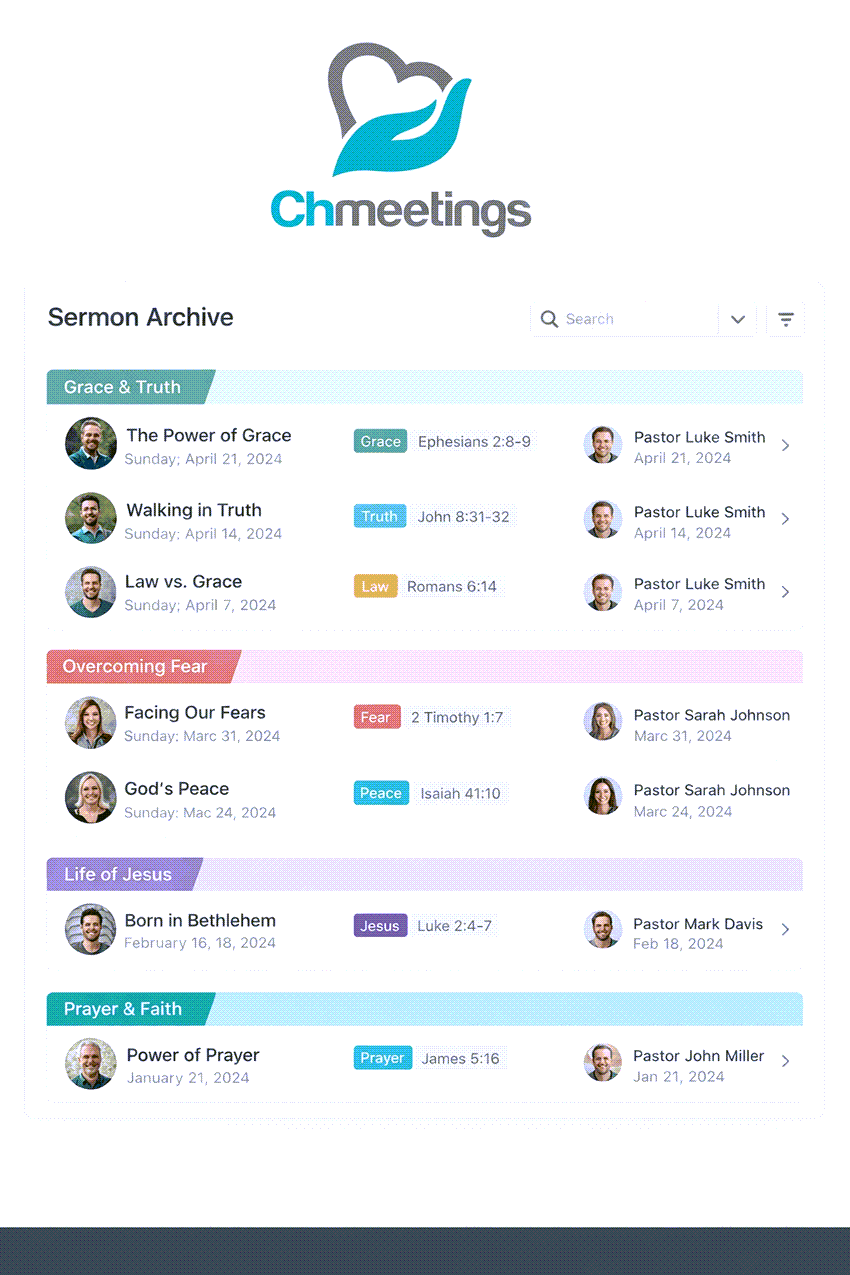
Inside ChMeetings, sermons connect directly to your media library and church calendar. That means when someone searches for a past teaching on forgiveness or generosity, they are not hunting across three different platforms to find it.
Teaching Material Storage System
Teaching materials have a tendency to multiply. A small group outline gets revised before the new semester. A volunteer training guide gets updated after a policy change. A workshop resource gets adapted for a different audience and saved under a slightly different name. Before long, four versions of the same document are floating across different inboxes and nobody is confident which one to use.
A reliable teaching material storage system gives your church one source of truth. The current version of every resource lives in one place, with clear permissions that determine who can view it, who can edit it, and who simply needs to know it exists.
For example, a church running a six-week discipleship course might store the facilitator guide, the participant workbook, and the session slides all within the same ministry folder in ChMeetings, linked directly to the relevant ministry so leaders can find everything without asking anyone where it is.
Instead of managing attachments across email threads, materials live inside ChMeetings alongside the ministries, calendars, and member records your team already works from every day. When a small group leader needs the current facilitator guide, they find it in the same place they check attendance. Nothing is separate. Nothing gets lost. Content stays connected to ministry rather than drifting into personal folders where it becomes invisible to everyone else.
Managing Ministry Documents
Every ministry generates documents that support the practical side of church life. Planning sheets, safety guidelines, budget outlines, policy drafts, room booking forms. The challenge is rarely creating them. It is keeping them organized, current, and findable six months later when someone actually needs them.
Managing ministry documents effectively comes down to four simple standards:
- Naming conventions that tell you what a file contains before you open it
- Dates or version numbers on every document so nobody guesses which copy is active
- A defined archive location for older versions that keeps them accessible but out of the way
- Restricted editing access for documents that should stay stable once approved
When these standards are applied consistently inside ChMeetings, documents stay tied to the ministries and teams that use them. A children’s ministry leader does not need to ask the administrator where the safety policy is. It is in the children’s ministry folder, clearly labeled, with the current version marked.
Version Control for Church Resources
This point is simpler than it sounds.
Version control just means having a clear answer to one question: which document are we actually using right now? It matters because even small updates can cause real confusion. A volunteer policy that changes slightly might look almost identical to the previous version. A registration form might be updated without everyone on the team noticing.
The fix does not require complex software. It requires three habits:
- Date every update at the time it is saved
- Archive the old version rather than deleting it
- Mark the current version clearly so it cannot be confused with anything else
A practical example: a church updates its child protection policy in March. The February version gets moved to a folder labeled “Previous Versions” and the March version is saved as the active document in the main policy folder. Anyone who opens the folder sees exactly which one to use.
With version control for church resources handled inside ChMeetings, outdated files stop circulating informally because everyone is working from the same central location.
Access Permissions for Leaders
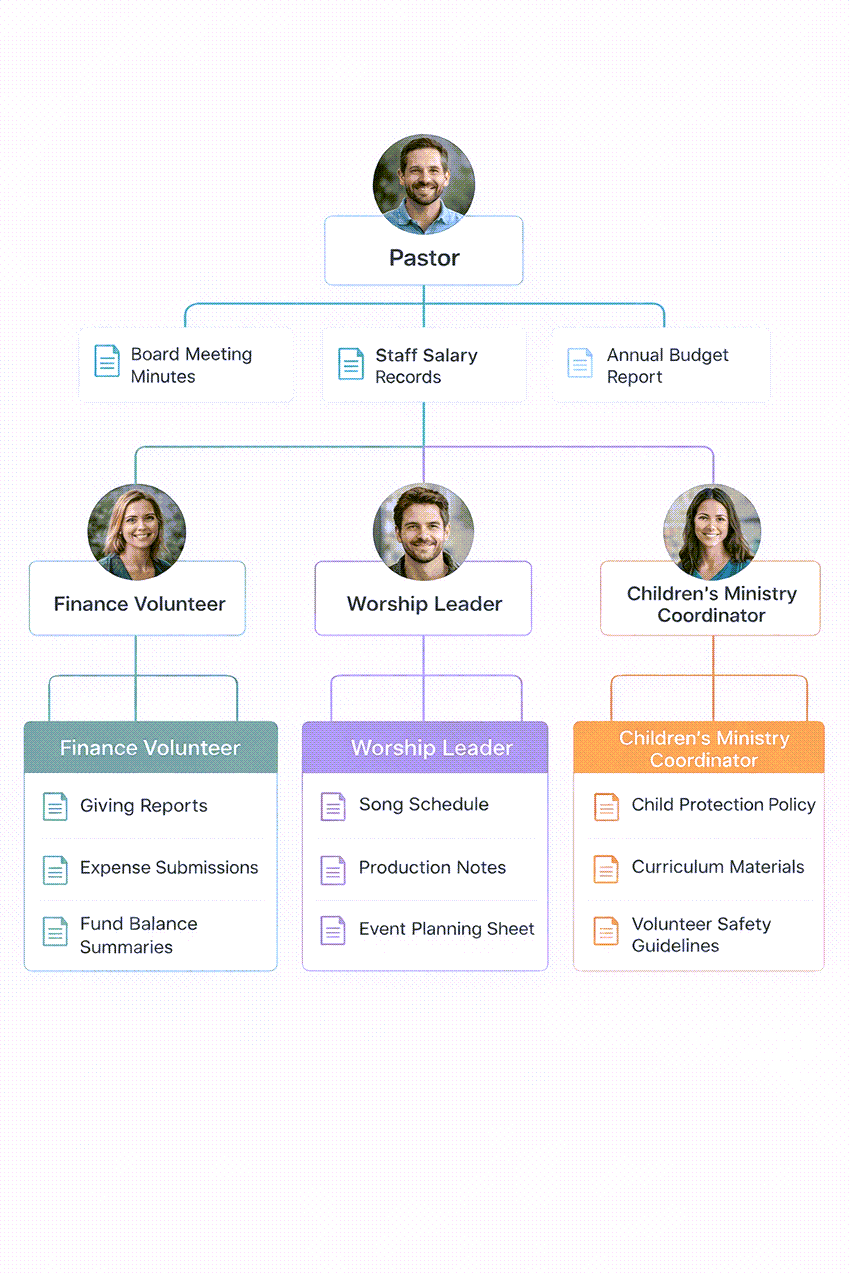
Not every document should be open to everyone, and getting this right is less complicated than most churches think.
The principle is straightforward: access should reflect responsibility. A worship leader needs the song schedule and production notes. They do not need board meeting minutes or staff salary records. A finance volunteer needs giving reports. They do not need pastoral correspondence.
Setting up access permissions for church leaders inside ChMeetings works through user roles rather than manual file-by-file settings. When a leader’s role in the system reflects their actual ministry role, their document access follows automatically. When their role changes, so does their access, without anyone having to remember to update a separate permissions list.
This protects sensitive information without creating unnecessary barriers for the people who genuinely need it. Inside ChMeetings, when a volunteer transitions into a leadership role, their access updates with their responsibility. No manual file sharing required, no forgotten permissions left open, and no sensitive documents reaching people who should not see them.
Content Publishing Workflow Inside Church
Creating content is only half the process. Getting it published consistently, accurately, and on time is where many churches lose the thread.
Without a defined workflow, announcements get posted by whoever is available. Event descriptions go live before they have been reviewed. Sermon summaries sit in someone’s drafts folder and never get published at all. The result is communication that feels reactive and inconsistent, even when the underlying content is good.
A defined church content publishing workflow brings order to that process. The path from draft to publication should be clear enough that anyone on the team can follow it without asking for instructions. For most churches, a simple three-stage flow works well: someone drafts the content, a designated reviewer approves it, and it gets published to the right place inside ChMeetings, whether that is a calendar event, a member-facing page, or a ministry resource folder.
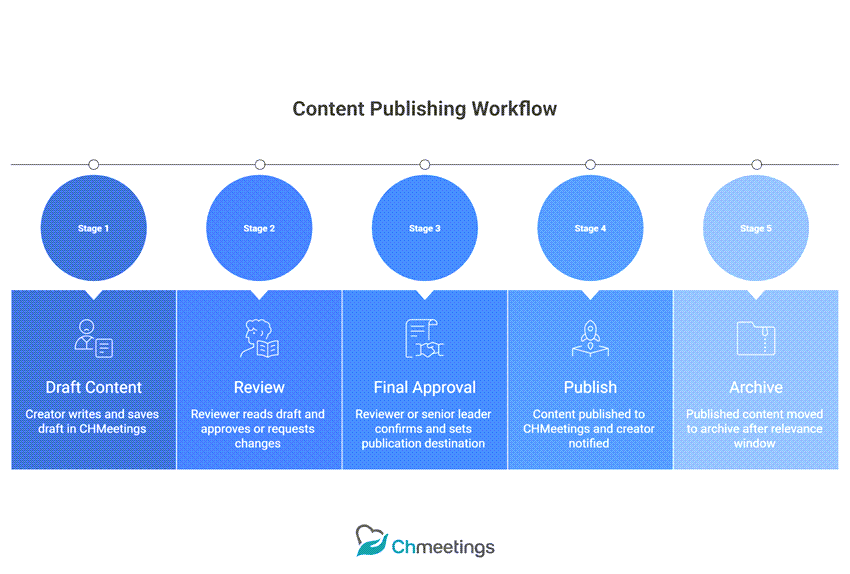
There is no need to copy content between platforms or wonder whether the right version reached the right audience. A church communications coordinator, for example, can draft a Sunday announcement, route it for pastoral review, and publish it directly to the member portal inside ChMeetings without ever leaving the system or sending a single follow-up email to confirm it went live. That kind of end-to-end clarity is what separates a content workflow from a content habit.
Donor Management: How to Build and Maintain Meaningful Giving Relationships
A church does not simply collect contributions. It builds relationships with people who have chosen to invest in something they believe in. Every gift, whether given once or faithfully repeated for years, represents a decision rooted in trust. Donor Management is how a church honors that trust beyond the moment of giving.
Without a structured approach, donor relationships exist only in memory. Names get forgotten. Giving patterns go unnoticed. Meaningful moments of follow-up never happen because nobody has a clear picture of who is giving, how often, and what their history with the church looks like.
A mature donor management system does not replace the personal dimension of those relationships. It protects it. When the right information is available at the right time, conversations become more meaningful, recognition becomes more intentional, and stewardship becomes something the congregation can feel rather than just hear about.
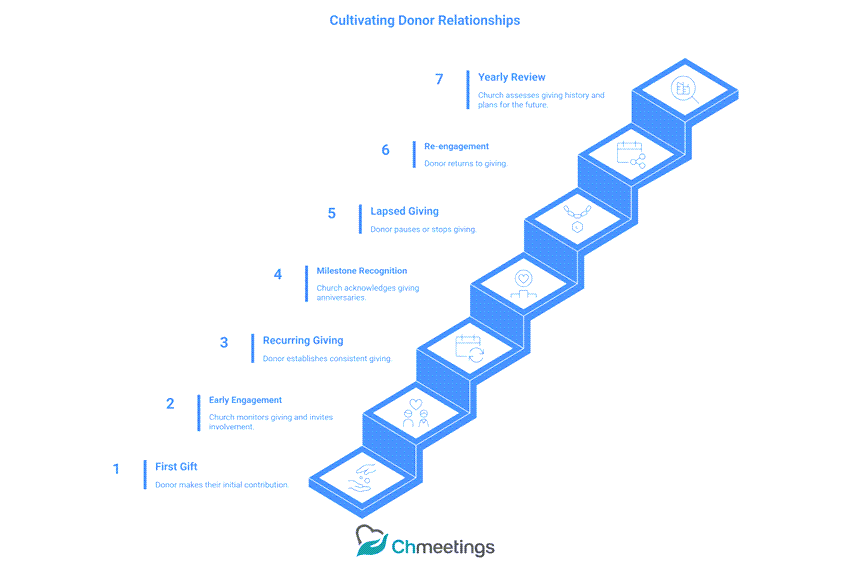
ChMeetings brings donor relationships into a single, organized environment where profiles, history, communication, and follow-up all connect. The result is a church that knows its donors not just as entries in a spreadsheet, but as people whose generosity deserves to be understood and honored over time.
The sections that follow cover each dimension of donor management in practical detail.
Donor Profile Management
Every giving relationship starts with a name. But a name alone tells a church very little about the person behind it. Effective Donor Profile Management is about building a complete, living picture of each donor that grows more useful over time rather than sitting static in a database.
A well-structured donor profile goes beyond contact details. It captures giving history, communication preferences, ministry involvement, and significant milestones. When a pastor sits down with a long-time contributor, they should not need to rely on memory alone. The profile should tell them when that person first gave, what they have supported over the years, and whether anyone from the church has followed up with them recently.
In practice, this means your team needs more than a name and an email address on file. It means knowing whether someone gives monthly or seasonally, whether they have designated gifts to specific funds, and whether their engagement with the church extends beyond financial contribution into volunteering or ministry participation.
When donor profiles are managed inside ChMeetings, every interaction, every gift, and every communication sits in one place. Nothing has to be reconstructed from memory or pieced together from separate records. The profile becomes the foundation for every meaningful conversation your leadership has with the people who make ministry possible.
A donor who feels known gives differently than one who feels like a transaction. Profile management is how your church makes that distinction felt.
Knowing a donor well starts with their profile. Understanding them deeply requires something more: a clear, uninterrupted record of how their generosity has moved over time.
Contribution History Tracking
There is a story behind every giving record. A first-time gift from someone still finding their place in the congregation. A sudden increase that reflects a season of personal growth. A long pause followed by a quiet return. Contribution History Tracking is how your church reads those stories accurately rather than guessing at them.
At its most practical level, tracking contribution history means having clean, reliable answers to straightforward questions:
- When did this donor first give?
- How frequently do they contribute?
- Have their giving patterns changed over the past year?
- Which funds have they supported and how consistently?
But the value of that data goes beyond reporting. Patterns reveal relationship. A donor who gives every December but rarely at other times may respond well to year-end stewardship communication. Someone whose giving has steadily increased over three years may be ready for a deeper conversation about legacy or planned giving. Neither insight is possible without a clear, organized history to draw from.
The risk in many churches is not that giving goes unrecorded. It is that records exist in fragments. One year lives in a spreadsheet. Another in an old software export. Recent months in a system that does not connect to anything else. When your team needs a complete picture, they spend time reconstructing it instead of using it.
Within ChMeetings, contribution history builds continuously against each donor profile. Every gift adds to a running record your leadership can review at any point without assembling data from multiple sources. Year-end summaries, multi-year comparisons, and fund-specific histories are all accessible from the same place.
The goal is simple: when someone on your team sits down to understand a donor’s relationship with the church, the history should be waiting for them, complete and clear.
History tells you what someone has done. Communication is how your church responds to it, and for the donors who give most consistently, that response deserves more than a automated confirmation.
Communication with Recurring Donors
Recurring donors are among the most committed people in your congregation. They have moved beyond a single decision to give and made generosity a rhythm of their lives. Communication with Recurring Donors is how your church acknowledges that commitment in a way that feels personal rather than automated.
The mistake many churches make is treating recurring donors the same way they treat first-time givers. A generic thank-you email that arrives the same way every month stops feeling like gratitude and starts feeling like a receipt. Over time that silence around the relationship communicates something unintentional: that the gift matters more than the person giving it.
Meaningful communication with recurring donors looks different at different moments:
- At the start of a giving relationship — a personal acknowledgment that goes beyond the automated confirmation, ideally from a pastor or ministry leader rather than a system notification
- At giving milestones — recognizing one year of consistent giving, or a cumulative total that reflects significant sacrifice
- During ministry updates — connecting the donor’s faithfulness to specific outcomes, showing them where their consistency has made a difference
- During unexpected gaps — a gentle, caring check-in when a recurring gift pauses, framed around the person rather than the missed contribution
The tone of each touchpoint matters as much as the timing. Recurring donors do not need to be managed. They need to feel that their relationship with the church is noticed and valued between Sundays.
Within ChMeetings, recurring donor profiles surface giving patterns, flag milestones, and keep communication history visible alongside contribution records. Your team does not need to manually track who deserves a follow-up. The system makes the right moment visible so the right conversation can happen naturally.
Consistency in giving deserves consistency in relationship. That is what intentional communication with recurring donors makes possible.
Not every donor, however, wants that kind of relationship. Some give quietly and deliberately, and honoring their generosity means respecting the distance they have chosen.
Handling Anonymous Donations
Not every donor wants to be known. Some give quietly by conviction. Others prefer that their generosity remain between themselves and God. Whatever the reason, Handling Anonymous Donations requires a level of care that balances operational accuracy with genuine respect for the donor’s wishes.
The challenge anonymous giving introduces is not financial. The money is received, recorded, and deposited like any other contribution. The challenge is relational and administrative. How does your church acknowledge a gift it cannot attribute? How does it maintain accurate records without compromising a donor’s stated preference?
Anonymous does not mean unrecorded. Every contribution must still be documented, assigned to the correct fund, and reflected in your financial reports regardless of whether the donor is identified. The anonymity belongs to the donor, not the transaction. Your team needs to know a gift was received. The donor simply does not want their name attached to it publicly or relationally.
It is also worth recognizing that some donors give anonymously situationally rather than permanently. A system that allows for flexible attribution means their preference can be honored at the transaction level without permanently obscuring their profile if that changes in the future.
Within ChMeetings, anonymous contributions can be recorded accurately while keeping donor identity protected where the donor has requested it. Fund balances update correctly, reports remain complete, and your financial integrity is preserved without compromising the trust of someone who gave in confidence.
Respecting anonymity is itself an act of stewardship. It tells your congregation that giving safely is always an option.
For every other donor whose name is known and whose giving is visible, the question is not whether to follow up. It is whether the church has a process reliable enough to make sure it actually happens.
Donor Follow-Up Procedures
Following up with donors is one of the most impactful things a church can do, and one of the most consistently overlooked. Not because churches do not care, but because without a defined process, follow-up depends entirely on whoever happens to remember. Donor Follow-Up Procedures replace that uncertainty with something your whole team can rely on.
The moments that deserve intentional follow-up are more varied than most churches account for:
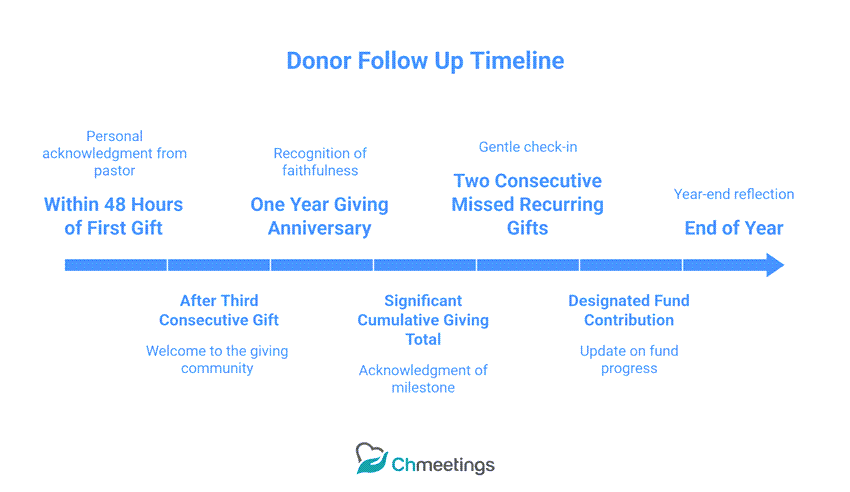
Each of these moments carries a different emotional weight for the donor. A first-time giver is still deciding whether this church is worth their long-term investment. A returning donor may have walked through something difficult in the time they were away. Treating every follow-up the same way misses what makes each moment significant.
What makes follow-up work is not frequency. It is relevance. A brief, personal message that arrives at the right moment does more for a donor relationship than a monthly newsletter that feels like it was written for nobody in particular.
Within ChMeetings, donor activity triggers visibility for your team rather than requiring manual monitoring. When a giving pattern changes, when a milestone is reached, or when a first contribution is recorded, the information is surfaced so the right person on your team can respond at the right time with the right tone.
Follow-up is not administration. It is the moment where data becomes relationship.
Those individual moments of follow-up matter enormously. But once a year, it is worth stepping back from the individual conversations and asking a harder question: how well did the church steward its donor relationships as a whole?
Yearly Donor Review Process
Most churches produce year-end giving statements because they are required to. Fewer use that same moment as a genuine opportunity to step back and assess the health of their donor relationships as a whole. The Yearly Donor Review Process is the difference between compliance and stewardship.
A year of giving data, when read carefully, tells your leadership things that no single report can. Which donors gave consistently and which gave once and disappeared. Whether first-time givers returned. Whether recurring donors who lapsed were ever followed up with. How designated fund contributions shifted compared to the previous year. Whether overall donor retention improved or quietly declined.
The goal is not to evaluate donors. It is to evaluate your church’s stewardship of those relationships over time. If retention is declining, that is worth understanding before it becomes a trend. If first-time giving increased but second gifts are rare, that points directly to a gap in early follow-up that the coming year can address.
Within ChMeetings, the data needed for this review already exists across donor profiles, contribution histories, and communication records. Your leadership does not need to compile it manually. The yearly review becomes a genuine act of reflection, a moment to ask honest questions about how well your church honored the generosity it received, and what it intends to do differently in the year ahead.
Membership: How to Welcome, Track, and Retain the People Who Make Your Church Home
A church is not a building or a program. It is people. And the way those people are welcomed, recorded, and cared for over time says more about a congregation’s values than almost anything else it does publicly. Membership is where the relational identity of a church becomes operational.
The challenge most churches face is not a lack of care. It is a lack of structure around that care. People arrive, fill out a form, and enter a process that nobody has fully defined. Some get followed up with. Others quietly disappear before anyone realizes they were gone. The gap between a warm Sunday welcome and a genuine long-term connection is almost always a process gap rather than a people gap.
A well-managed membership system does not make a church feel corporate. It makes it feel attentive. When the right information is captured at the right moment, when status is maintained accurately, and when transitions are handled with intention, members experience a church that knows them and notices them through every season of their involvement.
ChMeetings organizes membership from first visit to long-term engagement inside one connected environment. Every record, every status change, and every transition lives in the same place, giving your leadership a clear and current picture of who your church is made of and how well it is caring for them.

The sections that follow walk through each dimension of membership management in practical detail.
Member Registration Process
Every membership begins with a moment. Someone decides, after weeks or months of attending, that this church is not just a place they visit but a community they want to belong to. What happens next, in the hours and days following that decision, shapes how seriously they take that commitment and how seriously the church takes them.
Member Registration Process is the bridge between intention and belonging. When that bridge is clear and well-maintained, new members cross it with confidence. When it is unclear, people hesitate, and hesitation has a way of becoming indefinite delay.
A registration process worth trusting captures more than basic contact information. It should gather:
- Full name and household details
- Contact preferences and communication channels
- Baptism and previous church membership history
- Ministry interests and areas of availability
- Any specific pastoral care needs the member wishes to share
The depth of that information matters less than the consistency with which it is collected. A church that gathers the same information from every member in the same way builds a membership record that is actually usable. One that collects different things from different people at different times builds a database full of gaps.
What the registration moment communicates is equally important. A process that feels rushed or purely administrative sends an unintentional message. A process that feels personal and intentional tells a new member that their decision to join was noticed and valued.
Within ChMeetings, member registration connects directly to the broader membership record. Information captured at registration does not need to be re-entered elsewhere. It becomes the foundation of the member profile that your team will reference for years, and when registration is connected to your broader membership system, no new member enters your church unnoticed.
The registration process is not paperwork. It is the first act of pastoral care a church extends to someone who has chosen to call it home.
New Visitor Assimilation Workflow
Sunday morning is the easiest part. A visitor arrives, feels welcomed, enjoys the service, and leaves with a good impression. What happens in the six days that follow determines whether they come back.
Most churches lose new visitors not because the experience was poor but because nobody had a clear answer to a simple question: whose responsibility is this person right now? New Visitor Assimilation Workflow answers that question before it needs to be asked.
Assimilation is not a single conversation or a welcome packet. It is a sequence of intentional touchpoints that move a visitor from curious guest to connected member. That sequence looks different in every church, but the underlying logic is consistent. Contact must happen quickly. Follow-up must feel personal. And the path from first visit to belonging must be visible enough that no one falls through the cracks unnoticed.
A reliable workflow typically moves through several stages:
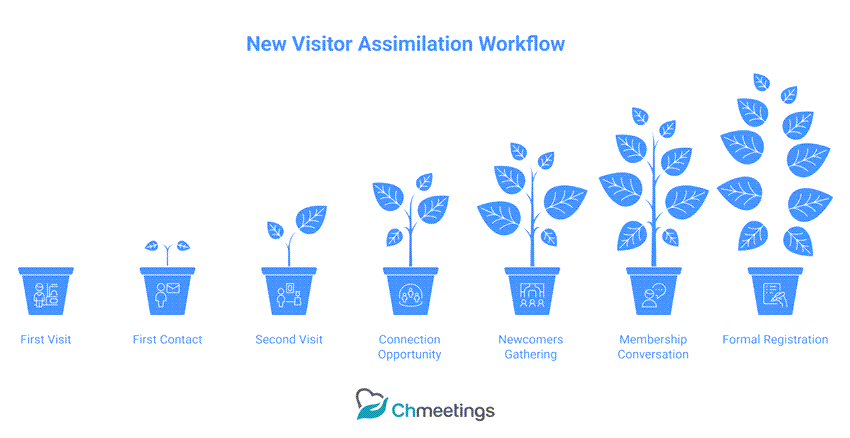
The gap between first visit and formal membership can span weeks or months. What fills that gap is not a system. It is people, supported by a process that ensures nobody is forgotten while that journey unfolds.
Within ChMeetings, visitor records are created from the first point of contact and tracked through each stage of assimilation. A platform like ChMeetings extends that journey beyond Sunday by giving visitors a way to stay connected to church life between visits. The workflow does not replace the warmth of human follow-up. It makes sure that warmth actually reaches everyone it should.
A visitor who feels genuinely pursued becomes a member who genuinely belongs. That outcome rarely happens by accident.
Member Status Categories
Not everyone in your congregation occupies the same place in their relationship with the church. Someone who has attended for twelve years and serves on three ministry teams is in a fundamentally different position than someone who joined six months ago and has not yet connected beyond Sunday morning. Member Status Categories give your church the language and structure to reflect those differences accurately.
Without clear categories, membership records flatten everyone into the same label. Active and inactive sit side by side with no distinction. Long-term members and recent visitors look identical in a report. Leadership makes decisions based on numbers that do not reflect reality.
The specific categories a church uses will vary, but a functional system typically distinguishes between:
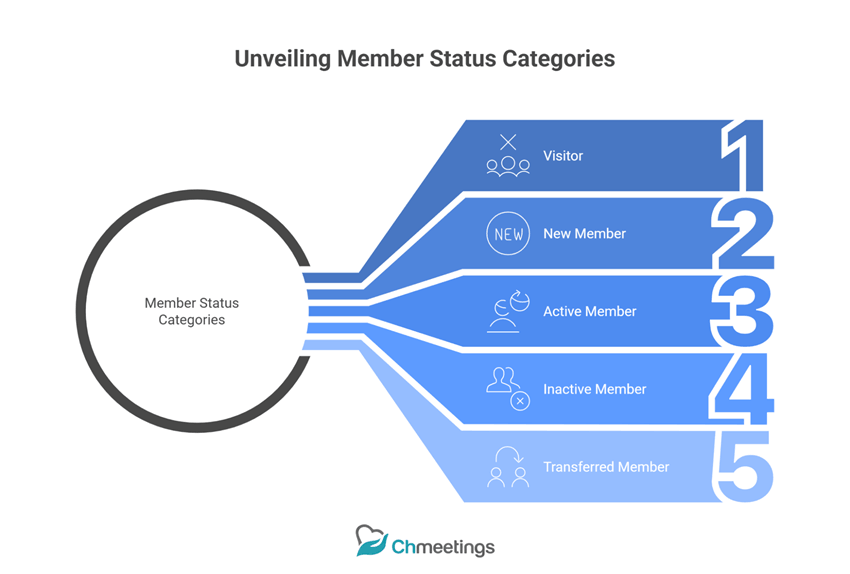
What matters is not the labels themselves but the consistency with which they are applied and updated. A status that never changes stops meaning anything. A membership roll where everyone is technically active regardless of actual engagement gives leadership a false picture of congregational health.
Within ChMeetings, member status is not a static field that gets filled in once and forgotten. It updates as circumstances change, giving your team a live and accurate view of where every person stands in their relationship with the church at any given moment.
Knowing who your members are is inseparable from knowing where they are.
Handling Inactive Members
Inactivity rarely announces itself. It arrives gradually, through a series of missed Sundays that nobody tracks closely enough, until one day someone realizes they have not seen a familiar face in months. By that point the distance has grown in ways that a single phone call may not bridge. Handling Inactive Members is about catching that drift early enough to respond to it meaningfully.
The instinct in many churches is to avoid the conversation entirely. Reaching out to someone who has stopped attending can feel intrusive, as though the church is policing commitment rather than expressing genuine care. That hesitation is understandable. It is also costly.
What an inactive member usually needs is not a reminder of their obligation. It is evidence that their absence was noticed by someone who actually cares why.
How a church responds to inactivity depends on understanding what caused it. The reasons vary more than most leadership teams assume:
- A season of personal difficulty that made Sunday attendance feel impossible
- An unresolved relational conflict within the congregation
- A life transition such as a new job, a new baby, or a move that disrupted the routine
- A quiet sense of disconnection that built slowly without any single defining moment
- A genuine decision to worship elsewhere that simply was not communicated
Each of these calls for a different response. A member navigating grief needs pastoral presence. Someone who felt hurt needs a careful and humble conversation. A person whose life circumstances shifted may simply need a lower-friction way back in.
Within ChMeetings, inactivity becomes visible before it becomes permanent. Attendance patterns, giving trends, and engagement records surface changes in behavior that would otherwise go unnoticed until too much time has passed. Your team can respond while the relationship is still warm rather than after it has gone cold.
An inactive member is not a lost cause. They are someone whose connection to the church loosened at a moment when life got complicated. How your church responds to that moment defines what membership actually means.
Transfer In / Transfer Out Procedures
People move. Circumstances change. A family relocates to a new city. A couple finds a congregation closer to where their life is now centered. A minister transitions to serve a different community. These moments are a natural part of church life, and how a church handles them reveals something important about how it views membership, not as possession but as stewardship.
Transfer In / Transfer Out Procedures exist to make those transitions dignified, clean, and well-documented on both sides.
When someone transfers in
A member arriving from another congregation brings history your church does not yet know. A transfer process that captures that history well gives your team a meaningful head start in understanding who this person is and how to connect them quickly.
A transfer in should prompt your team to gather:
- Previous church name and denomination
- Length of prior membership and ministry involvement
- Baptism records and any formal membership documentation
- Ministry interests they hope to continue in their new church home
The goal is not bureaucracy. It is continuity. A person who transfers in and immediately feels known is far more likely to become genuinely rooted than one who has to reintroduce themselves from scratch at every turn.
When someone transfers out
This is where many churches stumble. A departing member is sometimes treated as a loose end to be tied off rather than a relationship worth honoring on the way out. A transfer out handled well leaves the door open to a future relationship, whether that means reconnecting years later, maintaining a broader ministry network, or simply parting in a way that reflects the church’s genuine care for the person beyond their membership status.
A clean transfer out process includes formal acknowledgment of the departure, documentation of the member’s record for their receiving congregation if requested, and an update to your membership roll that reflects the change accurately and promptly.
Within ChMeetings, both transfer directions are handled inside the same membership environment. Records update cleanly, history is preserved, and your membership data reflects reality rather than carrying ghost entries of people who left months ago without anyone formally noting it.
How a church says goodbye matters almost as much as how it says hello.
Membership Directory Maintenance
A membership directory is only as useful as it is accurate. And accuracy is not a one-time achievement. It is a discipline that requires consistent attention because people’s lives change constantly. Addresses shift. Phone numbers change. Families grow. Members move on. Membership Directory Maintenance is the ongoing commitment to ensuring that what your church knows about its people reflects who they actually are right now, not who they were when they first joined.
The consequences of a neglected directory are more practical than they might seem. A pastoral care visit scheduled to the wrong address. An emergency contact that no longer answers. A communication sent to someone who left the congregation two years ago. None of these failures are dramatic on their own. Together they communicate something a church never intends to say: that it is not paying close enough attention.
Keeping a directory current requires more than periodic data entry. It requires a culture where updating information feels natural rather than administrative. A few habits make a significant difference:
- Encouraging members to review and update their own details annually, ideally tied to a moment they already associate with the church calendar
- Training ministry leaders to flag changes they become aware of through natural conversation rather than waiting for a formal process
- Conducting a systematic review of contact records for members who have not engaged in an extended period
- Archiving rather than deleting records for departed members so that history is preserved without cluttering the active directory
The directory is not simply a contact list. It is a living reflection of your congregation. When it is maintained well it becomes a tool your entire leadership team reaches for confidently, knowing what they find will be accurate and complete.
Within ChMeetings, directory maintenance is not a separate administrative task that lives outside your normal workflow. Member records connect directly to attendance, giving, communication history, and ministry involvement. When members have ownership over their own information within a shared system, accuracy becomes a shared responsibility rather than something the administrator chases alone.
A directory that is current is not a bureaucratic achievement. It is a pastoral one. It means the church knows where its people are, how to reach them, and that it has not lost track of anyone it committed to care for.
Attendance Tracking: How to Record, Monitor, and Respond to Who Shows Up
Showing up matters. For a congregation member, walking through the doors on a Sunday morning or joining a small group on a Wednesday night is an act of commitment that deserves to be noticed. For church leadership, attendance is not just a number to report. It is a window into the health of the congregation, the effectiveness of ministries, and the early signs of disconnection before they become permanent.
Attendance Tracking is where operational discipline and pastoral care intersect. A church that tracks attendance well does not do so to police participation. It does so because patterns of presence and absence tell stories that leadership needs to hear.
The challenge most churches face is not motivation. It is infrastructure. When attendance is recorded on paper sheets that nobody digitizes, or in systems that do not connect to member records, the data exists but the insight does not. Numbers accumulate without ever becoming actionable.
A structured attendance system changes that entirely. When records are consistent, connected, and visible in real time, leadership moves from reacting to absence to anticipating it. From counting heads to understanding trends. From managing data to caring for people.
ChMeetings brings attendance tracking into the same environment where member records, giving history, and ministry involvement already live. Whether through QR code check-in, kiosk registration, or manual recording, every attendance event connects directly to the member profile it belongs to. The result is a church that always knows who was there, who was not, and what that pattern means over time.
The sections that follow cover each dimension of attendance tracking in practical detail.
Service Attendance Recording
Picture a Sunday morning three months ago. A member who had attended faithfully for two years quietly stopped showing up. No announcement. No explanation. Just an empty seat that nobody formally noticed because the attendance sheet from that day was never fully digitized, and the weeks that followed looked the same.
That is not a failure of care. It is a failure of infrastructure.
Service Attendance Recording exists to make sure that kind of invisible departure becomes impossible. Not by adding bureaucracy to Sunday morning, but by building a system that notices what busy people cannot always notice themselves.
A weekly headcount tells leadership very little on its own. What makes attendance data genuinely useful is the layer beneath the number. Whether the people who showed up are the same people who showed up last week. Whether first-time visitors are returning or disappearing after a single Sunday. Whether a member whose engagement was already fragile has now missed enough consecutive services to warrant a personal conversation.
That level of insight only emerges when attendance is recorded at the individual level rather than the aggregate. When service types are distinguished from one another on the same campus. When the record is created at the moment of arrival rather than reconstructed from a paper sheet two days later.
Within ChMeetings, QR code check-in and kiosk registration capture attendance the moment it happens, connected directly to each member’s profile without requiring manual entry afterward. Patterns become visible across weeks and months rather than sitting buried in disconnected spreadsheets. When someone who never misses a Sunday stops appearing in the record, leadership knows before the absence becomes a story nobody told them.
The goal of recording attendance is not to produce a number for the board report. It is to stay close enough to your congregation that distance does not grow unnoticed.
Small Group Attendance Tracking
A church can fill its Sunday services and still have a congregation where most people do not genuinely know each other. Weekend attendance measures reach. Small group attendance measures depth. Small Group Attendance Tracking treats both with equal seriousness because a church that only monitors one is only seeing half the picture.
The insight small group data provides is different in kind, not just in scale. A member who attends every Sunday but has missed their group for two months is sending a signal that the service record alone would never surface. These distinctions matter for pastoral care, and they are only visible when both streams of attendance live in the same system.
Within ChMeetings, small group attendance connects directly to each member’s profile rather than sitting in isolation. Group leaders can record attendance quickly without switching platforms, which makes consistency the natural outcome rather than the exception. What leadership sees is not a collection of separate group reports but a complete picture of how each member is engaging across every dimension of church life.
Children Check In and Check Out
Every parent who hands their child to a church volunteer is making a trust decision. They are not thinking about administrative process. They are thinking about whether their child will be safe, cared for, and returned to them without confusion or delay. Children Check In and Check Out is how a church honors that trust with something more reliable than good intentions.
A children’s check-in system serves two purposes simultaneously. For parents, it provides visible confirmation that their child’s presence is formally recorded and that pickup will be controlled. For the church, it creates a documented chain of custody that protects both the children in its care and the volunteers responsible for them.
What makes this different from general attendance recording is the stakes involved. A missed check-in in an adult service is a gap in data. A missed check-in in a children’s ministry is a safety vulnerability. The process must be consistent every single week, not because leadership is watching, but because the one time it is not is the one time it matters most.
A reliable children’s check-in process ensures:
- Every child is matched to a verified parent or guardian at arrival
- A secure label or identifier connects child to family throughout the session
- Pickup requires the same verification used at drop-off
- Any volunteer or staff member can immediately account for every child in their care at any point during the session
Within ChMeetings, children’s check-in operates at the family level rather than the individual level. When a family checks in, each child is recorded against their profile and linked to the parent or guardian responsible for pickup. The process is fast enough not to disrupt the flow of a busy Sunday morning and secure enough to give every parent confidence that the system is working even when they cannot see it.
Trust is built in small moments. A smooth, secure check-in experience is one of them.
Volunteer Attendance Logs
Someone who attended every week for a year and then stopped coming has not necessarily left. They may be going through something difficult. They may be waiting to see if anyone notices. That waiting is the part most churches never know about, because by the time the absence becomes obvious enough to prompt a response, weeks have already passed and the distance has grown in ways that a single phone call may not bridge.
Follow up based on absence is the church’s answer to that waiting. And the difference between follow up that lands well and follow up that feels too late almost always comes down to one thing: timing.
Reaching out after two missed Sundays communicates something completely different than reaching out after two months. The first feels like genuine care. The second feels like the church finally noticed a problem it should have caught much earlier. The member on the receiving end of both messages knows the difference immediately, even if they never say so.
What makes early follow up possible is not attentiveness alone. It is infrastructure. A church that reviews attendance manually once a month will always be behind. By the time someone scans a paper sheet and notices a familiar name missing, the pattern is already established and the relational window is already narrower than it should be.
The follow up itself does not need to be elaborate. A personal message. A phone call from someone who actually knows them. A pastor stopping by if the situation calls for it. The form matters less than the fact that it happens at all, and that it happens while the relationship is still warm enough to receive it.
What the follow up conversation should never feel like is administrative. A member who stopped attending does not need a reminder that they have been absent. They need evidence that someone in the church noticed them as a person and cared enough to ask why.
ChMeetings surfaces absence patterns automatically against each member’s attendance history, giving the right person visibility at the right moment without requiring anyone to manually scan through records looking for gaps. The technology handles the detection. The people handle everything that matters after that, which is the only part that can actually make a difference.
Follow Up Based on Absence
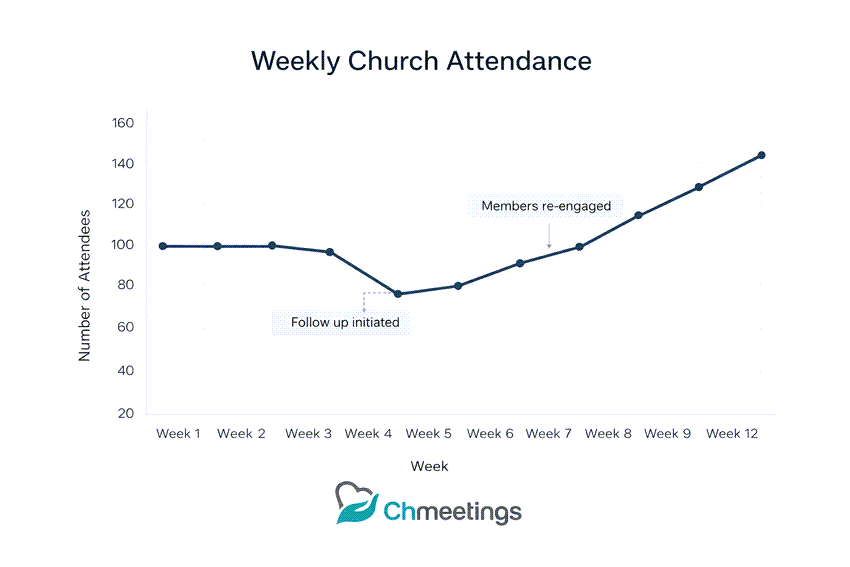
Someone who attended every week for a year and then stopped coming has not necessarily left. They may be going through something difficult. They may be waiting to see if anyone notices. Follow Up Based on Absence is the church’s answer to that waiting.
The follow-up itself is not complicated. A message. A phone call. Someone stopping by. What makes it meaningful is the timing. Reaching out after two missed Sundays communicates something completely different than reaching out after two months. The first feels like genuine care. The second feels like the church finally noticed a problem it should have caught much earlier.
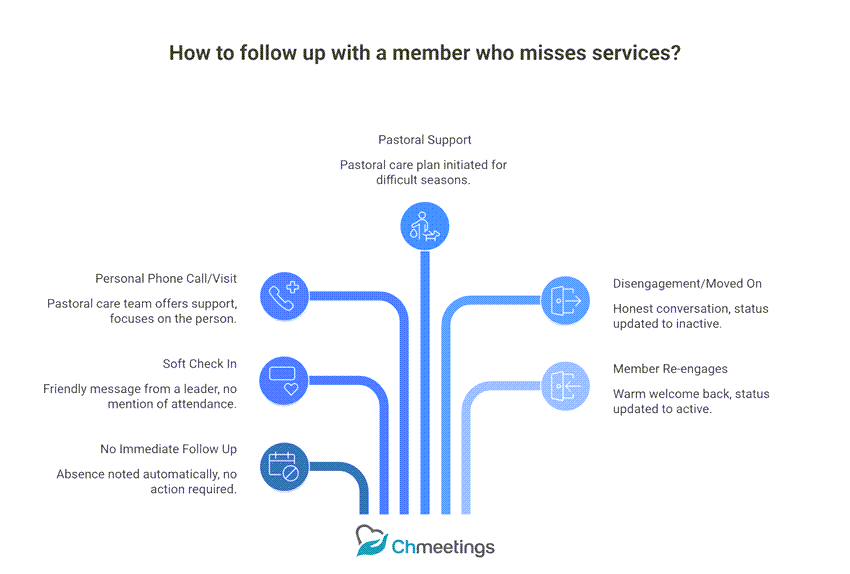
That timing depends entirely on whether absence is visible in real time or discovered in retrospect. A church that reviews attendance manually once a month will always be responding too late. Absence needs to be flagged as it accumulates, not after it has already become a pattern that is difficult to reverse.
ChMeetings surfaces those patterns automatically against each member’s attendance history, giving the right person visibility at the right moment without requiring anyone to manually scan through records looking for gaps. The technology handles the detection. The people handle everything that matters after that.
Because the follow-up conversation itself belongs entirely to those who know the member. What the system does is make sure that conversation happens while it can still make a difference.
Attendance Reporting Cycles
Numbers without context are just counts. Attendance Reporting Cycles are what turn a week of check-ins into a leadership conversation worth having.
The question most churches ask is whether attendance went up or down. The question a reporting cycle is designed to answer is why, and what to do about it. That shift from observation to interpretation is only possible when data is reviewed consistently, at the right intervals, by the right people.
A weekly report belongs in the hands of ministry leaders. It tells them who showed up, who did not, and whether anything in that pattern needs immediate attention. A monthly summary belongs at the department level, where trends across multiple weeks start to reveal something a single Sunday never could. A quarterly review belongs in a leadership conversation where decisions about programming, staffing, and resource allocation are actually made.
Each interval serves a different purpose. Collapsing them into one occasional report, or reviewing data only when something feels wrong, means the church is always catching up rather than staying ahead.
ChMeetings produces these views without requiring anyone to compile them manually. The data that was recorded at check-in becomes a leadership report at whatever interval and level of detail the moment calls for, broken down by service, group, gender, and membership status. The reporting does not add work to the attendance process. It is the return on the work already done.
Communication: How to Reach the Right People with the Right Message at the Right Time
Every church communicates constantly. Announcements go out. Emails get sent. Leaders share updates with their teams. Prayer requests move through care networks. Staff coordinate across departments. The volume of communication inside a healthy, active church is significant, and most of it happens without anyone stepping back to ask whether it is actually working.
The gap between sending a message and having it received, understood, and acted on is wider than most churches realize. An announcement buried in a bulletin. An email that arrived during a busy week and never got opened. A staff update that reached three people instead of eight. Communication that feels complete from the sender’s perspective is often incomplete from the recipient’s.
Communication in a church context is not simply about information transfer. It is about maintaining the trust and clarity that holds a congregation, a staff team, and a ministry network together. When it works well, people feel informed and connected. When it does not, confusion fills the space that clarity should have occupied.
ChMeetings connects communication across every layer of church life, from congregation-wide announcements to targeted ministry messages to internal staff coordination, inside one environment where nothing has to be manually duplicated across platforms. The sections that follow address each distinct communication challenge your church faces and how to handle each one with the consistency it deserves.
Weekly Announcement Workflow
Every week, the same problem appears in churches of every size. Someone has information that the congregation needs. Getting that information out accurately, on time, and through the right channels depends entirely on whoever happens to be available and whatever process they happen to follow that week. The result is inconsistency that compounds quietly over time.
Weekly Announcement Workflow solves that by replacing availability-dependent communication with a defined sequence that produces the same result regardless of who is executing it.
The sequence needs to answer four questions before anything gets published:
- Who is responsible for submitting announcements and by what deadline
- Who reviews submitted content before it goes out
- Which channels carry which type of announcement
- What happens when a submission arrives after the deadline
Without clear answers to all four, the workflow exists in name only. Deadline flexibility becomes the norm. Review steps get skipped when time is short. The same announcement appears in three places with three slightly different versions because nobody confirmed which one was final.
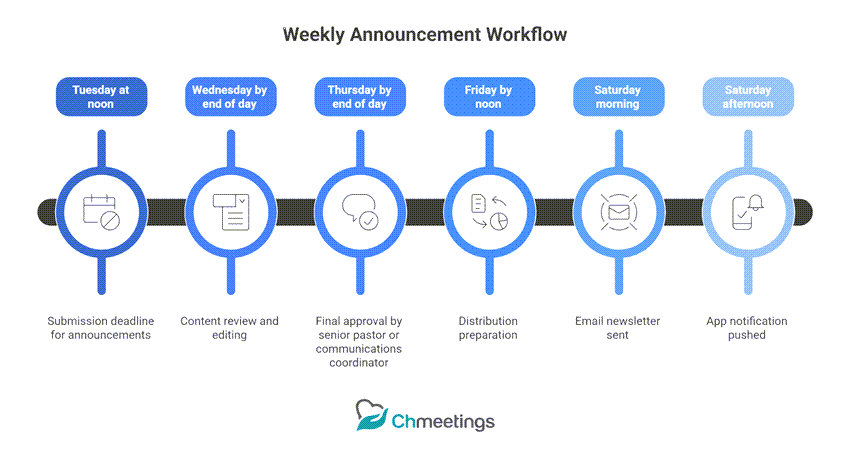
A practical announcement workflow runs on a weekly calendar that everyone involved knows and respects. Submissions close by a fixed point midweek. Review happens within a defined window. Final versions are confirmed before distribution begins. ChMeetings supports this by centralizing submission, review, and publishing inside one environment, so the workflow is not spread across email threads and shared documents that nobody fully controls.
Targeted Member Messaging
Not every message belongs to everyone. A reminder about the men’s retreat does not need to reach the women’s ministry. A volunteer briefing for the parking team does not need to land in the inbox of every small group leader. When every communication goes to every person, people stop reading. And when people stop reading, the messages that actually matter to them get lost alongside the ones that never should have arrived in the first place.
Targeted Member Messaging is less about technology and more about respect. Respecting people’s attention. Respecting the relevance of what you send them. Respecting the difference between keeping someone informed and overwhelming them with information that has nothing to do with their life in the church.
The starting point is knowing your audience well enough to segment it meaningfully. Not every church needs dozens of communication groups. Most need a manageable set that reflects how the congregation actually organizes itself. Ministry teams. Age groups. Volunteer roles. Geographic zones for multisite contexts. The right segments are the ones that make a message more relevant to the people receiving it, not the ones that simply exist because the system allows them to.
Within ChMeetings, member groups and ministry structures that already exist in the system become the natural foundation for targeted messaging. A message intended for small group leaders does not need a separate mailing list built from scratch. The people are already organized. The communication follows the structure rather than working around it.
What changes when messaging becomes targeted is subtle but significant. Members start paying attention again because what arrives in their inbox tends to be relevant to them. Leaders gain confidence that their communications are actually reaching the people they were written for. And the church as a whole feels less like it is broadcasting into a room and more like it is having the right conversations with the right people.
Emergency Communication Protocol
Every church will face an emergency. The question is not whether a crisis will occur but whether leadership will be ready to communicate when it does. A fire. A medical incident during a service. A safeguarding concern. A sudden pastoral departure. Each of these situations demands clear, coordinated communication under conditions that are inherently stressful and time-compressed. Emergency Communication Protocol is the decision your leadership makes in advance so that the right decisions do not have to be made under pressure.
What distinguishes churches that communicate well in a crisis from those that do not is rarely resources or technology. It is preparation. Specifically, whether three questions have been answered before the emergency occurs:
- Who has the authority to initiate emergency communication on behalf of the church
- What channels are used to reach the congregation, staff, and leadership simultaneously
- What the message hierarchy looks like, meaning who gets contacted first, second, and third, and by whom
Without documented answers to these questions, emergency communication defaults to whoever acts first. That creates inconsistency, potential misinformation, and a congregation that receives fragmented updates from multiple sources with no clear authority behind any of them.
The protocol itself does not need to be complex. It needs to be clear, accessible, and known to the people responsible for executing it before they ever need to. A document that lives in a folder nobody has opened in two years is not a protocol. It is a liability.
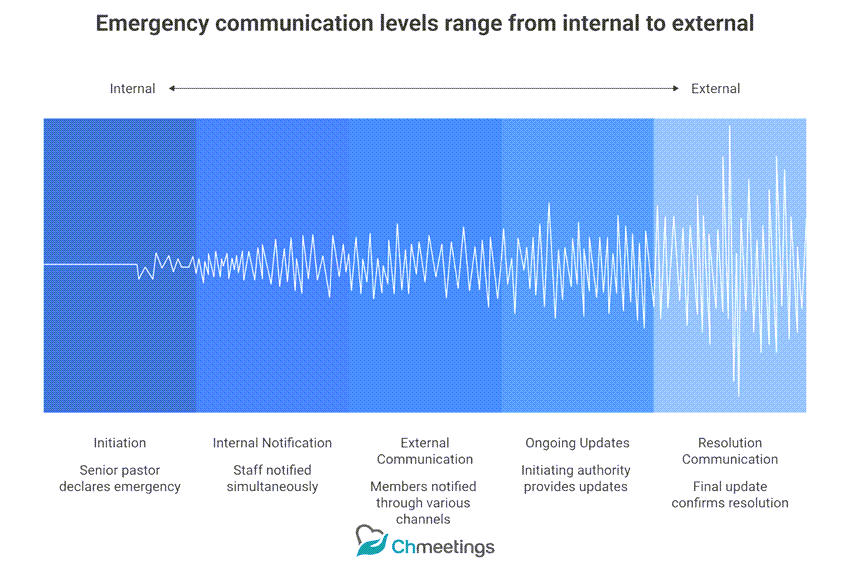
ChMeetings allows emergency messaging to reach segmented groups simultaneously through multiple channels without requiring manual coordination across platforms in the middle of a crisis. When the protocol is defined and the system is already in place, leadership’s role in an emergency shifts from figuring out how to communicate to focusing entirely on what to communicate.
A church that has prepared its emergency communication protocol has made a leadership decision that its congregation will never see and will always benefit from.
Staff Communication Structure
Internal staff communication fails in a predictable way. Not because people do not communicate, but because they communicate through too many channels simultaneously with no shared understanding of which channel carries which type of information. A urgent facilities issue gets buried in the same email thread as a routine scheduling update. A decision that affects three departments gets made in a private message that only two people see. Important context lives in someone’s inbox rather than somewhere the whole team can access it.
Staff Communication Structure defines which channel is used for what, who is responsible for initiating communication at each level, and how information moves through the staff team without getting lost or duplicated.
The structure does not need to be elaborate. It needs to answer a few specific questions clearly:
- Which channel handles time-sensitive operational updates
- Which channel handles decisions that require input from multiple staff members
- Which channel handles documentation that needs to remain accessible beyond the conversation itself
- What the expected response time is for each channel so urgency is not assumed by default
Without those definitions, staff default to whatever feels easiest in the moment. Everything becomes urgent because there is no agreed standard for what urgency actually means. Meetings get called to discuss things that a structured written update would have resolved. And information that should be institutional knowledge disappears when a staff member leaves because it only ever existed in a personal conversation thread.
ChMeetings centralizes staff-level communication alongside the member records, ministry structures, and event data that staff are already working from. Updates stay connected to the context they belong to rather than floating in a separate messaging platform that has no relationship to the rest of the church’s operational environment.
A staff communication structure is not about controlling how people talk to each other. It is about ensuring that what gets communicated actually reaches the people who need it, in the form they can use it, without anyone having to ask twice.
Ministry Leader Reporting Flow
Ministry leaders sit between their teams and senior leadership. Information moves in both directions through them, and when that flow is undefined, it stalls. Updates that senior leadership needs arrive late or not at all. Direction that ministry teams need gets filtered inconsistently. The gap between what is happening on the ground and what leadership believes is happening widens without anyone intending it to.
Ministry Leader Reporting Flow defines how information moves upward, how often, in what format, and to whom. Without that definition, reporting depends entirely on individual initiative. Some leaders report thoroughly. Others report only when something goes wrong. Senior leadership ends up with an uneven picture of ministry health that reflects reporting habits more than actual reality.
A functional reporting flow answers three things: what ministry leaders are expected to report, when they are expected to report it, and where that report goes. ChMeetings supports this by giving ministry leaders a structured environment to log activity, track attendance, and surface relevant data without building a separate report from scratch each time.
When reporting is consistent, leadership conversations shift from status updates to strategic decisions. That shift is the point.
Prayer Request Handling
When someone shares a prayer request, they are doing something that requires courage. They are trusting the church with something personal, sometimes deeply so. A health diagnosis. A struggling marriage. A child who has walked away from faith. The moment that request is shared, the church’s response either deepens that trust or quietly erodes it.
Prayer Request Handling is not an administrative function dressed in spiritual language. It is one of the most sensitive areas of pastoral care a church manages, and it deserves to be treated that way.
Two things matter most. The first is confidentiality. A prayer request shared in a small group should not appear in a church-wide email without the person’s knowledge. A personal struggle disclosed to a pastor should not circulate through a volunteer prayer chain unless the person explicitly consented to that. The pathway a request travels must be defined clearly and honored consistently, because a single breach of confidence can close someone off from seeking support for years.
The second is follow-up. Receiving a request and praying for it privately is meaningful. Circling back to the person weeks later to ask how things are going is transformative. It tells them that they were not just an item on a prayer list but a person whose situation someone continued to carry.
ChMeetings allows prayer requests to be recorded, assigned to appropriate care team members, and followed up within the same environment where member profiles and communication history already live. The request stays connected to the person it belongs to rather than existing as a disconnected note that nobody revisits.
A church that handles prayer requests well communicates something that no announcement or sermon can fully replicate. That it is genuinely safe to be known here.
Volunteering: How to Recruit, Equip, and Retain the People Who Make Ministry Possible
No church runs on staff alone. Behind every Sunday service, every children’s class, every outreach event, and every hospitality moment is a network of people who showed up because they chose to. Volunteers are not a support system for ministry. In most churches, they are the ministry.
That makes how a church manages its volunteers one of the most consequential operational decisions it makes. A volunteer who feels organized, equipped, and genuinely valued serves longer, recruits others naturally, and carries the church’s culture into every role they fill. One who feels overlooked or overloaded quietly steps back, and the gap they leave is rarely filled as easily as it was created.
This part of the guide covers the full volunteer lifecycle inside ChMeetings, from the first recruitment conversation to the long-term practices that keep good people engaged and coming back.

Volunteer Recruitment Process
Most churches recruit the same way. A general announcement from the front. A bulletin insert. An appeal that reaches everyone and targets no one. A few people respond, usually the same ones who always do, and the broader congregation stays on the sidelines.
The problem is not that people are unwilling. It is that general appeals feel like they are meant for someone else.
A targeted ask changes that entirely. Someone with a background in logistics, approached personally about coordinating an outreach event, is far more likely to say yes than someone who caught a vague announcement about needing volunteers. The difference is not the ask. It is that someone noticed them specifically.
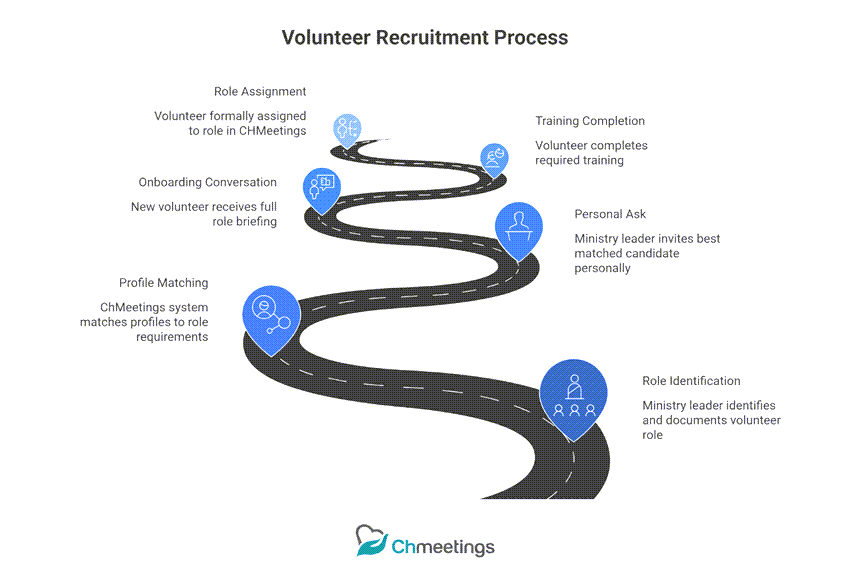
ChMeetings member profiles capture ministry interests, skills, and availability so that volunteer recruitment becomes a targeted conversation rather than a broadcast. The right ask reaches the right person before the need becomes urgent enough to take anyone willing rather than anyone suited.
Role Assignment System
Getting someone to say yes is step one. Knowing what they said yes to is step two.
Every role should answer four things before anyone is assigned to it:
- What it involves on a typical week
- How much time it realistically requires
- Whether it is ongoing or tied to a specific event
- Any prerequisites such as a background check or a training session
When that clarity exists upfront, role assignment becomes a matching process rather than a guessing one. ChMeetings connects assignments directly to volunteer profiles so that availability, existing commitments, and role requirements are all visible before any decision is made. That prevents the two most common mistakes: overloading the people who are easiest to ask, and leaving capable volunteers waiting for direction that never arrives.
Scheduling Rotations
Burnout in volunteer teams rarely announces itself. It builds quietly over weeks when the same people are scheduled every Sunday because the coordinator knows they will show up.
Committed volunteers will say yes almost every time they are asked. That is precisely why a rotation system matters. It protects your best people from their own willingness.
Scheduling rotations inside ChMeetings are built around availability windows that volunteers set themselves. The system distributes responsibilities across the team rather than defaulting to whoever is most reliable. No single volunteer carries a disproportionate load. The team stays fresher, more engaged, and far less likely to quietly disappear after a season of overcommitment.
Substitution Handling
Life happens. A volunteer who was scheduled for Sunday morning wakes up sick. A family situation pulls someone away without warning. How a church handles that moment says a lot about how organized its volunteer system really is.
Without a clear substitution process, the scramble begins. Phone calls, group texts, last-minute favors. It works, barely, but it creates stress that compounds over time.
A defined substitution handling process removes that friction. In ChMeetings, substitution requests can be initiated by the volunteer or the coordinator, with visibility into who is available and qualified to step in. The right replacement is identified quickly, notified directly, and confirmed before Sunday morning becomes a problem.
The goal is simple: no role goes uncovered and no coordinator spends their Saturday night making frantic calls.
Training Tracking
A volunteer placed in a role without adequate preparation is set up to struggle. That is not a people problem. It is a systems problem.
Training requirements vary significantly across ministry areas. Children’s ministry volunteers need safeguarding training before their first Sunday. Sound technicians need hands-on orientation before they touch the board. Hospitality teams need far less formal preparation. A single training policy does not fit all of them.
Training tracking in ChMeetings keeps a clear record of what each volunteer has completed and what is still required. Before someone is assigned to a role with specific prerequisites, those requirements are visible in their profile. No one falls through the cracks. No ministry area operates with undertrained volunteers because nobody remembered to follow up.
When training is tracked systematically, it also becomes easier to identify patterns. If a particular ministry has a high proportion of volunteers who never completed their orientation, that is a signal worth acting on before it affects ministry quality.
Volunteer Care and Retention
Recruitment fills a team. Care keeps it together.
The churches with the strongest volunteer cultures are not necessarily the ones with the most sophisticated systems. They are the ones where volunteers feel genuinely seen. Where someone notices when they have been serving faithfully for two years. Where a difficult season in their personal life is acknowledged rather than worked around.
That kind of culture does not happen by accident. It is built through consistent, intentional practices:
- Regular check-ins with ministry team leaders, not just during busy seasons
- Acknowledgment of milestones, anniversaries, and long-term commitment
- Opportunities for volunteers to grow into new roles rather than staying static indefinitely
- Clear channels for volunteers to raise concerns or step back without feeling they have let anyone down
ChMeetings supports volunteer care and retention by keeping engagement history, role history, and communication records in one place. When a leader sits down with a volunteer, they are not working from memory. They are working from a clear picture of that person’s journey in the church.
Retention is not about holding people in place. It is about making the experience of serving worth continuing.
When recruitment is targeted, roles are clear, schedules are fair, substitutions are handled gracefully, training is tracked, and people feel genuinely cared for, volunteering stops feeling like a logistical challenge and starts functioning the way it was always meant to: as a natural expression of a healthy, engaged congregation.
Event Management: How to Plan, Run, and Learn From Every Church Event
Churches are gatherings by nature. The Sunday service is the most visible expression of that, but it is far from the only one. A church calendar fills quickly with prayer nights, youth retreats, community dinners, leadership conferences, outreach days, and everything in between. Each of those events represents an opportunity, and each one carries real organizational weight.
The difference between an event that strengthens the church and one that exhausts the team running it usually comes down to process. Not creativity. Not budget. Process. When the steps from idea to execution are clear, events run smoothly and the people leading them have the energy to actually show up present rather than frantically managing what should have been sorted out weeks earlier.
Event management inside ChMeetings brings the full lifecycle of a church event into one place. Proposals move through an approval process. Planning timelines keep teams on track. Registrations are handled without spreadsheets. Volunteers are coordinated without endless group chats. And when it is all over, the evaluation process captures what worked and what to carry forward.
This part of the guide covers each stage of that lifecycle practically, from the first proposal conversation to the debrief that makes the next event better.
Event Proposal Approval Process
Every event starts as an idea. The question is what happens to that idea next.
In many churches, event proposals move informally. A ministry leader mentions an idea to the pastor after a service. Someone sends a message in a group chat. A deacon brings it up in a meeting. The idea gets enthusiasm but no structure, and weeks later nobody is quite sure whether it was approved, postponed, or quietly forgotten.
A defined event proposal approval process gives every idea a clear path. It does not slow things down. It actually speeds them up by removing the ambiguity that causes ideas to stall.
A practical proposal process covers five things:
- The event concept. What is the event, who is it for, and what is its ministry purpose?
- The proposed date and venue. Is the space available? Does the date conflict with anything already on the church calendar?
- The estimated budget. What will it cost to run, and which fund will it draw from?
- The team required. Who needs to be involved, and does the capacity exist to do it well?
- The approval authority. Depending on the size and cost of the event, approval might rest with a ministry leader, the executive pastor, or the full leadership team.
Inside ChMeetings, event proposals can be submitted and routed through the appropriate approval chain before any planning begins. That means resources are not committed, dates are not announced, and volunteers are not recruited until the event has actually been greenlit. It protects the church’s calendar, budget, and team from the cost of half-started events that never should have launched in the first place.
A small event like a mid-week prayer gathering might move through approval in a single conversation. A large conference with external speakers, ticketed registration, and a significant budget needs a more thorough process. The framework should scale to the size of the event rather than applying the same level of scrutiny to everything.
Planning Timeline Checklist
Approval is not the beginning of the event. It is the beginning of the planning. And planning without a timeline is just hoping.
A planning timeline checklist converts an approved event into a sequence of concrete actions with owners and deadlines. It answers the question that every event coordinator eventually asks: what needs to happen, and by when?
The answer looks different depending on the scale of the event, but the structure is consistent. Work backwards from the event date and identify every task that needs to be completed before doors open. Then assign each task to a person and attach a deadline that gives enough lead time for dependencies to resolve.
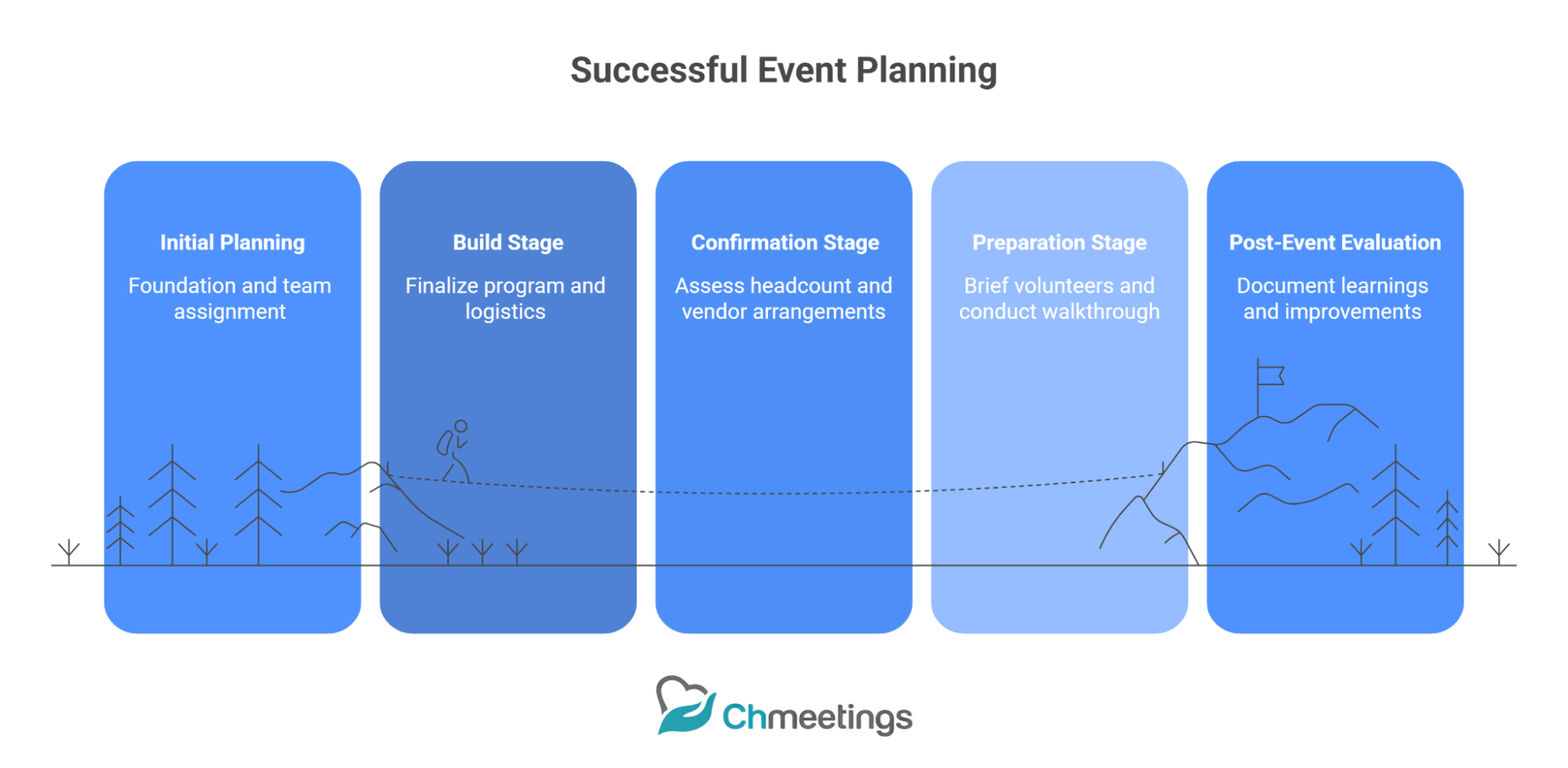
For a large church conference happening in twelve weeks, a planning timeline might look like this:
Ten to twelve weeks out: Confirm venue, finalize speaker lineup, open registration, begin marketing, assign a planning team lead for each workstream.
Six to eight weeks out: Finalize the program schedule, confirm audio and visual requirements, brief the volunteer coordinator on staffing needs, send save-the-dates to the congregation.
Three to four weeks out: Close early registration, confirm catering or hospitality arrangements, hold a full team planning meeting, send detailed briefings to all ministry leads involved.
One to two weeks out: Confirm final headcount, brief all volunteers on their roles, conduct a venue walkthrough, prepare any printed materials.
Two to three days out: Final volunteer confirmation, tech and sound check, emergency contact list distributed to the full team.
For a smaller event like a community dinner or a youth night, the same framework applies with a shorter runway and fewer workstreams. The principle is identical: every task has an owner and a deadline, and nothing is left to be figured out on the day.
ChMeetings allows planning tasks to be assigned and tracked alongside the event record, so the entire team can see progress in real time rather than relying on a coordinator to chase updates manually.
Registration Handling
Registration is often the first point of contact between an attendee and an event. It shapes expectations before anyone walks through the door.
A clunky registration process, one that requires too many steps, loses confirmation emails, or fails to communicate clearly, sets a negative tone that the event itself has to work to overcome. A smooth one does the opposite. It signals that the church is organized, that the event is well-prepared, and that the attendee made a good decision to come.
Registration handling inside ChMeetings is built around the event record itself, which means registration data stays connected to everything else rather than living in a separate spreadsheet that someone has to manually reconcile later.
A practical registration setup covers several decisions upfront:
Open or ticketed? Some events are open to all with no registration required. Others need a headcount for catering, venue capacity, or resource preparation. Knowing which applies determines how registration is structured from the start.
Paid or free? Events with a registration fee need a payment process that is simple for attendees and automatically recorded in the church’s giving system. ChMeetings handles fee collection and links it directly to the event financial record.
What information is needed? A children’s event needs parental contact details and medical information. A leadership conference might need dietary preferences and session selections. Collect only what is genuinely useful. Long registration forms reduce completion rates.
Communication after registration. Every registrant should receive a confirmation immediately after signing up. A reminder a week before the event and another the day before reduces no-shows significantly and keeps the event visible in a busy week.
When registration closes, ChMeetings generates an attendance list that feeds directly into check-in on the day, volunteer briefings, and post-event follow-up. The data collected at registration does not disappear after the event. It becomes part of the member record, which informs future planning and communication.
Volunteer Coordination for Events
An event without enough volunteers is stressful. An event with volunteers who do not know what they are doing is worse. The goal is not just coverage. It is clarity.
Volunteer coordination for events is distinct from ongoing ministry volunteering. Event volunteers often include people who serve in a specific context once or twice a year rather than on a regular rotation. That means the briefing process needs to be more thorough, the role descriptions need to be clearer, and the communication timeline needs to start earlier than it might for a team that already knows the drill.
Start with a volunteer needs assessment as soon as the event is approved. For every area of the event, identify the roles required, the number of people needed in each role, and the skills or prerequisites that apply. A large outreach event might need:
- A welcome and registration team at the entrance
- Ushers and crowd flow coordinators inside the venue
- A children’s area team with safeguarding-trained volunteers
- A setup and teardown crew available before and after the event
- A hospitality team managing food and refreshments
- A technical team handling sound, lighting, and presentation
Once roles are mapped, ChMeetings allows coordinators to match volunteers from the existing pool based on availability, skills, and serving history. Volunteers are invited to specific roles rather than receiving a general call for help, which increases confirmation rates and reduces the last-minute scramble.
Briefing matters as much as recruitment. Every event volunteer should receive a written briefing at least a week before the event that covers their specific role, arrival time, who they report to, what to do if something goes wrong, and where to find support on the day. A volunteer who arrives knowing exactly what is expected of them is a completely different asset to the event than one who shows up and waits to be told what to do.
On the day itself, a volunteer check-in process through ChMeetings confirms who arrived, flags any gaps early enough to address them, and creates an attendance record that informs future event planning.
Event Day Operations
The planning is done. The volunteers are briefed. The registration list is printed. Now comes the part that all of it was building toward.
Event day operations are where preparation either holds or falls apart. The churches that run events smoothly are not the ones that improvise best under pressure. They are the ones that made enough decisions in advance that the day itself requires execution rather than problem-solving.
A strong event day framework has three phases: setup, live operations, and close.
Setup begins well before the first attendee arrives. The venue needs to be configured, technical systems need to be tested, registration needs to be ready, and every volunteer needs to be in position and clear on their role. A dedicated setup coordinator, separate from the event host or MC, owns this phase and is responsible for confirming that everything is ready before doors open. A walkthrough checklist run thirty minutes before start time catches the things that were missed.
Live operations is the phase most people think of as the event itself. The role of the operations team during this phase is to stay invisible. When the event is running well, attendees should not be aware of the coordination happening around them. That requires clear communication channels between team leads, a single point of contact for issues that need escalation, and the confidence to handle small problems without interrupting the event experience.
Inside ChMeetings, team leads can communicate and flag issues in real time, keeping the coordination layer organized without it spilling into the attendee experience.
Close is the phase that gets underway as the event wraps. Teardown, equipment return, venue reset, and volunteer release all need to happen in an organized sequence. A post-event checklist ensures nothing is left behind, borrowed equipment is returned, and the venue is left in the condition it was received. Closing well is also a way of honoring the volunteers who served. A clear end time and a coordinated close respects the time commitment they made.
Post Event Evaluation Process
The event is over. The chairs are stacked. The volunteers have gone home. Most churches stop there.
The ones that keep improving do not.
A post event evaluation process is what separates churches that run the same event the same way year after year from the ones that get meaningfully better at it. It is not a lengthy debrief or a blame session. It is a short, structured conversation that captures institutional knowledge before it fades.
The evaluation should happen within a week of the event, while details are still fresh. It does not need to be long. A sixty-minute conversation with the core planning team, structured around a handful of honest questions, produces more useful insight than a lengthy written report that nobody reads.
The questions that matter most are straightforward:
- What worked well and should be repeated exactly as it was?
- What created friction or stress that better planning could have prevented?
- Were there enough volunteers, and were they in the right roles?
- Did the registration and check-in process serve attendees well?
- Did the event achieve its ministry purpose?
- What would we do differently if we ran this again tomorrow?
The answers to those questions should be documented inside ChMeetings alongside the event record. That way, the next person who plans a similar event has access to the hard-won knowledge from the last one rather than starting from scratch.
Attendance data, registration numbers, volunteer turnout, and budget actuals should all be reviewed as part of the evaluation. Numbers tell a part of the story that conversation alone cannot. If registration was strong but attendance was low, that is a communication problem. If the budget came in significantly over or under, that informs future planning. If volunteer no-shows created gaps on the day, the recruitment and confirmation process needs to be tightened.
The post-event evaluation is not a formality. It is where the next event gets better before it even starts.
When proposals move through a clear approval process, planning follows a structured timeline, registration runs smoothly, volunteers are briefed and ready, operations are coordinated, and every event ends with an honest evaluation, church events stop being a source of organizational stress and start being what they were always meant to be: meaningful expressions of a church that is alive, engaged, and growing.
A church that manages its members well, handles its finances with integrity, communicates clearly, equips its volunteers, runs its events with intention, and pays its staff accurately is not just an organized church. It is a church that has removed the friction standing between its people and its mission. Every process covered in this guide exists for that reason. Not to add administrative weight but to take it away, so that the energy of the congregation flows toward ministry rather than getting absorbed by systems that do not work. ChMeetings is the environment where all of those processes connect, and if this guide has shown anything, it is that the operational and the spiritual are not opposites. When the infrastructure is right, the mission moves.
Start building that foundation with ChMeetings today.